
The patriarchs and heads of churches in Jerusalem condemned an attack by “masked settlers” against Palestinian olive farmers and visiting European diplomats and officials in Taybeh, a town east of Ramallah in the central West Bank. The attack happened during an olive harvest event coordinated with the town’s Latin Patriarchate parish.
Calling the violence “not an isolated incident,” leaders have urged authorities to hold those responsible accountable and protect residents.
The attack followed another violent incident in the Palestinian village of Abu Falah, north of Ramallah, when a Washington Post photojournalist was attacked and seriously injured by Israeli settlers while she and other journalists were covering the olive harvest there.
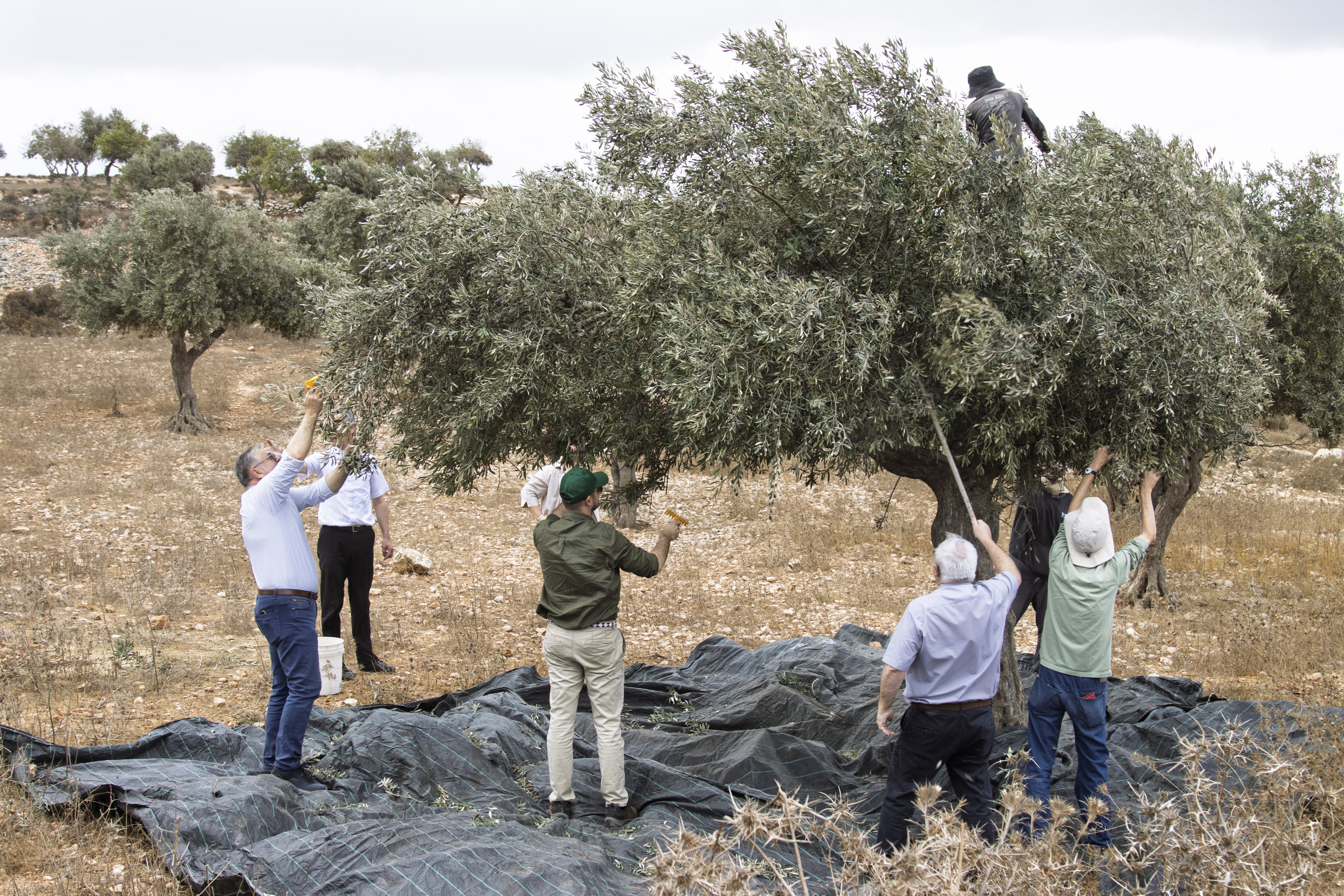
In a statement following the Oct. 17 attack, the church leaders said Palestinian villages across the West Bank were experiencing widespread settler violence during the olive harvest, when families return to their land to gather their crops and renew ties stretching back generations.
“This wild attack on the Christian village of Taybeh and against its peaceful population is not an isolated incident. In the past weeks the Palestinian villages of the West Bank have been exposed to a wide-scale terror by settlers, which is reaching a peak during this time of the olive harvest, when families go to their lands to collect what they need to live and renew their generations-long bond with their lands,” the statement said.
The leaders also expressed concern over a recently published religious ruling permitting Jews to take Palestinians’ olives, describing it as “unfounded, very worrying and dangerous, and absolutely unacceptable.” They welcomed the public rejection of the ruling by several rabbis and other Jewish voices.

Those targeted in the attack included diplomats from France, Belgium, and Poland. The mayor of Aulnoye-Aymeries in northern France, Bernard Baudoux, was physically assaulted, and a Belgian consular vehicle was damaged. Independent international reporting corroborated the attack.

Israeli authorities said they had opened an investigation and later announced arrests.
The attack occurred during a harvest that provides a vital source of income for Palestinian families and reflects farmers’ generations-long connection to their land. The targeting of a delegation that included European diplomats also brought wider international diplomatic attention to the violence facing Palestinian farmers.
The church leaders welcomed Israeli President Isaac Herzog’s condemnation of the attack and the steps taken by Israeli police. They said, however, that conditions on the ground showed the attacks were continuing because of the perpetrators’ “impunity.” They expressed hope that law enforcement would continue “in a serious and consistent manner” rather than remain a one-time response.
In August, the Israeli military declared Taybeh a closed military zone, restricting access to nonresidents in what it described as an effort to curb attacks by Israelis in the area. Attacks nevertheless continued, including the Oct. 17 assault on farmers and the visiting European diplomatic delegation.

Taybeh is one of the West Bank’s most prominent remaining Palestinian Christian communities. The church leaders’ appeal therefore concerns more than the protection of a religious site: It addresses the safety of a Christian community whose residents live and work in the town, facing threats to their security, land, and livelihoods, as well as uncertainty over the future of their families and young people.
The church leaders called on the relevant authorities to bring those responsible to justice and urged the international community to intensify efforts to protect the people of Taybeh and the wider West Bank, along with visitors expressing solidarity with them. They reaffirmed their support for Taybeh’s churches and community and pledged to continue working to preserve the Christian presence there.
The leaders’ statement came a day after a high-level U.S. delegation visited Taybeh. The delegation included Brian Burch, U.S. ambassador to the Holy See; Riley Barnes, assistant secretary of state for democracy, human rights, and labor; and other U.S. diplomatic and security officials.
The delegation met with Father Bashar Fawadleh, pastor of the Latin Patriarchate parish in Taybeh, and the executive director of the Christian Presence Observatory — Holy Land. They heard accounts of the attacks and their effects on residents’ lives and livelihoods.
Members of the delegation said they took those concerns seriously. Participants in the meeting called for practical measures to protect civilians, ensure access to agricultural land, strengthen accountability, and help Palestinian Christian communities remain in their homeland.
This story was first published by ACI MENA, the Arabic-language sister service of EWTN News. It has been translated and adapted by EWTN News English.