
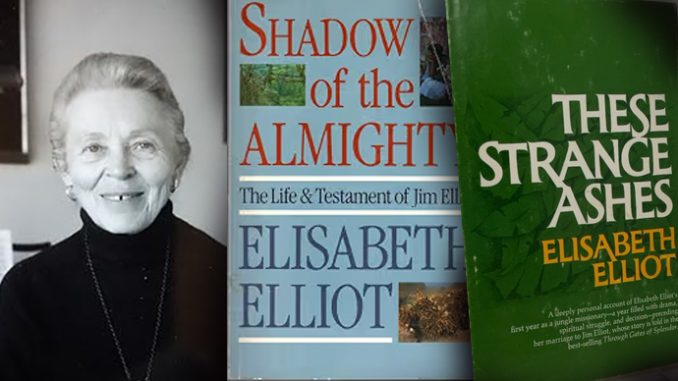
I first encountered Elisabeth Elliot (1926-2015) through her husband.
I was a new student at a college in South Carolina when a friend pressed a copy of Shadow of the Almighty (1958) into my hands with a question: “Have you read this?”
I hadn’t. But I soon did.
The story of Jim Elliot and his attempt to bring the Gospel to the Auca Indians of Ecuador, an undertaking that ended with his death at the point of a spear, made a powerful impression on an impressionable college freshman. Told by his widow, the story seemed almost tailor-made for the then still distinctly Baptist culture of a Southern university campus.
So did the writings of Elisabeth Elliot herself. Here was a woman who offered no-holds-barred opinions on faith, gender roles, obedience, and the necessity of choosing the difficult path. Especially the difficult path.
How difficult? I began to understand a year or so later when, browsing a Logos bookstore in downtown New Orleans, I picked up another Elliot book, this time on my own. These Strange Ashes (1975) was a very different sort of missionary story. This was back when writers like Elliot could still find a home with mainstream publishers like Harper & Row, before Christian publishing became a world unto itself. Rather than recounting the heroic sacrifice of her husband, Elliot described her own less-than-triumphant efforts as a Bible translator. There were frustrations, and the unsettling possibility that years of faithful work might produce very little of lasting value.
The slim volume floored me. Especially one declaration that has stayed with me ever since: “It is in our acceptance of what is given that God gives Himself.”
I was hooked. I went on to read Furnace of the Lord, her surprisingly dispassionate travelogue of the Middle East, and Discipline: The Glad Surrender, something of a Protestant version of Lorenzo Scupoli’s Spiritual Combat. But it was in her collections of essays, Love Has a Price Tag and Twelve Baskets of Crumbs, that I felt I got to know the woman herself.
Elliot was one of those rare evangelical writers who found an appreciative audience among Catholics. She also had an interesting family connection to Rome.
Her brother was Thomas Howard (1935-2020), the celebrated author and literary scholar whose conversion made him something of a celebrity on both sides of the Protestant-Catholic divide, at least in precincts where doctrine was still thought to matter. Elliot never followed him, although she once reportedly said that she wished she had her brother’s courage. Asked why she hadn’t made the move herself, she replied, “Cowardice, I suppose. My listeners and readers simply would not understand.” Coming from a voice as unflinching as Elliot’s, that’s quite an admission.
Her admirers have sometimes elevated Elisabeth Elliot to the level of evangelical saint. But that’s not how I encountered her. Even at her most uncompromising, she struck me as wonderfully human—occasionally cranky, a little prickly, sometimes quirky, but also capable of passages of soaring spiritual insight. She could be stern, funny, impatient, and remarkably candid about her own shortcomings.
That brings me to the latest controversy.
It comes courtesy of Christianity Today, the flagship evangelical magazine founded by Billy Graham in 1956. Some disgruntled evangelicals now call it Christianity Astray, not so much because it has abandoned theological orthodoxy as because it sometimes seems to have developed an allergy to conservative evangelicals. Bono or The Shack author William Paul Young might get a warm embrace, while an Albert Mohler or James Dobson is more likely to get a raised eyebrow and a lecture.
Which makes my reaction to its latest offering a little unexpected: I think its writer is getting something of a raw deal.
Lucy S. R. Austen, Elliot’s biographer, has taken something of a beating over her recent Christianity Today article raising questions about Elliot’s sexuality. I understand why. Elliot occupies a hallowed place in evangelical memory—my memory—and the suggestion that one of its most influential defenders of traditional sexual morality may have experienced same-sex attraction was bound to provoke a reaction.
The magazine itself seemed to have second thoughts. Shortly after publication, the article disappeared from its website, only to reappear following an additional editorial review. Hardly the sort of thing that inspires confidence in an already controversial editorial decision.
But having read Austen’s piece, I’m not convinced she deserves the drubbing. Austen is a serious biographer who knows Elliot’s life and writings very well. Her treatment strikes me as reasonably measured, acknowledging both the limitations of the evidence and the impossibility of reaching firm conclusions.
Still, I share many of the concerns expressed by Denny Burk and other critics.
But I would locate the problem elsewhere. My question is: why are we having this conversation at all?
The controversy began with William Stell, a historian whose work includes “queer studies” and the history of gay activism within evangelicalism. In his book Born Again Queer and a subsequent essay titled “A Rickety Closet,” Stell suggests that Elliot may have experienced romantic attractions to women during the years following her first husband’s death and before her subsequent marriages.
His most provocative evidence comes from a 2020 interview with Virginia Mollenkott, an evangelical feminist who later became a prominent lesbian activist. Mollenkott recalled a private confrontation with Elliot at a 1975 women’s conference in which she allegedly threatened to expose something about Elliot’s sexuality, prompting a fearful response.
It’s a remarkable story. It’s also a recollection recorded 45 years after the alleged encounter, when Mollenkott was 88. Elliot had been dead for five years, and Mollenkott died later that same year. Neither woman can now be questioned, and nothing in Elliot’s surviving papers independently corroborates Mollenkott’s account.
I have considerably less patience with Stell’s enterprise than with Austen’s attempt to assess its claims. Austen introduces other material from Elliot’s papers: her close friendship with Mollenkott during the 1960s, some unusually thoughtful comments about same-sex attraction in a letter to her mother, and her seven-year household arrangement with Eleanor Vandevort, a college friend who helped raise Elliot’s daughter. Austen also wonders whether an oddly worded journal entry about Elliot’s second marriage suggests that her relationship with Vandevort had become emotionally complicated.
Taken together, these details make Stell’s theory plausible. Established? Hardly. They don’t demonstrate that Elliot had a romantic relationship with either woman, much less that she acted upon any such attraction. And somewhere along the way, the whole exercise begins to feel uncomfortably prurient.
We’re invited to scrutinize friendships, parse private correspondence, and speculate about domestic arrangements we know only from a distance. A woman who spent much of her life writing about faith and morals becomes the subject of an investigation into desires she may or may not have experienced.
Whatever Stell intended, the result is to conscript Elliot, posthumously and without the possibility of a reply, into a contemporary argument over Christian ethics. The implication is difficult to miss: One of evangelicalism’s most influential defenders of traditional sexual morality may herself have harbored attractions she chose not to disclose.
But even if the allegation were true, what exactly would it establish? That Elliot experienced attractions inconsistent with her public teaching? That she entertained desires she believed she ought not act upon? That, like the rest of us, she sometimes struggled to reconcile what she wanted with what she believed?
None of those possibilities would invalidate her convictions about sex or marriage. Indeed, the distinction between desire and obedience was central in much of her teaching.
And beyond all that, we’re talking about events from the 1960s and ’70s. A lifetime ago.
Heaven forbid that someone should someday rummage through the affections, romantic entanglements, or passing desires of our younger years and use them to define who we eventually became. We might even be surprised by what others remembered about us, especially if their recollections differed from our own. Maybe we can allow historical figures the same humanity we would wish for ourselves.
I understand that the private lives of public figures are legitimate subjects of biography. But surely the more intimate the allegation, the greater the obligation to establish not merely that it might be true, and that its disclosure serves some worthwhile purpose.
Austen herself has demonstrated the value of serious, sympathetic biography. But, even so, there’s a difference between understanding someone’s life and treating every private thought or intimate conversation as material for public consumption. Biography has an obligation to the truth. Both biography and journalism have another obligation as well: to ask whether a disclosure serves any purpose beyond satisfying our curiosity.
I didn’t need a scholar rummaging through Elisabeth Elliot’s private life to convince me that she was a complicated human being. Her own books had already done that. The Elliot I encountered nearly half a century ago could be severe, and I sometimes found her prescriptions harder to swallow than her descriptions of the Christian life. But she remained a sincere and gifted writer who could make the ordinary demands of faithfulness seem both terribly difficult and wonderfully worthwhile.
Agreement with everything she wrote was never the basis of my admiration.
I admired the woman who had wrestled with suffering and disappointment and somehow found the words to help the rest of us do the same. I admired the woman who returned to live among her husband’s killers and wrote The Savage My Kinsman. And I still admire the woman who went on to lose a second husband, found companionship in a third marriage, and endured the humiliations of Alzheimer’s disease, finally sealing her testimony not with another book but with her death.
“Blessed are the dead which die in the Lord,” writes St. John, “that they may rest from their labours; and their works do follow them” (Rev. 14:13).
Elisabeth Elliot’s works certainly do.
If you value the news and views Catholic World Report provides, please consider donating to support our efforts. Your contribution will help us continue to make CWR available to all readers worldwide for free, without a subscription. Thank you for your generosity!
Click here for more information on donating to CWR. Click here to sign up for our newsletter.
Leave a Reply
You must be logged in to post a comment.