
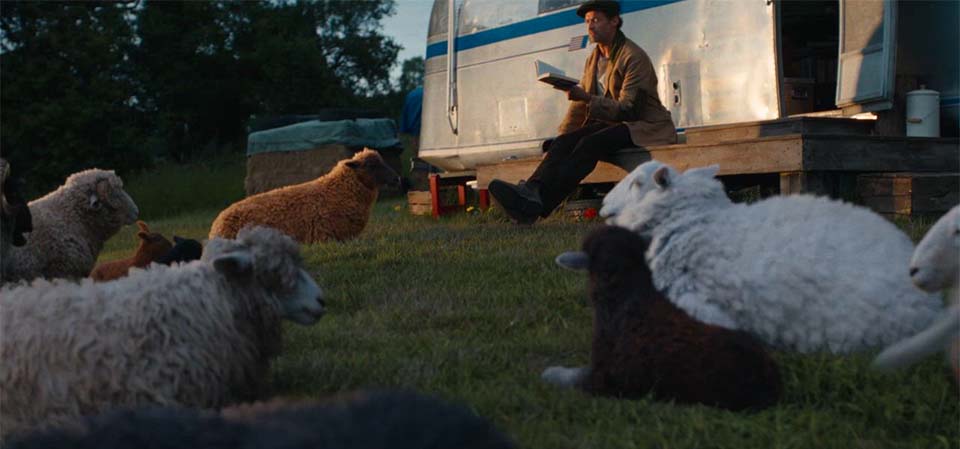
Like Rian Johnson’s Benoit Blanc mysteries, The Sheep Detectives is packed with an eminent cast, both playing humans and voicing sheep. Also like the Knives Out movies, the movie has more on its mind than solving a case.
Loosely adapted by Craig Mazin from German writer Leonie Swann’s Three Bags Full: A Sheep Detective Story, The Sheep Detectives was pitched to Jackman as “Babe meets Knives Out,” the exact phrase that occurred to me halfway through the movie. (I went in cold, not knowing what to expect.) Like Rian Johnson’s Benoit Blanc mysteries, The Sheep Detectives is packed with an eminent cast, both playing humans and voicing sheep. Also like the Knives Out movies, the movie has more on its mind than solving a case.
Besides George, the human characters, most of whom are suspects, include an innkeeper with a secret (Hong Chau); a rival sheep farmer (Tosin Cole); a reporter looking for a story (Nicholas Galitzine); a local butcher disliked by George (Conlith Hill); a vicar whom George mysteriously owes money (Kobna Holdbrook-Smith); and George’s lawyer (a hilarious, scene-stealing Emma Thompson). Particularly important characters include the inexperienced village constable (Nicholas Braun, also very funny) and George’s long-lost daughter, Rebecca (Molly Gordon).
Most notable among supporting sheep voices are Bryan Cranston as Sebastian, an aloof Black Icelandic ram with worldly experience Lily and the others can’t imagine, and Chris O’Dowd as patient, loyal Mopple, who carries a burden the others have no idea about. Others include Regina Hall, Patrick Stewart, Rhys Darby, and Brett Goldstein (in a dual role as belligerent twin rams). The sheep themselves are CGI, which, compared to the real animals in Babe, adds a layer of unreality; fortunately, the animals’ movements are pretty naturalistic in the way that Jon Favreau used successfully in The Jungle Book and less successfully in The Lion King. The postcard-picturesque village of Hambleden in Buckinghamshire, with its centuries of patchwork architectural styles from medieval to 18th-century brick and flint, stands in for Denbrook; the 12th-century Anglican parish church, St Mary the Virgin, is seen at various points.
As a genre piece, the film adroitly manages to have its cake and eat it too, both spelling out and largely adhering to the expected tropes while at the same time confronting the sheep, who learned everything they know about crimes and solving them from escapist fiction, with the hard truth that real life can be more complicated than books.
As a whodunit, The Sheep Detectives is pretty clever and plays pretty fair. (A few things don’t make sense, like the dramatic way that George repays his debt to the priest. Vague spoiler alert: The priest has sold George something he wasn’t supposed to in order to raise money for church repairs. Unlike the clerical protagonist in the latest Knives Out movie, he’s not a great priestly character, though he’s not a bad guy either; what he does benefits everyone, and he feels bad about breaking the rules. The clergyman didn’t bother me, but I was annoyed by the lazy inauthenticity of a brief church scene with the priest a) vested only in an alb and stole b) reading the Gospel c) from the altar d) while the collection is being taken up. It’s not hard to get these things right if filmmakers care to.)
As a genre piece, the film adroitly manages to have its cake and eat it too, both spelling out and largely adhering to the expected tropes while at the same time confronting the sheep, who learned everything they know about crimes and solving them from escapist fiction, with the hard truth that real life can be more complicated than books. This turns out to be a particularly difficult lesson for sheep in this world, given their unique gift for not learning hard truths. You see, these sheep can literally choose to forget unpleasant things at will. When something bad happens that they don’t want to be reminded of, they simply collectively decide that they want to forget, count to three … and, just like that, life is good again.
The Sheep Detectives is, then, partly about — at times movingly about — the importance of facing hard realities: about not suppressing painful memories, or pretending that traumatic events didn’t happen.
Or is it? Two sheep are different in this regard: Cranston’s Sebastian, who chooses not to forget, and O’Dowd’s Mopple, who for some reason was born without the ability to forget. He’s like a reverse Dory from Finding Nemo, burdened with memories of shared experiences that no one recalls but him. Lily is a natural leader, though she’s complacent in her cleverness and naive about her naivete. Mopple and Sebastian ideally complement Lily; the three of them make a good team.
The flock’s habit of deliberately shedding unpleasant memories means that, when young Zora is learning for the first time about mortality, so is the whole flock. They have no recollection of any knowledge they may have had of human death, and certainly not of sheep death. The prevailing belief among sheep is that, at the end of their lives, they float into the sky and become clouds. Incidentally, that’s not the only dubious belief among sheep; they also believe that winter lambs — lambs not born in the spring — don’t belong in the flock. If the lesson of inclusion is embraced a little too easily in the end, I appreciate that even sympathetic characters aren’t spared from sharing in the prejudices of their community.
While the movie never directly answers Zora’s questions about the meaning of human existence, and who created humans or sheep, I appreciate that the questions are raised — and that the existence of attempts to answer these questions among humans is at least obliquely acknowledged.
The Sheep Detectives is, then, partly about — at times movingly about — the importance of facing hard realities: about not suppressing painful memories, or pretending that traumatic events didn’t happen. It’s also about recognizing that some of the comforting beliefs we grew up with may not be as true as we thought. The movie is not, though, a debunking of faith or hope. For one thing, there’s an intimation, as a noble character faces death, that departing may mean reunion with loved ones (a moment visually underscored by a faint beam of light from the sky). There are also moments of magical realism that matter-of-factly present the ongoing reality of loved ones; while a couple of lines of dialogue point to the role of memory in “keeping the ones we love alive,” nothing here says that “living on in our memories” is all we can hope for, or all we see here. Ultimately, even the naive ovine idea about becoming clouds isn’t entirely rejected as worthless.
Finally, while the movie never directly answers Zora’s questions about the meaning of human existence, and who created humans or sheep, I appreciate that the questions are raised — and that the existence of attempts to answer these questions among humans is at least obliquely acknowledged. As the central trio of sheep pass the church, Sebastian explains that “someone called God” lives there. His attempts to explain who God is from snatches of human conversation are simultaneously ridiculous and partly profound. What a welcome contrast to the institutional secularity of Disney and most Hollywood animation houses, which scrub virtually all acknowledgment of the very existence of religion from their movies.
P.S. Regarding Hollywood not knowing how to make movies like this, it may or may not be significant that The Sheep Detectives is an Amazon Original. (The Paddington movies, which have a not dissimilar vibe, are from France’s StudioCanal and the UK’s Heyday Films.) It may be even more significant that the film’s executive producers include Phil Lord and Chris Miller, and that Lord Miller Productions is a production partner. Currently riding high with the success of Project Hail Mary, which they directed, Lord and Miller are co-creators of the Spider-Verse films, The Lego Movie, and Cloudy with a Chance of Meatballs. Sheep Detectives writer Mazin has said that the duo’s “entire career has been about taking things that other people might not make good and making them good.” I don’t know how exactly much to credit Lord and Miller for The Sheep Detectives, but if anyone in Hollywood today knows how to make a movie like this, it’s them.
Leave a Reply
You must be logged in to post a comment.