
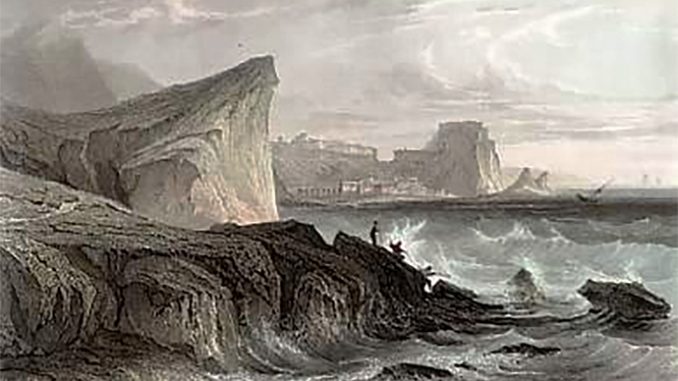
In Book 12 of Homer’s Odyssey, the goddess Circe prepares Odysseus for his trip between Scylla and Charybdis, two monsters dwelling on opposite sides of the Strait of Messina, dividing Sicily and Italy. The former, a monster of the cliff, will reduce the crew violently; the latter, a monster of the whirlpool, will destroy it utterly.
Circe’s counsel is unambiguous: “Better to mourn six than the whole crew at once.”
Naturally—facing this ancient precursor of the philosophical “trolley problem”—Odysseus asks if he can chart a middle course, escaping them both. But it’s not possible; he will have to go, unarmed, the way of Scylla. “It’s a flight, not a fight,” Circe instructs him. “Just row past as hard as you can.” As predicted, six men, the “strongest hands aboard,” are pulled out of the ship like writhing fish, drawn up into the cliff, and devoured.
In his powerhouse adaptation of The Odyssey, Christopher Nolan adds a creative twist to this vignette: Odysseus orders his crew to sail by Charybdis, knowing full well they will rebel against him. Eurylochus, his second-in-command, falls right into the trap, insisting they cleave to the cliff instead, and in short order, Scylla’s tentacles pluck off six of the men. Odysseus admits to the ruse: Charybdis would have meant their doom, and ordering them toward it was the only way to escape it.
Thus, while the mythological pair has become shorthand for two equally dangerous possibilities—to be between a Scylla and Charybdis is to be “between a rock and a hard place”—the image is far more “out of the frying pan and into the fire.” Scylla is terrible, yes—but Charybdis is far worse.
While this disparity between the two monsters may have faded from the Western mind, it is evident across the long history of the Christian use of the story. Theologians and pastors of the God-man, eager to guide their flock between the opposite extremes that have so often plagued the Church, have naturally invoked Scylla and Charybdis. But again and again, in each new strait, some whirlpool of the mind has proven the more dangerous route—and thus more worthy of the latter name.
In his Exhortation to the Heathen, Clement of Alexandria compares pagan custom not to Scylla but to “the threatening Charybdis.” Augustine of Hippo, in one of his sermons, argues that Catholics navigate a straight (orthodoxon) course between twin Trinitarian errors: the Scylla of Sabellianism (“ship-wrecking rocks”), which denied the plurality of the divine persons, and the Charybdis of Arianism, which denied their unity (“a ship-swallowing whirlpool”).
Erasmus, in the throes of the Reformation, writes in one of his letters, “I fear we shall escape this Scylla [Martin Luther] only to fall into some far more disastrous Charybdis.” More recently, Hans Urs von Balthasar writes of finding a “path between the Scylla of extrinicism and the Charybdis of immanentism”—of a Christianity wherein grace sits atop nature and one wherein revelation is reduced to human thought and experience.
But what determines which extreme is Scylla and which is Charybdis? Is it just a matter of whatever error is wreaking greater havoc on the Church at the time, as Arianism did for so long? Or is there something deeper at work?
An interesting pattern, however unconscious, emerges in the kinds of movements identified with Charybdis. For all their distinct differences, paganism, Arianism, corruption (Erasmus warns of “bullies with full bellies”), and immanentism share the same fundamental character—namely, “earthward” thinking. They all choose earthly reality at the expense of heaven. Man becomes the measure of all things, not God; the plurality of life below defines the Son, not the unity of life above; and physical goods of the body become life’s great aim, not spiritual goods of the soul.
This earthward whirlpool is more dangerous precisely because it denies the inherent primacy of the vertical over the horizontal. In this whirlpool, it’s the earth that leads heaven, not the other way around. And its downdraft leads to dispersion and ultimately to death.
Homer’s poem, too, reflects—on the natural level—this same heaven-earth division. The rock of Scylla is above: It “stabs its peak into the sky and is ringed by a dark blue cloud.” Even the strongest archer, Circe explains, couldn’t shoot an arrow from the cave to the ship, so high up is it from the water. The rock of Charybdis, in sharp contrast, is below: It “lies lower” than Scylla’s, and “beneath” its leafy fig tree is the monster, who—Circe points out no less than three times—“sucks down” the seawater. Scylla attacks wayfarers from the airy heights; Charybdis pulls them into the murky depths.
That the earthward Charybdis is worse than the heavenward Scylla doesn’t mean, of course, that Scylla ceases to be monstrous. Even less does it mean that hugging the cliffs is an ideal way forward. When faced with Arianism, which says that the Son is a creature of the Father, the answer isn’t flying into its opposite, countering that the Son is simply a name for the Father. Instead, Augustine counsels, it’s in hearing the Son himself: “I and the Father are one.” “Let Sabellius hear are,” the ever-balanced Augustine preaches, “and the Arian hear one. By hearing are, you will save yourself from Scylla; by hearing one, you will hold yourself back from Charybdis.” God, in Christ, has gathered and reconciled all of heaven and earth (Eph 1:10; Col. 1:20); thus, the heavenward path—heaven at the expense of earth—is, like the earthward, foreign to the incarnational instincts of Christianity.
It also doesn’t mean—as the two-thousand-year history of the Church’s internal debates makes clear—that finding a path between Scylla and Charybdis will always be easy. In 1907, the Jesuit theologian George Tyrell published a treatise titled Through Scylla and Charybdis: Or, The Old Theology and the New. Later that same year, he was excommunicated from the Catholic Church, and his movement—modernism—was declared by Pope Pius X as “the synthesis of all heresies.” The high drama of Christian life is that, agree as we might on various essentials—the same basic worldview, beliefs, and practical norms—these two monsters still lurk in the minutiae, precisely because they lurk in our minds and hearts.
But it does mean that the Christian, unlike Odysseus, has to try to evade them both. He will chart a straight path between the two monsters, or, like Aeneas in Virgil’s epic, find an alternate route around them altogether. In other words, he will honor both the heavenly and earthly dimensions, without falling into the monstrous clutches of one without the other. But heaven comes first; and if, after all’s said and done, he’s still forced to tilt in one direction or the other, he will tilt away from the whirlpool that sucks everything down, because he knows—even as he must constantly watch for Scylla out of the corner of his eye—that the two monsters are not the same.
The Christian today, as in ages past, finds himself pulled, viciously, between opposite extremes. In the Church, in the culture, and maybe above all in the encounter between the two, divergent paths—sacred or secular, prayer or action, tradition or change, order or openness, proclamation or accommodation, doctrine or accompaniment, truth or love, rigor or relaxation—open up again and again. And while Christians might generally agree on an answer of “both/and,” there’s great debate and confusion about priority, emphasis, and energy—about whose path is the crooked and whose the straight.
Simply “feeling” our way through the morass (if it ever worked) will no longer work. We have to step back and ask: Where is the immovable cliff, and where are the open waters? Along which path lurks the deadly Scylla, and which the even deadlier Charybdis? What might it look like to navigate between them, honoring both the heavenly and the earthly, and in that order? Do we have the clarity and courage to identify the greater danger—the abyss of the earthward—and to lean away from it as we go?
The course cut by this prow will invariably be choppy and, at times, discouraging. We sail toward the unrealized—and, on this side of eternity, unrealizable—fullness of life in Christ. But better to follow the Way than to go the way of monsters.
If you value the news and views Catholic World Report provides, please consider donating to support our efforts. Your contribution will help us continue to make CWR available to all readers worldwide for free, without a subscription. Thank you for your generosity!
Click here for more information on donating to CWR. Click here to sign up for our newsletter.
Leave a Reply
You must be logged in to post a comment.