
VATICAN CITY — Amoris Laetitia, Pope Francis’ 2016 apostolic exhortation on the family, is consistent with the Church teaching and practice that came before it, Sister Helen Alford, OP, said at the opening of a Vatican meeting about the papal document on Wednesday.
Like an earlier document on the family by St. John Paul II, Amoris Laetitia was an innovative response to the challenge of following the moral law “when social situations are turbulent and changing quickly,” Alford said.
Amoris Laetitia sparked intense debate following its publication in 2016, especially after the bishops of the Buenos Aires Pastoral Region interpreted it as allowing, following a process of accompanied pastoral discernment, access to the sacraments of reconciliation and the Eucharist for some Catholics who are divorced and civilly remarried “when a person judges that he or she would fall into a further fault by harming the children of the new union.”
In 2023, the Dicastery for the Doctrine of the Faith confirmed that this interpretation forms part of the authentic magisterium after being incorporated into the Acta Apostolicae Sedis, the Holy See’s official bulletin.
Earlier this year, Pope Leo called the presidents of bishops’ conferences and heads of Eastern Churches, together with some married couples and theological experts, to spend a week at the Vatican in “synodal discernment” on families and the challenges they face today, including “abandonment, separation, and divorce,” in the light of Amoris Laetitia.
The ‘law of gradualness’
Alford’s address on the first day of the Oct. 7–14 meeting of bishops followed an opening prayer and a speech by Pope Leo XIV, who also said there is continuity in the teaching on marriage from Pope John Paul I through Pope Francis.
Like Leo, Alford, too, connected the two recent apostolic exhortations on the family: St. John Paul II’s Familiaris Consortio and Pope Francis’ Amoris Laetitia.
They both, she said, include the idea of the “law of gradualness.” In Amoris Laetitia, Pope Francis said John Paul II proposed it “in the knowledge that the human being ‘knows, loves, and accomplishes moral good by different stages of growth.’”
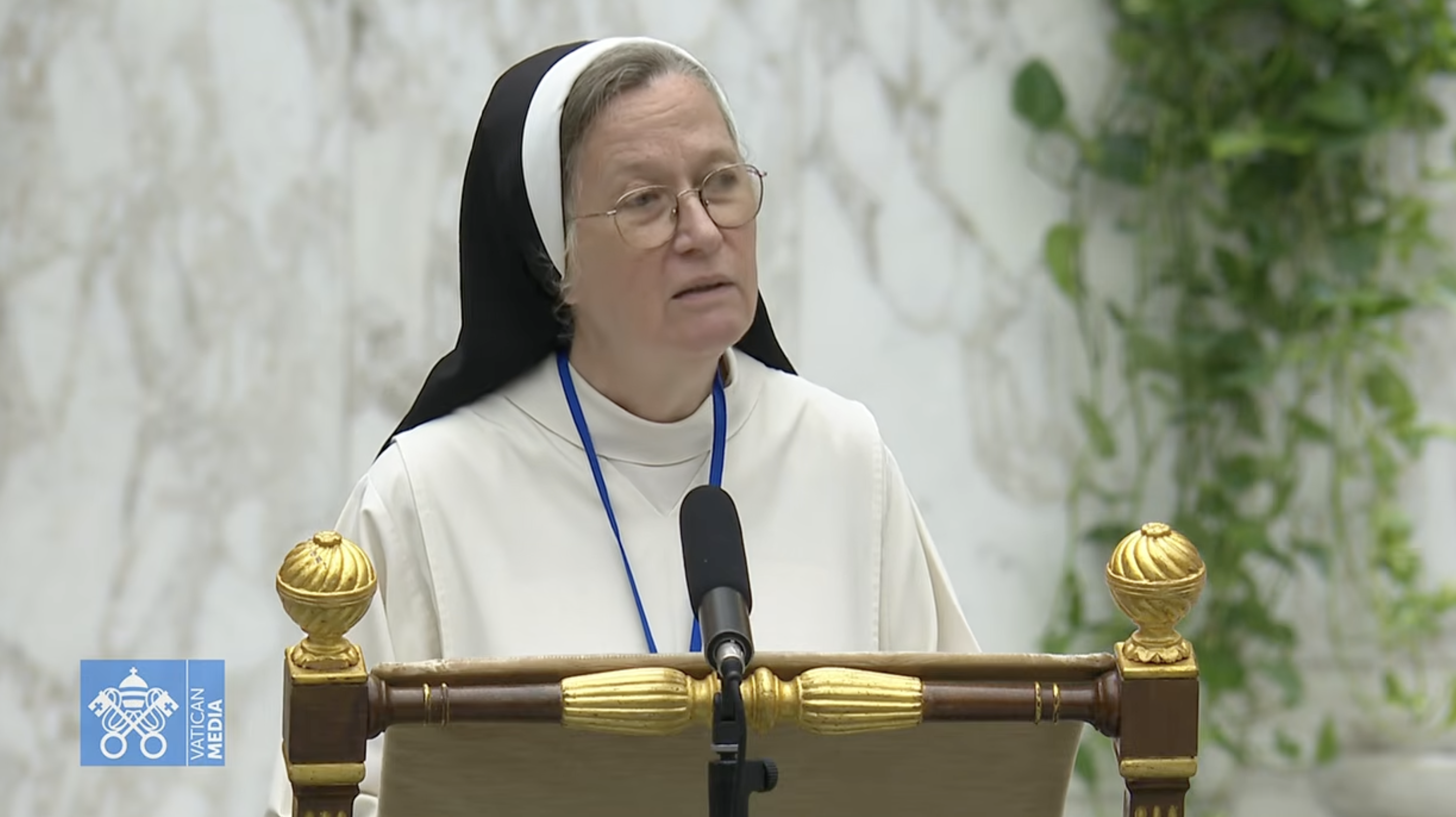
Alford, quoting Pope Francis, said that “this is not a ‘gradualness of law’ but rather a gradualness in the prudential exercise of free acts on the part of subjects who are not in a position to understand, appreciate, or fully carry out the objective demands of the law. For the law is itself a gift of God which points out the way, a gift for everyone without exception; it can be followed with the help of grace.”
Both popes, the sister said, “are concerned to maintain the ideal, ‘law [which] is a gift of God which points out the way,’ as well as to recognize that many are not able to fully ‘understand, appreciate, or … carry out the objective demands of the law.”
She pointed out that 35 years separates Familiaris Consortio and Amoris Laetitia, during which time the lived situation of Christian families has seen many developments.
“As in other cases, such as in the social teaching of the Church, when social situations are turbulent and changing quickly, it can be necessary to find new ways of putting together both the ‘objective demands of the law’ (AL, 295) and the ‘law of gradualness’ (FC, 34) that many experience in trying to enter into it. Both Familiaris Consortio and Amoris Laetitia try to do this in their different historical contexts,” she said.
“Let us not forget,” the sister added, “that St. Thomas Aquinas and all the tradition that goes back to him would say that the law of God reaches its greatest expression in the new law, the law of the Gospel: the grace of Jesus.”
The purpose of the meeting
“In this meeting … we are called to proclaim the Gospel both of and to families,” the Dominican sister said. “It implies that the family is integral to the proclamation of the Gospel. The family both actively proclaims the Gospel and is in need of receiving the proclamation of the Gospel.”
Alford said the stress and brokenness often present in family life and marriage are an opportunity for greater holiness and trust in God. In order to unite their suffering with Christ’s, families need to hear the good news of the Gospel.
“Many families in situations of suffering and need could derive great help in facing their trials from hearing the good news proclaimed to them, receiving the new perspective the Gospel gives us on life and, thereby, the grace of the sacraments,” she said. “The very stresses, tensions, and brokenness in family life can be borne with more fortitude and with the hope that they can be worked through by uniting them to the sufferings of Christ.”
“As Pope Francis says, ‘In the darkest hours of a family’s life, union with Jesus in his abandonment can help avoid a breakup,’” she said, quoting from Amoris Laetitia No. 317.
“The beauty of the vocation to marriage is to be found through and with and in its fragility, not least because weakness can reawaken trust in God, and trust in God awakens the desire for holiness,” Alford said. “This, in a nutshell, is the Gospel of and to the family that we are talking about.”
Helping young people choose marriage
Alford’s talk also touched on the relational gaze of Jesus and its importance for recognizing and “seeing” the relationships that make up our lives, which are not visible like physical objects, yet, like the air we breathe, are really there.
She also spoke about the importance of helping young people enter into marriage with the proper outlook and tools to confront its difficulties.
“In the highly unstable world we live in today, if we are going to help young people have the courage to enter into marriage, and to give them the capacity to cope with the stresses they are going to meet, they will need to ‘see’ their relationships and think about their marriage and family life in a relational way,” she said.
“Social love, as a reflection of the Trinity, is what truly unifies the spiritual meaning of the family and its mission to others, for it makes present the kerygma in all its communal imperatives,” she added, quoting from Amoris Laetitia No. 324.
She encouraged the meeting’s participants to “search for ways to encourage young people to take up the great challenge of marriage and family life, embracing it in the full knowledge that they will experience great fragility as part of the process of realizing its beauty, and that in that fragility, they will find new and unexpected sources of God’s grace and experience a desire for holiness that is their very own.”
“Let us join Jesus in calling them to rise to the challenge, like Jesus called the Samaritan woman, of proclaiming the Gospel to others, precisely in the recognition of their fragility, so as to call others to join them in trusting in God’s grace and in experiencing the Christian desire for holiness,” Alford said.
Leave a Reply
You must be logged in to post a comment.