
Bishop Robert Barron of Winona-Rochester, Minnesota, argued that Catholic theology is deeply compatible with the founding of the United States as it marks its 250th anniversary.
The evangelist and founder of Word on Fire Ministries delivered the keynote address at the “America at 250” event at the U.S. Embassy to the Holy See in Rome on Sept. 30. The embassy sponsored the event, and U.S. Ambassador to the Holy See Brian Burch was present.
Catholicism and America: A shared but tense history
In his speech, Barron praised the relationship between the Catholic Church and the U.S. while acknowledging tense moments in their shared history.
“I speak to you today as both a proud American and a proud bishop of the Catholic Church,” Barron said. “I stand with those who see no essential or fundamental tension between these two identities. To be sure, Catholicism and America have had a somewhat rocky relationship over the past two and a half centuries, and their rapport has been variously interpreted.”
Burch, speaking to EWTN News on the sidelines, described this tension as indicative of a unique moment in U.S. history, particularly with the first U.S.-born pope, Leo XIV.
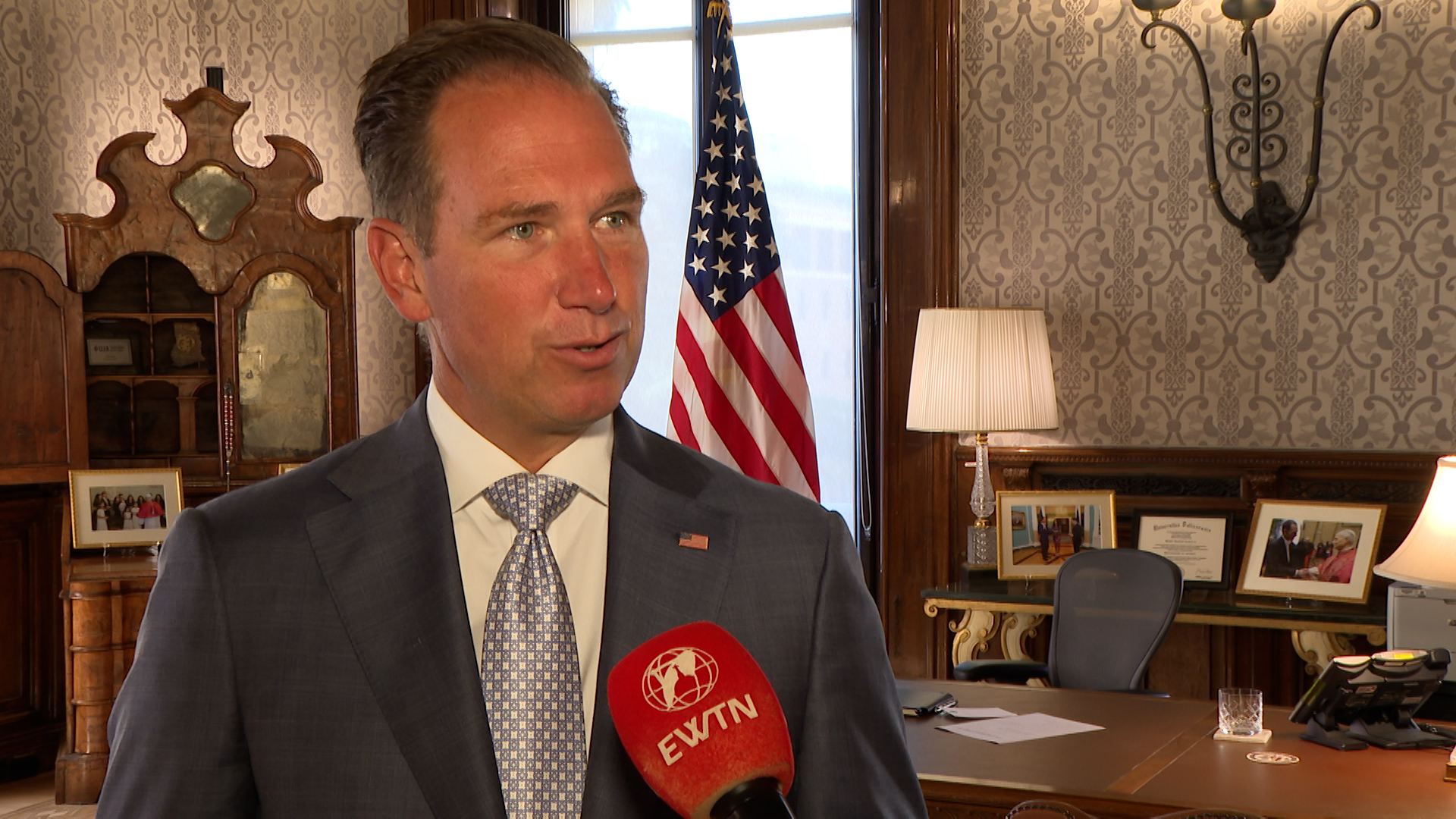
“You have this extraordinary confluence of circumstances where you have an American pope, and you have a president and an administration filled with many Catholics,” Burch said. “The American experiment itself has a lot of common ground with the Churchʼs teaching and social doctrine.”
Catholic praise for America’s commitment to human rights
Barron said the U.S. founders drew on a mix of sources and that their ideas shouldn’t be reduced to modern secular philosophy alone. St. John Paul II explained rights differently, he said.
“During his first trip to the U.S. as pope in 1979, John Paul praised our country for its commitments to human rights, defined in a theological rather than Hobbesian way,” Barron said. “Instead of grounding rights in individual desire, John Paul II grounds them in human dignity.”

Speaking to EWTN News on the sidelines, Barron also described his involvement with the U.S. Commission on International Religious Freedom, which is tasked with defending religious freedom, as a Catholic bishop.
“Well, Iʼve just started on that commission. I spent a year with the national commission that President Trump established, but this one was established by Congress many years ago. We just had our first meetings by Zoom because I was here in Rome,” Barron explained.
“Itʼs a watchdog group to keep an eye on violations of religious liberty.”
Barron will ordain 18 deacons for the Pontifical North American College at St. Peter’s Basilica on Oct. 1.
Brian Schumacher contributed to this report.