
More than 100 financial professionals and clergy from various faiths gathered in New York City Sept. 16-17 to attend the second annual Catholic Faith Investor Summit organized around the theme “Empowering Catholic Leaders to Align Their Investments with Their Faith and Create Impact.”
Catholic business leaders “can’t just check a box” when it comes to faith, Pierre LeCocq told attendees on Sept. 17 after the event’s opening Mass at St. Patrick’s Cathedral. “You’re in charge of a community of persons. Every decision you make has to be done with that in mind. You’re not here to check a box … you’re here to love.”
In his remarks, LeCocq, past president of UNIAPAC, the International Christian Union of Business Executives, along with other conference speakers, often cited Mensuram Bonam: Faith-Based Measures for Catholic Investors — A Starting Point and Call to Action, a 2022 document from the Pontifical Academy of Social Sciences.
While not a binding magisterial text, the document offers faith-based guidelines for finance and investment drawn from Catholic social teaching.
Conference founder and chairman, Roger Aguinaldo, a Wall Street veteran, said in his opening address that “most Catholic institutions inherited their investment processes from the broader market, which was never built with Catholic social teaching in mind. Your consultantʼs model portfolio doesn’t know what Mensuram Bonum (“A Good Measure”) is. Your benchmark doesn’t scream for human dignity.”
He told EWTN News he organized the summit after a “reversion” to the Catholic faith several years ago, saying he believes “Jesus wants me to dedicate the last third of my career to helping Catholics align institutional dollars with the Catholic faith and create real social impact … not the ESG screens [environmental, social, governance] Wall Street pushed on us. That was virtue signaling. We have 2,000 years of Church teaching to guide us.”
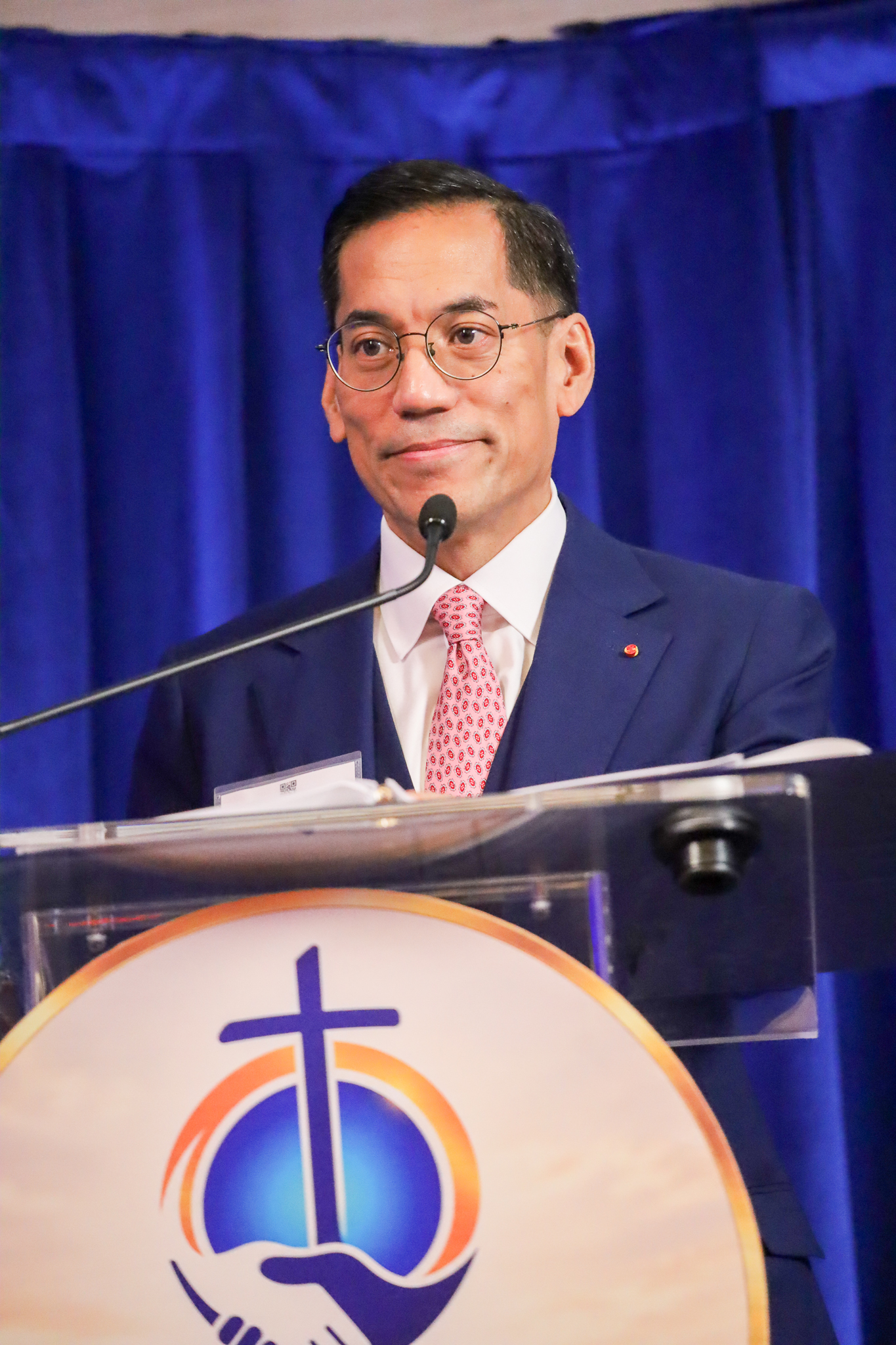
Aguinaldo, who is a former member of the U.S. Conference of Catholic Bishops’ National Advisory Council, said Catholics do not have to sacrifice returns when they invest in alignment with their faith and values.
“Without a deliberate act of will,” however, he said “a portfolio drifts toward whatever the market calls responsible, which is not the same thing as what the Church calls faithful.”
Exclusion, engagement, impact
Several speakers discussed the three-part investment process of exclusion, engagement, and impact.
Exclusion, or negative screening, means ruling out companies whose products or practices contradict human dignity, such as abortion drugs and contraceptives, pornography, and gambling, among others.
Engagement means using ownership: writing to management, voting proxies, and filing shareholder proposals under Securities and Exchange Commission rules so a resolution can appear on a company’s proxy ballot.
Aguinaldo said Catholic investors need not “just throw away oil stocks. You can engage with the companies as a stockholder,” asking them to bring practices into line with Catholic principles.
Father Séamus Finn, who served on the working group that produced Mensuram Bonam with Cardinal Peter Turkson, chancellor of the Pontifical Academy of Social Sciences, told attendees that stockholders can file proposals under SEC rules and use their ownership to press for change.
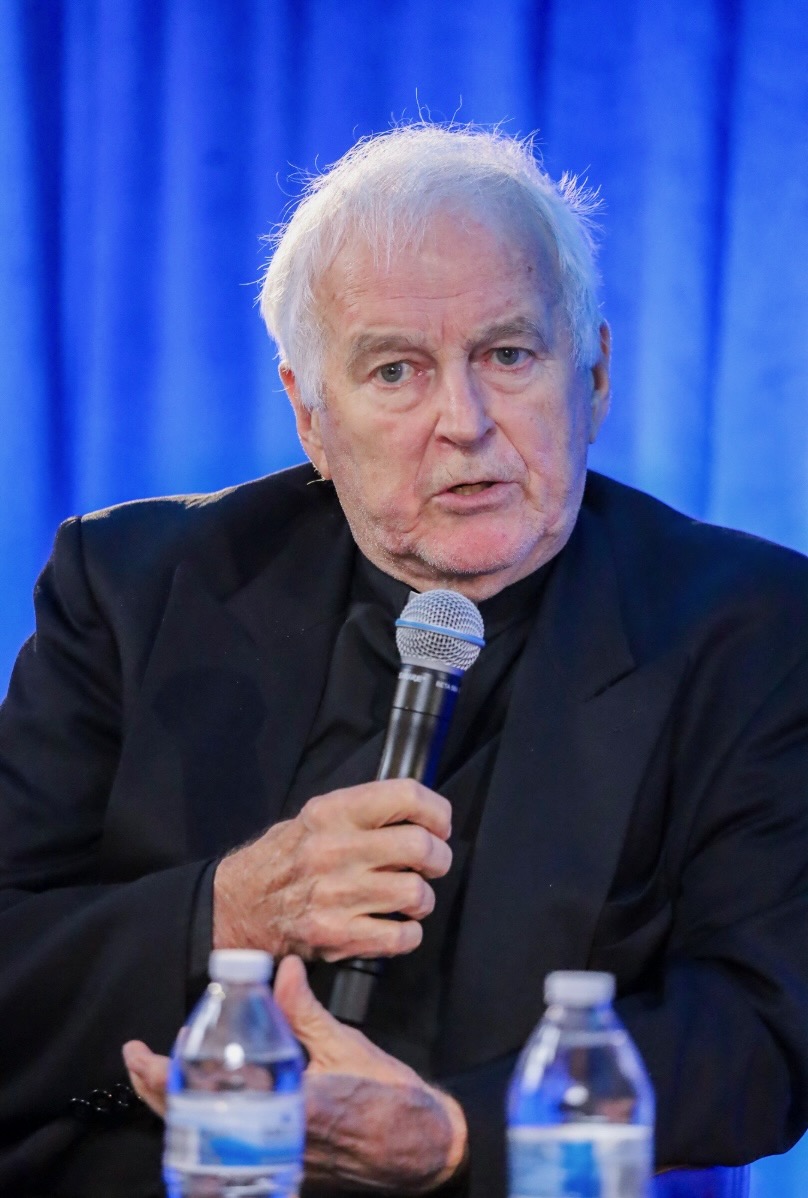
Engagement sometimes changes policy. When it does not, investors may sell the stock, thus creating impact. Rabbi Rachel Kahn-Troster, executive vice president of the Interfaith Center on Corporate Responsibility, described that sequence from her work.
She said many of the group’s members, including non-Christians, have welcomed Pope Leo XIV’s encyclical Magnifica Humanitas, which focuses on human dignity as economies are reshaped by rapidly advancing technologies like artificial intelligence. That concern also ran through a summit session on new financial infrastructure.
Eddie Cullen, who with Karl Kilb cofounded a digital assets firm that has issued a stablecoin called Catholic USD, told attendees that AI automation of finance “is coming like a freight train” and Catholic financial professionals should be prepared.
The question, as he framed it, was not whether the rails get built but who writes the rules. Cullen said Catholics must get out in front of emerging technologies.
Blockchain, Cullen said, can make transactions faster and more transparent and “will empower the poor” who have been shut out of ordinary banking — an impact play that speakers contrasted with the ESG screens they called insufficient.
Financial consultant Carolyn LaRocco, who works largely with women religious, discussed the challenges of bringing financial products aligned with Catholic social teaching to investors, who might fear making less money with such investments.
“You can make money and do good at the same time,” LaRocco said. “You can keep up with the indexes, but you have to push your financial adviser or consultant, to prove Catholic products do not yield worse returns.”
She said a problem with her industry is “we want it to scale. We love capitalism; we want to make a lot of money, but it takes time.”
In the long run, “how much money do we need?” she went on to ask. “Are we just trying to make money, or are we trying to do good?”
LaRocco said Catholics should challenge themselves and “drive their whole portfolios to mission.”
James Good, the chief investment officer at an investment advisory firm, told EWTN News he was “impressed to see a remarkably diverse group of financial professionals converge with a unified mission” centered on aligning faith and financial management, saying “this demonstrates that Catholic values can influence our world for good … while also fulfilling fiduciary and stewardship responsibility.”
Leave a Reply
You must be logged in to post a comment.