
For the first time in seven centuries, Aquileia, a city in northeastern Italy with a fascinating past, has reunited the three scattered fragments of a sixth-century manuscript that for centuries was venerated as if it were the Gospel written by St. Markʼs own hand.
The author of the Gospel that bears his name was St. Peter’s interpreter and secretary. He followed the apostle to Rome, where he witnessed his preaching in the homes of the first followers of Christ, who dared to defy the Roman Empire’s laws governing worship.
St. Mark carefully recorded every courageous word of that early catechesis, and his notes became a firsthand source for the story of Jesus’ life.
Today, Aquileia, a small town of just over 3,000 inhabitants, treasures St. Mark’s memory as the founder of one of the most flourishing Christian communities of the Middle Ages.
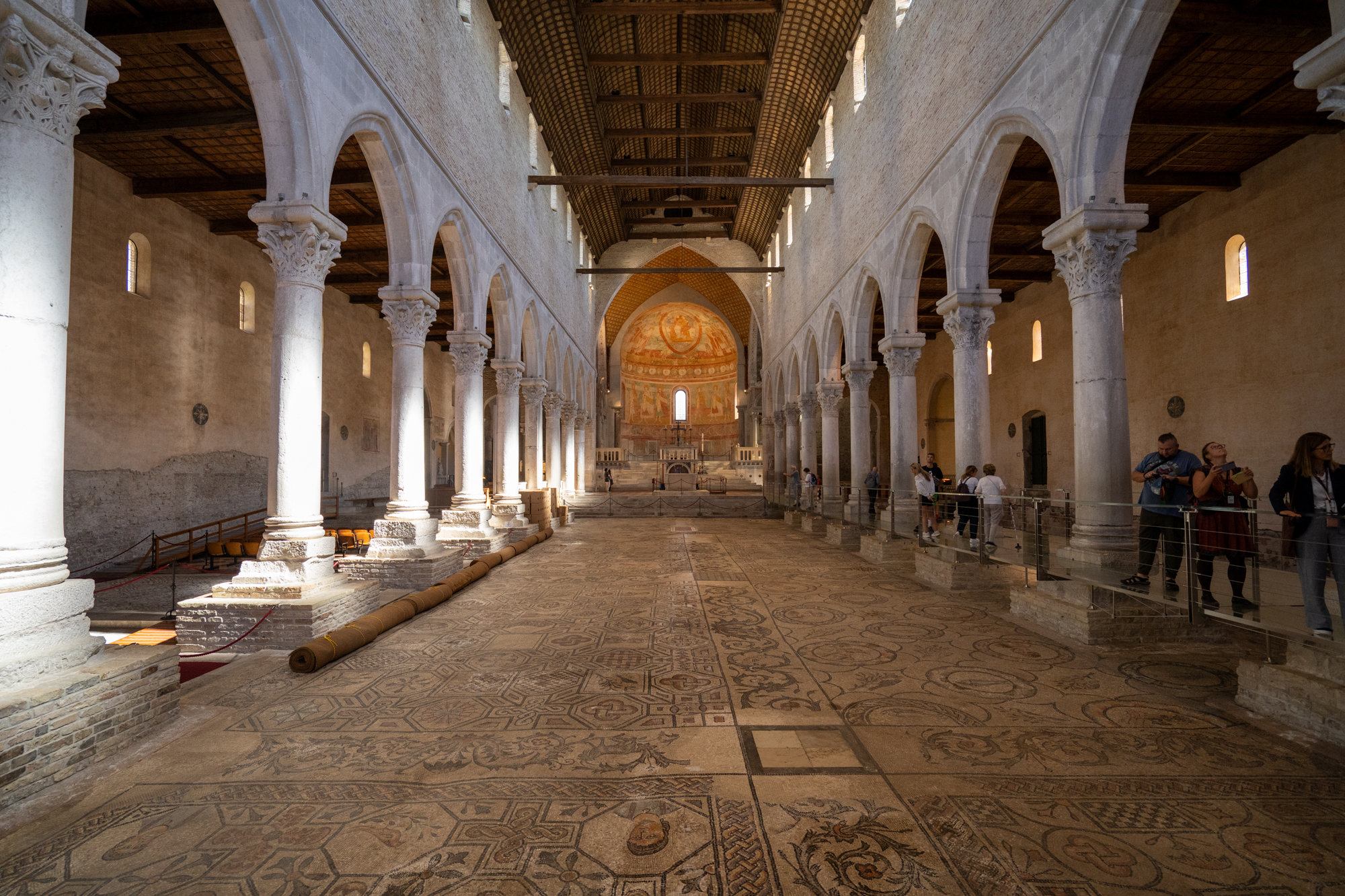
After the Edict of Milan in A.D. 313, the city, situated at the crossroads of East and West and serving as a bridge between the Mediterranean world and Slavic culture, became a center for the spread of Christianity into Central Europe and the Balkans.
By the fifth century, it had even been honored with the title of apostolic city, and its bishop held the rank of patriarch. That privilege was reserved only for dioceses that traced their origins to the preaching of an apostle.
“We preserve extraordinary medieval frescoes in the basilica depicting St. Mark arriving here to found the city’s first Christian community. That is why we believe he truly came to Aquileia,” Aquileia tour guide Anna Sairu told “EWTN Noticias,” the Spanish-language broadcast edition of EWTN News.
The codex that became a relic
One of the principal witnesses to this tradition is the “Codex Forojuliensis,” also known as the “Cividale Gospel Book.” The sixth-century manuscript, written in uncial script, the calligraphy reserved for sacred texts, originally contained all four Gospels in St. Jerome’s Latin translation.
Scholars believe it was most likely produced in Ravenna, Italy. From there it arrived in Aquileia during the second half of the ninth century, where it was authenticated by the signature of Theodemar, patriarch of Aquileia.
The presence of the codex strengthened the tradition linking St. Mark to the evangelization of the region. Its significance became so great that in 827 the Synod of Mantua recognized Aquileia’s ecclesiastical supremacy over Grado.
Venice looked with suspicion on the growing religious prestige of its neighbor. Just a year later, in 828, Venetian merchants brought the relics attributed to the evangelist from Alexandria to the city on the lagoon. In doing so, “The Most Serene Republic” of Venice gained a patron of apostolic rank and strengthened the religious and political foundations of its power.

The fragmented Gospel
Between the 12th and 13th centuries, the seven quires — folded sheets of paper stitched into booklets — containing the Gospel of Mark were separated from the rest of the codex, rebound independently, and covered with an elaborate gilded silver binding that transformed the book into an object of veneration resembling a reliquary.
From that point on, the manuscript ceased to be viewed as merely an ancient copy and began to be regarded as an autograph written by St. Mark himself. Medieval inventories of the Patriarchal Treasury of Aquileia reflect this belief.
“The Gospel was fragmented when it was removed from the Gospel book containing all four Gospels and began to be regarded as an autograph of the evangelist himself. This is connected to the tradition that St. Mark evangelized this region of Italy, Aquileia, and its surrounding territory. During the 12th and 13th centuries, the Gospel of Mark acquired a life of its own and came to be regarded as an extraordinary relic,” Cristiano Tiussi, director of the Aquileia Foundation and curator of the exhibition, told “EWTN Noticias.”
The emperor who wanted a piece of St. Mark
The fame of the supposed authentic Gospel of St. Mark quickly spread across Europe. In 1354, while traveling to Rome to receive the imperial crown, Charles IV of Luxembourg stopped in Aquileia. At the time, his half-brother, Nicholas of Luxembourg, served as patriarch there.

The emperor requested part of the revered manuscript and received two of the seven quires that comprised the Gospel of Mark. Those pages were taken to Prague, where they were deposited in St. Vitus Cathedral alongside the relics of St. Wenceslaus. Over the centuries, they became the oldest written document preserved in Czech libraries.
The exhibition even displays the original documents recording Charles IV’s request to the patriarch of Aquileia.
“Possessing part of the Gospel of St. Mark meant owning not only a religious relic but also a symbol of prestige, legitimacy, and power,” Tiussi noted.
The conquest of Venice
The remainder of the manuscript remained in Aquileia until May 30, 1420, when Doge Tommaso Mocenigo conquered the city. Venice then claimed the remaining fragments, arguing that they belonged beside the evangelist’s tomb in the Basilica of St. Mark.
Their transfer symbolized Aquileia’s definitive incorporation into the Venetian sphere.
The gesture also carried an unmistakable political significance. If Venice had claimed custody of the evangelist’s body since 828, it now also acquired part of the manuscript believed by tradition to have been written by his hand.
As a result, the Gospel of Mark became permanently divided among the cities of Cividale del Friuli, Venice, and Prague.
For the manuscript itself, however, the consequences proved devastating. Humidity from the Venetian lagoon gradually damaged the pages until they became almost illegible. Today, those remnants are preserved in a reliquary display case within the Treasury of St. Mark.

A medieval Facebook
The exhibition offers visitors a second surprise. Before it was dismantled, the manuscript served as a “Liber Vitae,” or “Book of the Living.” More than 1,500 names were entered into its pages by people who wished to be remembered in the prayers of the monastic community that safeguarded the codex.
“This is one of the features that makes this Gospel book exceptional. In Italy, we know of only two Carolingian-era ‘libri vitae.’ This is one of them. These inscriptions, written in a hand different from the original uncial script, were initially simple liturgical annotations. They are notes written on the Gospel between the seventh and eighth centuries indicating which passages should be read during particular periods of the year or providing other instructions for the book’s liturgical use,” said Luca Villa, another curator of the exhibition.
Beginning in the second half of the ninth century, the names of benefactors, nobles, pilgrims, and distinguished visitors were added.
Among them were figures as notable as Emperor Louis II the Younger and his wife Engelberga, the Moravian prince Svatopluk, and envoys from the newly Christianized Kingdom of Bulgaria.
“There are more than 1,500 important figures who wrote their names in the Gospel, not merely to leave a record of themselves but because they believed that by doing so they would share in the liturgical celebrations every time the book was used in the church where it was kept,” Villa told “EWTN Noticias.”
For historians, these lists provide an extraordinary window into medieval Europe. They reveal a network of contacts, pilgrimages, and cultural exchanges linking distant regions centuries before the emergence of modern nation-states.
A European story
Now, for the first time in roughly 700 years, the three surviving portions of the Gospel have been reunited.

The quires preserved in Prague have left the Czech Republic for the first time. The fragments kept in Venice have temporarily departed St. Mark’s Basilica. Together with the pages preserved in Friuli, they reconstruct a story that had remained fragmented since the Middle Ages.
Czech curator Martina Dlabajová said she believes the reunion also symbolizes the very essence of Europe.
“What is beautiful is that, while acknowledging that each fragment has had a different history and followed a different path, by bringing them together we have chosen to embrace that shared history. That is why the exhibition’s title speaks of ‘Seven Centuries, Three Fragments, One European Story,’ because the three fragments never ceased to be part of a common narrative, and that narrative is a European one,” she explained.
“I also like to emphasize that Europe itself should recognize differences, accept that distinct histories exist, and understand that those different histories from various countries enrich our shared history,” she added in comments to “EWTN Noticias.”

The exhibition, “The Gospel of Mark: Seven Centuries. Three Fragments. One European Story,” will remain open through April 2027. Due to the fragility of the parchment, however, restrictions are necessary. The original manuscripts will be on display only during the exhibition’s first six weeks. They will then be replaced by high-resolution digital reproductions.
This report was made possible thanks to the support of the Aquileia Foundation.
This story was first published by ACI Prensa, the Spanish-language sister service of EWTN News. It has been translated and adapted by EWTN News English.