
Pope Leo XIV flies to France on Friday, where across four days in three cities he will proclaim Catholic teaching to the heart of secular Europe on matters that include end-of-life questions, immigration, and artificial intelligence.
The visit “will truly be a moment in which Leo’s project of making the Church’s social doctrine better known can take shape,” said Father Patrick Valdrini, a former rector of the Institut Catholique de Paris.
France is statistically more secular than it was in 2008, when Pope Benedict XVI made a pastoral visit to the country. The latest data on religious identity in France, in 2019-2020, found that 51% of adults in France say they have no religious affiliation, an 8% increase from a decade before. While 29% of the population identifies as Catholic, the survey found only 8% say they go to Church regularly, according to the Institut National D’Etudes Démographiques.
Yet according to Cyprien Viet, a journalist with the French agency I.Media, the country has become more open to Catholicism in recent years. The reasons for this shift include sympathy for Christianity following attacks on churches and the 2016 killing by Islamist terrorists of Father Jacques Hamel, enhanced appreciation for France’s Christian heritage after the 2019 burning of Notre-Dame Cathedral, and gratitude for the Church’s charitable service during the COVID-19 pandemic.
More recently, “Pope Leo’s encyclical on artificial intelligence [Magnifica Humanitas] has had a fairly strong impact in France, and people recognize that there is a need to explore these issues more deeply. The pope is helping greatly in providing points of reference,” Viet said.
The challenge of laïcité
During his Sept. 25–28 visits to Paris, Lourdes, and Metz, Leo’s approach to sharing the Catholic Church’s teaching on political and social issues will draw wide attention, not least because of France’s tradition of “laïcité,” a strict legal separation of Church and state.
This policy has always involved a certain distrust, even hostility, toward the idea that faith can contribute something good to society, Valdrini said.
“The concept of ‘laïcité’ emerged especially during the French Revolution, rooted in the view that religion hinders freedom and reason, that it is something burdensome rather than liberating,” he said.
Among the most sensitive issues that the pope is expected to address are end-of-life questions. France legalized assisted suicide and euthanasia this summer, becoming the fifth European country to do so after Belgium, the Netherlands, Luxembourg, and Spain. In addition, Switzerland and Austria permit assisted suicide.
Euthanasia is the intentional ending of a person’s life to relieve suffering. It differs from assisted dying, in which the patient takes life-ending drugs himself, under a physician’s guidance. Both practices are prohibited by Catholic teaching.
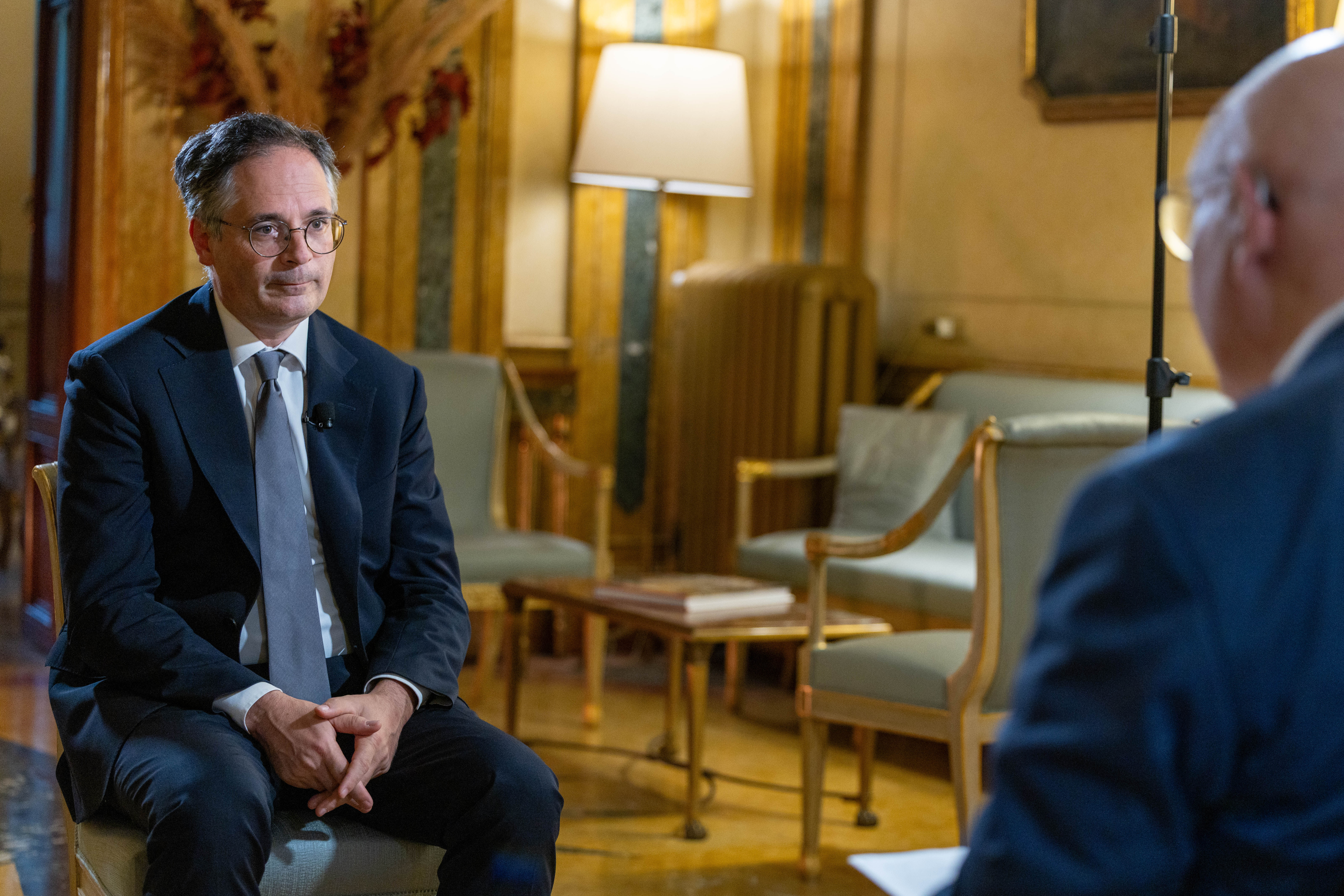
Charles Personnaz, France’s ambassador to the Holy See, says he expects the pope to speak out on the issue but to leave the political debate to the French bishops, who were already outspoken in their vigorous condemnation of the euthanasia bill before it passed in July.
“I think the pope will certainly repeat what is the Catholic doctrine: the preservation of life from the beginning to … the natural end,” the ambassador said. “But he will also leave to … the French Catholic Church the debate with the political parties in France and the institutions. That is the subsidiarity that is at the heart of Catholic doctrine as well.”
A message about human dignity
On a visit to the Sanctuary of Our Lady of Lourdes, Pope Leo is expected to deliver a message about the inherent dignity of every human person, even when suffering from illness or disability.
Meeting and praying with the sick and vulnerable at one of the most visited Catholic shrines in the world, the Holy Father will give a concrete sign of faith in the value of every human life.
At the shrine he will also meet privately with victims of abuse in the Catholic Church in France and with the country’s bishops.

Leo is expected to address the global challenges posed by artificial intelligence when he speaks at the headquarters of UNESCO, the United Nations Educational, Scientific, and Cultural Organization, in Paris on Sept. 25. On his last day, he will reflect on interreligious dialogue and the future of Europe at meetings in Metz.
The pope’s visit to a migrant integration center run by the Archdiocese of Paris will touch on one of the most volatile political issues in Europe and beyond, and one closely tied to next year’s presidential election in France, in which the anti-immigration politician Marine Le Pen is the current frontrunner.
Personnaz said he expects the pope’s comments on immigration to be well received, calling the pontiff’s previous statements on the topic “very balanced” with a focus on the responsibility of nations to help people stay in their homeland.
State visit or apostolic journey?
Pope Francis visited France three times during his pontificate, but Leo will be making the first state visit by a pope to France since Benedict XVI’s apostolic journey in 2008.
The French Catholic newspaper La Croix has reported that the Holy See has refused some requests by the government, including a proposal that President Emmanuel Macron accompany the pontiff into Notre-Dame Cathedral for a prayer service on Sept. 25. The Holy See Press Office and the Élysée Palace, the official residence and office of the French president, did not respond to requests for comment on the report.

According to Valdrini, Leo is following in the tradition of St. Paul VI, who sought to emphasize the pastoral character of his travel — the visit to a local Church by the successor of Peter — rather than his role as a head of state.
“It will still be a state visit, and there will be official ceremonies, but it is clear that the pope wanted to emphasize, as previous popes did, this [apostolic] dimension of the journey,” Valdrini said.
Catholicism grows
Despite a lack of religious practice in France, enthusiasm for Pope Leo’s visit is high, as demonstrated by the response to his events with the public in France’s capital.
Adolescents and young adults have snapped up tickets for a prayer vigil in the 81,000-seat Stade de France and an open-air Mass in Place de la Concorde. Paris’ largest public square may draw some of the biggest crowds of his pontificate thus far, with 600,000 people expected to fill the square and a nearly two-mile stretch of avenue connecting to the Arc de Triomphe. This enthusiasm is also reflected in an atypical outpouring of donations to the dioceses to cover organizational costs.
Leo will address France’s Catholics at a critical juncture in their history, as they welcome rising numbers of converts. He is likely to encourage the nation traditionally known as “the eldest daughter of the Church” to rediscover her Catholic roots.
This Easter, France recorded more than 20,000 adult and adolescent baptisms, a 20% increase from the already record-high number in 2025, which saw a 45% increase from 2024 figures.
The phenomenon has prompted the bishops of Île de France, the ecclesiastical region that includes the Archdiocese of Paris, to convene a special council on how to respond to the huge influx of Catholic converts.
“Today people have not inherited their faith … and so they are kind of ignorant about the Catholic heritage,” Personnaz said. “But when they discover it, they have no prejudices about it. And in a world where the youth are searching for a sense to [their] life, the Catholic proposal remains very interesting.”
Francis X. Rocca and Victoria Cardiel contributed to this report.