
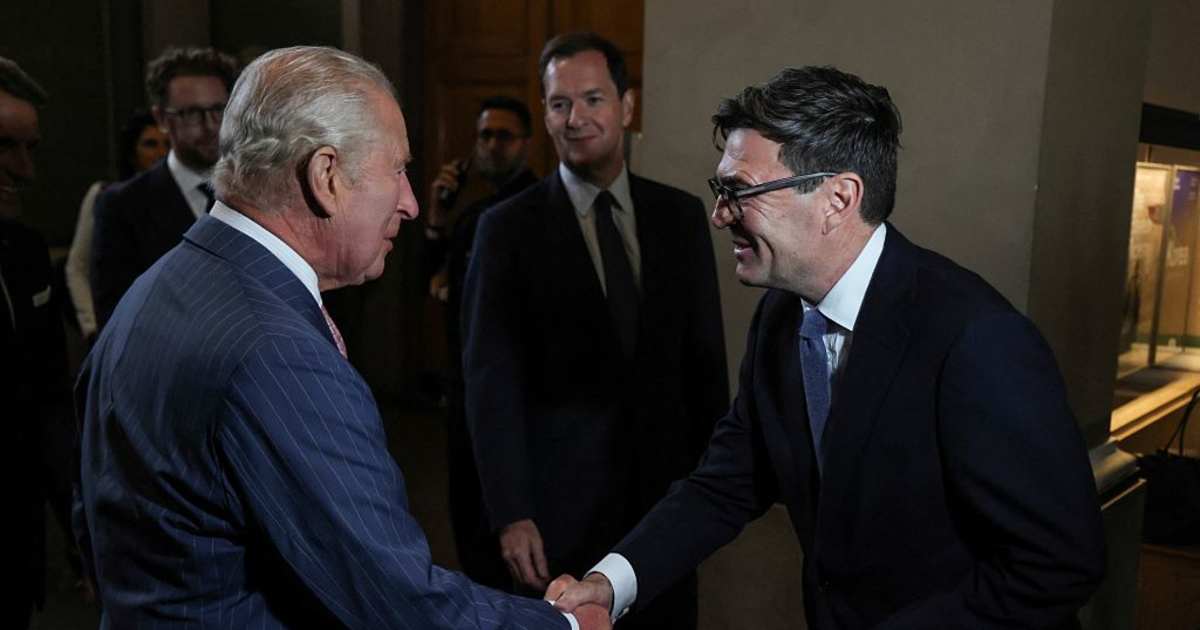
The U.K. government has introduced a new bill seeking to end restrictions that prevent U.K. prime ministers from exercising their full constitutional responsibilities.
The Church Appointments (Repeal of Discriminatory Provision) Bill would allow Catholic and Jewish prime ministers to provide advice to the monarch on Church of England appointments, which is part of the prime minister’s role.
According to the U.K. government, amendments were brought into law in the late 18th and early 19th centuries to remove restrictions on Catholic and Jewish people in public life, but the restriction related to advising on Church appointments was left in place.
Up until recently there have been no Catholic or Jewish prime ministers, but Prime Minister Andy Burnham, who came to power on July 20, is a Catholic and has had to transfer this responsibility to the lord chancellor.
Inquiry into police collusion in death of Catholic father in Ireland concludes
An inquiry in Ireland has found that four Royal Ulster Constabulary officers “did not collude” with attackers who assaulted a 25-year-old Catholic father of three in 1997 in County Armagh, according to a report in RTÉ.
The inquiry into the murder of Robert Hamill found however that there were “multiple police failings in the investigation, including a tip-off to a suspect to destroy the clothing he wore that night.”
Hamill was walking home with friends when he was assaulted by a large crowd. To date, no one has been convicted of the murder.
Vatican official urges Asian Catholic digital missionaries to be ‘responsible’
In her plenary address at the Asian Catholic Digital Missionary Assembly 2026 in Manila, Philippines, on Sept. 11, Natasa Govekar, director of the Theological-Pastoral Department of the Vatican’s Dicastery for Communication, said that Christian influencers online should treat their efforts “as a responsibility rather than a measure of status.”
According to LiCAS.news, Govekar said that “every Christian should be aware of his or her potential influence, regardless of the size of an online following, while responsibility grows as audiences expand.”
Govekar also said digital evangelization “should move away from individual-centered influence and toward communion, shared mission, and witness.” She warned against treating Christian communication as a form of marketing, saying: “We are not advertising, but communicating to live the life that was given to us.”
Archbishop says states should renounce nuclear weapons
At the 70th General Conference of the International Atomic Energy Agency (IAEA) on Sept. 15 in Vienna, Archbishop Paul Richard Gallagher, the secretary for relations with states and international organizations, called for the responsible use of nuclear technology, which he said is “inseparable from the commitments and responsibilities that accompany it.”
His comments were made while marking the 40th anniversary of the Chernobyl disaster.
According to a report in Vatican News, Gallagher highlighted the Holy See’s “longstanding commitment—as one of the IAEA’s original signatories seventy years ago—based on the conviction that a technology with such vast potential as nuclear energy ‘must be guided by sound ethical principles, be used for the service of peace and integral human development, and be protected from any destructive use.’”
The archbishop urged “sound ethical principles” on nuclear energy, saying that nuclear technology may be used to benefit humanity, but its development should not “lead to the acquisition of nuclear weapons, protecting facilities in wartime, and applying artificial intelligence with an awareness of the associated risks and sound safety standards.”
Missing Zimbabwean priest found dead at Harare hospital mortuary
The Archdiocese of Harare in Zimbabwe announced the death of Father Regis Chikuni days after appealing for prayers and assistance in locating the priest.
According to ACI Africa, the sister service of EWTN News in Africa, the archdiocese said Chikuni was found deceased at the mortuary of Parirenyatwa Hospital and relesed a death notice on Sept. 9.
Chikuni is believed to have been involved in a hit-and-run road accident in Harare while attempting to cross the road. He reportedly had no identification with him at the time of the accident, making it difficult for authorities to establish his identity. Police are expected to issue an official statement on the circumstances surrounding his death.
Archbishop of Westminster issues statement urging 2-state solution in Holy Land
The archbishop of Westminster and president of the Catholic Bishops’ Conference of England and Wales, Archbishop Richard Moth, issued a statement on Sept. 15 condemning violence in the Holy Land, stating that the two-state solution should “remain the goal of all people of good will.”
“The Church in England and Wales has a particular concern about the Holy Land. With the encouragement of the Holy See and the support of the Latin Patriarchate of Jerusalem, we have organized the Holy Land Co-ordination, an annual pilgrimage of bishops from around the world to support Christians in the region through presence, prayer, pilgrimage and persuasion,” he said.
“However, violence continues to engulf the Holy Land, pushing people apart while undermining hopes for peaceful co-existence in a two-state solution. It has also led to a polarisation of views and even despair, which make the necessary bridge building for forgiveness and reconciliation so much more difficult.”
The archbishop called violence a “stain on humanity,” and cited both Pope Francis and Pope Leo XIV, who have called for “the international community to work toward advancing the two-state solution, for a just and lasting peace.”
Syrian town revives its distinctive traditions for feast of the Holy Cross
This year’s feast of the Exaltation of the Holy Cross in Maaloula, Syria, drew thousands of residents, returning families, and visitors, bringing what local clergy described as a renewed sense of life to the historic Christian town, ACI MENA, the Arabic-language sister service of EWTN News, reported.
Father Fadi Barqil, superior of the Melkite Catholic Monastery of Saints Sergius and Bacchus, said preparations began nearly a month before the feast. Residents carried a cross to the mountaintop on Sept. 12 and illuminated it, while the eve of the feast included evening prayer, traditional processions, and the lighting of fires on the mountains. On the feast itself, processions moved through the town with banners, poetry, dabke (a traditional folk dance), and visits to homes followed by a communal meal.
Barqil stressed that the religious meaning of the celebration must remain at its center, warning against reducing the feast to its outward customs. He also encouraged Maaloula’s families to continue returning, visiting their homes and keeping them illuminated, saying their presence is what restores the town’s spirit.
Bishops in Australia seek married couples’ input for support programs
The Australian Catholic Bishops’ Conference’s Commission for Life, Family, and Public Engagement announced funding for a research project that responds to concerns raised in the late Pope Francis’ 2016 apostolic exhortation Amoris Laetitia (The Joy of Love).
“Pope Francis had a particular concern for the newly married,” Auxiliary Bishop Tony Percy of Sydney said. “He recognised that as a Church we have tended to focus on preparation for marriage and then, after the wedding, have more or less left couples to fend for themselves.”
The bishops want to hear from married couples so they are funding a professional survey, which has already collected 440 responses. “We hope to reach 1,000 respondents over September for best research results,” project manager Jessica George said.
Leave a Reply
You must be logged in to post a comment.