
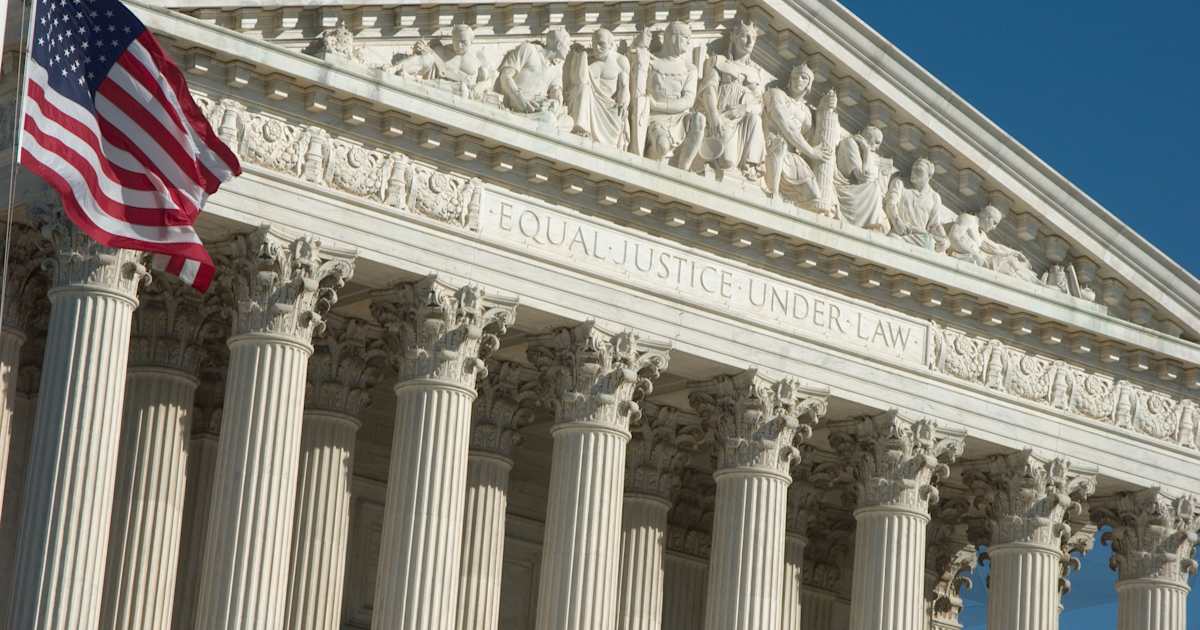
The U.S. Supreme Court should reject the broad application of a long-standing administrative rule that can prevent religious liberty lawsuits from progressing through the courts, U.S. bishops argued this week.
The U.S. Conference of Catholic Bishops joined with the Southern Baptist Convention’s Ethics and Religious Liberty Commission in filing an amicus brief in support of Daniel Grand, who is petitioning the high court to rule in his favor in a legal dispute with the city of University Heights, Ohio.
Grand filed a lawsuit against the city in September 2022 after the city blocked his efforts to convene a minyan, or Jewish prayer group, of about a dozen friends at his home.
A federal district court dismissed his case on the grounds of a legal concept known as “finality,” a legal principle requiring property owners to obtain a land-use decision from local officials before bringing certain federal court challenges. A federal appeals court also ruled against Grand in the dispute.
In June the Supreme Court said it would consider the finality question. Grand is being represented by the legal group Alliance Defending Freedom.
In their filing, the U.S. bishops and the Baptist leaders said the lower courts erred by misapplying certain finality standards to Grand’s case.
“Forcing a religious plaintiff to exhaust an administrative process before vindicating his rights does not prevent premature adjudication; it imposes the very burden the Constitution forbids,” the religious groups said.
Grand’s religious liberty objections are clear regardless of the outcome of the administrative process, the leaders said.
“His rights are priceless and he has already been prevented from praying and continues to be prevented from praying,” they said, describing the injury to his religious rights as “complete” and “immediately knowable.”
The alleged misapplication of the “finality” rule, they said, requires plaintiffs to “complete a potentially years-long administrative process and wait for a final adverse decision even though the act of subjecting [their] religious practice to that process is itself the constitutional and statutory injury.”
The bishops and the Baptist convention urged the court to reverse the lower court rulings, arguing that religious objectors have standing to bring a lawsuit “as soon as a credible threat arises.”
Grand in his filing with the Supreme Court argued that the finality rule offers “a playbook for government-sponsored religious discrimination.”
Numerous other groups, meanwhile, have filed amicus briefs in support of Grand’s case, including the Religious Freedom Institute, the American Hindu Coalition, the American Muslim League, the American Association of Jewish Lawyers, and several others.
Leave a Reply
You must be logged in to post a comment.