
For the second time during Pope Leo XIV’s pontificate, the Holy Father has been included in a top fashion magazine’s list for “best dressed.” Vanity Fair released its annual Best Dressed list on Aug. 5 and included the pope in “the originals” category.
In December 2025, the pope was named one of Vogue magazine’s 55 best dressed people of 2025.
Style correspondent José Criales Unzueta told The New York Post: “The reality is that everyone has a personal style, and this list celebrates people whose style we find most compelling, inspiring, idiosyncratic or a combination of those traits.”
“In the case of Pope Leo, we are drawn to his innate Americanness — the way he will pair a baseball cap or a pair of Nikes with his vestments, which speaks to the great tradition of American sportswear,” he said.
When Leo first appeared on the balcony of St. Peterʼs Basilica to the thousands of faithful gathered in the square after his election, many noticed the return of several papal vestments that were not used during Pope Francis’ pontificate.
So what are some of the papal garments Pope Leo has been wearing and what do they symbolize?
The papal mozzetta
One of the most obvious vestments that Pope Leo has brought back into use is the red papal mozzetta, reviving a long-established tradition.
The mozzetta is a nonliturgical garment worn by the pope, cardinals, bishops, abbots, and certain priests, including canons of a cathedral chapter. It is normally worn over the cassock.
The history of this garment dates back to at least the 14th century, shortly after the papacy returned to Rome from Avignon, France. Initially, it was worn by the popes in Avignon to adapt to the colder French climate. Eventually, it became part of the popeʼs ceremonial dress around 1400, initially reserved for the pope but later extended to all cardinals and bishops.
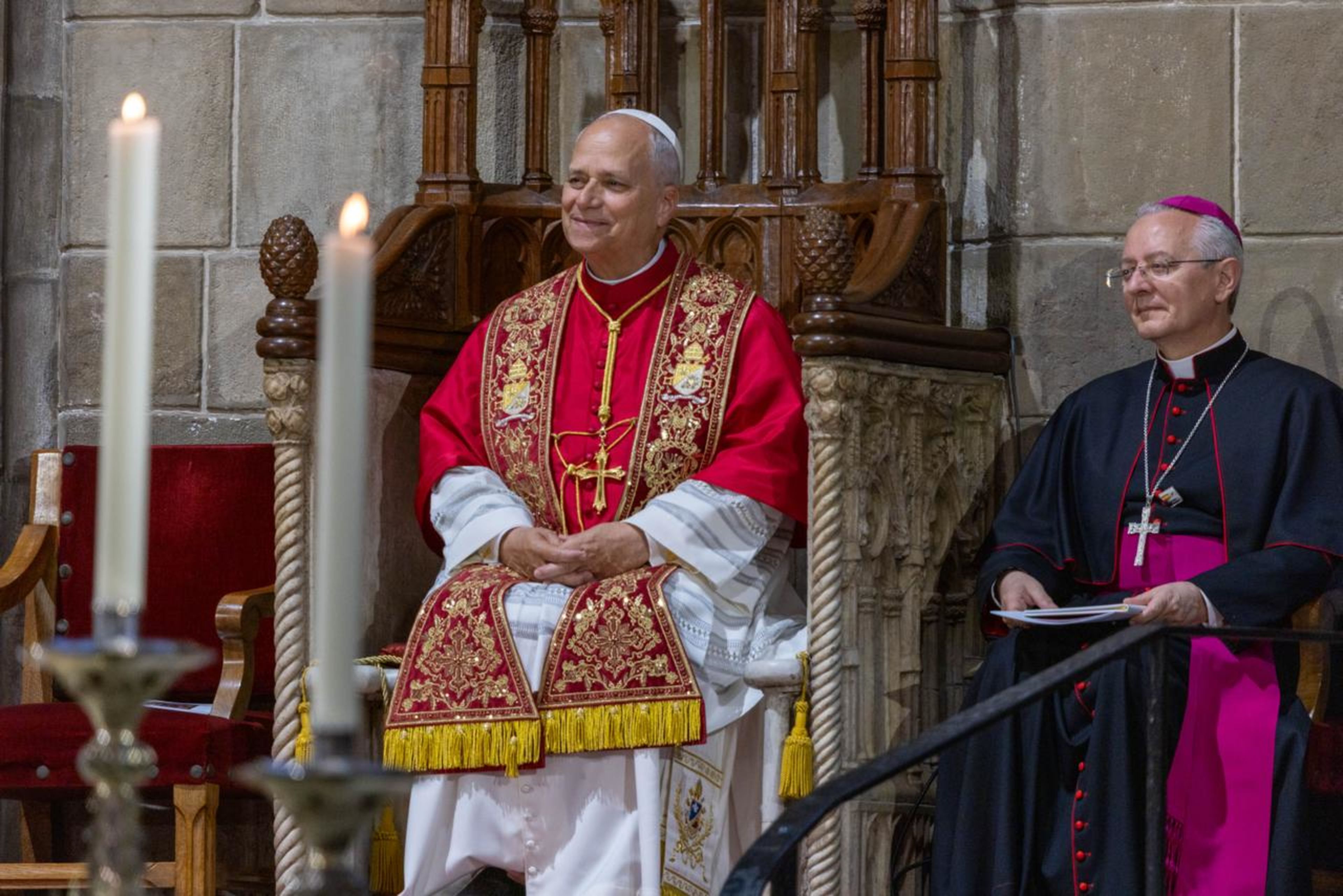
Pope Leo XIV at the Cathedral of the Holy Cross and St. Eulalia in Barcelona, Spain, on June 9, 2026. | Credit: Daniel Ibáñez/EWTN News
The mozzetta, in the case of a prelate, symbolizes his spiritual authority and rank within the Church hierarchy. For a pope, it is normally worn with the papal stole as a sign of his universal jurisdiction over all Catholics.
The mozzetta a pope wears is different from those worn by cardinals and other clerics. While the mozzetta for cardinals is red and for bishops purple, the pope has five versions of the mozzetta. The most commonly worn by the pontiffs is the red satin mozzetta, usually with an embroidered stole.
The white cassock
The white cassock is probably one of the most recognizable pieces of papal attire. It’s a long-sleeved, ankle-length garment and is tailor-made from 100% wool or a wool blend. White has a long Christian association with purity, innocence, holiness, and the glory of Christ.
Cassocks, which have historical links to the Roman robe known as the “caracalla,” are traditionally made with 33 buttons to represent the 33 years of Jesus’ life before his resurrection and ascension into heaven.
The white cassock became part of the papal vestments during the pontificate of Pope Pius V (1566-1572), who was a Dominican friar and continued wearing the white habit of his religious order after becoming pope.

Pope Leo XIV addresses pilgrims during his general audience on Wednesday, Aug. 5, 2026, in St. Peter’s Basilica. | Credit: Daniel Ibañez/EWTN News
A white sash
The white sash around the popeʼs waist, another traditional piece of papal attire, is called the fascia. It is essentially a wide, ceremonial band worn with the cassock and is made of linen or silk. It represents the pope’s devotion, dedication, and submission to Jesus Christ’s call to serve and look after his Church. The fascia is a symbol of readiness to minister to the people of God.

Pope Leo XIV greets the 47th Meeting for Friendship among the Peoples in Rimini, Italy, Aug. 22, 2026. | Credit: Vatican Media
A red stole
The stole is a liturgical vestment worn by priests and bishops as a sign of their ordained ministry. The General Instruction of the Roman Missal explains that a priest wears the stole around his neck, while a deacon wears it over his left shoulder and across the chest.
Pope Leo has made consistent use of the stole since his election in 2025. He typically wears a deep burgundy or scarlet silk stole with ornate gold embroidery during public and formal duties. However, he has also been seen wearing other stoles including a white one with gold embroidery.
Some instances in which the Holy Father has worn a stole include during his apostolic journeys, diplomatic audiences, state visits, major liturgical feasts, and ecumenical meetings, among others.
The United States Conference of Catholic Bishops (USCCB) explains that the stole symbolizes the authority and responsibility to serve in imitation of Christ, connecting it with Jesus’ words: “For my yoke is easy, and my burden light.”

Pope Leo XIV waves during a visit to Santa Ana Cathedral in Las Palmas de Gran Canaria, Spain, on June 11, 2026. | Credit: Vatican Media
The tradition of red leather shoes
Red leather shoes have been used by several popes over the centuries and have their origins in the early Church and the ancient Roman Empire.
In the Catholic faith, red symbolizes martyrdom and the passion of Christ.
Pope Benedict XVI’s red shoes became a bit of a trademark during his pontificate, with ABC News calling him a “fashionista” and Esquire naming him “accessorizer of the year.”
At another point, his loafers sparked controversy after false rumors claimed they were crafted by the high-end Italian fashion house Prada.
Benedict’s choice of shoes stands out because his predecessor and successor — St. John Paul II and Pope Francis — opted for alternatives. But popes have walked in red for centuries.
While Pope Leo has not yet been seen in red shoes, the Holy Father has made headlines for photoshares of him sporting a pair of white Nike sneakers around the Vatican grounds before he became pope.
Leave a Reply
You must be logged in to post a comment.