
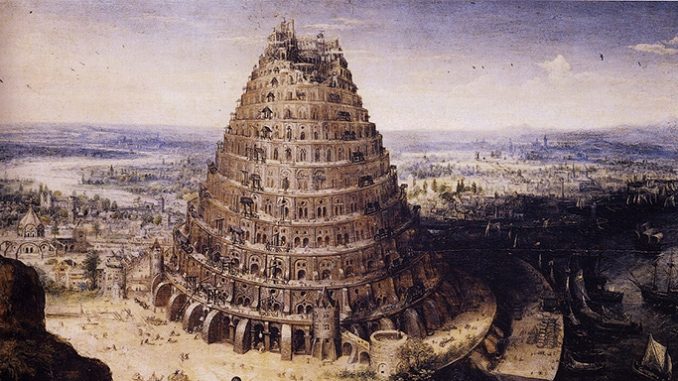
At its highest levels, political life today is an attempt to reach heaven through purely human means—that is, to construct Babel. That attempt is partly motivated by institutional interests, but at bottom has to do with basic understandings of man and the world.
The modern emphasis on technology, and its success in generating wealth and power, has given rise to an extensive and ever more closely coordinated society that emphasizes formal expertise, bureaucratic procedures, and fine-grained global markets. Everything can now be administered, bought, and sold, and studied by social scientists.
The smooth functioning of that society requires a scheme to determine what lines of thought and action are legitimate and rational. It is not necessary for the scheme to be clearly stated, adequate to reality, or even altogether coherent. But it must lend itself to the way the system works, and must seem simply rational, so as to exclude alternatives. And it must be easily transmissible, usable by properly trained people from almost any background, and generally coherent with regard to the questions it treats as legitimate.
Present-day public thought—the kind of thing you see in policy discussions and the New York Times—fits the bill. It is based on a technological understanding of reason: you decide on your goal, and then determine the most efficient way to achieve it. That way of proceeding suits rule by markets and expert bureaucracies, provides apparently rational answers to all questions, and views alternatives as crazy and oppressive. And it requires no particular cultural background to accept and live by, due to the abstract and quantitative nature of its goals and methods.
This kind of thought differs from the way most people think. Even so, it is the kind that dominates public life. Some public figures say they reject certain aspects of it, but usually that is for show—hence, for example, rank-and-file Republican complaints about “RINOs.”
How could it be otherwise? People who seek position and influence want to make sense to those who run things, but they can’t do that unless they present their thoughts in terms that fit the way their intended audience thinks about them. So they inevitably conform their outlook to that of their social betters.
This all spreads further. People today are mostly clients of the state, employees of large organizations, and consumers of mass-produced pop culture. So they are dependent upon society as a whole to an extent not seen in the past.
Our rulers make use of that. If deplorables have the wrong opinion—one seriously at odds with public thought—they make unremitting efforts to change it. And they are in a position to do so. Dominant institutions are becoming larger, more formal, and better coordinated, and are more involved in organizing daily life—work, amusements, and raising children. Through mass schooling and the mass media, they are directly involved in shaping how ordinary people think about the world. These efforts have had a great deal of success. Consider, for example, how they have changed attitudes toward homosexuality.
But this system of thought is radically anti-Catholic and even anti-human. It tells us that religion is private and individual, human nature is endlessly malleable, the human good is a matter of personal preference, and tradition exists to be questioned. None of these things can tell us what is good and true: for that, we look to human rights theory and science, including social sciences like economics. Beyond that, it’s all up to the individual.
As such, it treats efficiency, preference satisfaction, and equality as the standards for what is right and good. Efficiency and preference satisfaction define the system, and equality is the standard because all preferences are equally preferences and so should be put as much as possible on a level.
It feels called to force those standards into every aspect of life. It views that as a requirement of social justice, which consists in universal equal rational treatment, and liberation, which it understands as the elimination of all social restrictions not required to maximize equal preference satisfaction. To that end, it feels called to reconstruct the social order, and even human nature itself: if equality requires the disappearance of distinctions between the sexes, the distinctions must vanish.
That, to my mind, is the essence of the modern vision of Babel as a universal self-contained structure that promises to satisfy all human aspirations it views as legitimate. What makes that vision especially dangerous is that it conforms to the modern secular understanding of social justice and liberation, an understanding that is hard to dislodge because it is so closely tied to modern ways of thinking about things. It has even penetrated the Church.
That leads to my basic concern about the Holy Father’s recent encyclical. Pope Leo recognizes the attempt to construct Babel as an overarching danger today, and the ideal of efficiency as basic to that attempt. But then he makes the ideal of equality his own, seemingly identifying it with a recognition of the evils of extreme want. And he effectively admits preference satisfaction as the measure of the good, through an emphasis on cooperation with secular institutions that do so, and a continuing emphasis on outreach, dialogue, and nonjudgmental accompaniment.
He combines that with general support for homogenizing and secularizing initiatives such as the United Nations and the global human rights regime, an idealized version of the system of public thought now dominant. And he weakens his rejection of efficiency as a final standard through his sense of practical urgency, and his attitude toward current forms of expertise and regulation. Both are technocratic to the core, but he seems to take the former at face value, as a matter of the disinterested pursuit of truth, and sees no limit to what the latter can accomplish.
The result, it seems to me, is practical support for the actual attempt being made today to construct Babel. Once again, the opening to the world that was intended to promote the influence of the Gospel on secular affairs seems, as a practical matter, to be doing the reverse.
I can only present that as one layman’s view. But if Social Doctrine is “a process of shared discernment,” as the Holy Father says, it seems that I, like others, should present how things seem to me.
That is not a view from a poor rural diocese in Peru, which is undoubtedly an excellent position from which to view serious difficulties millions struggle with. Nor is it a view from the world of Catholic theological discussion. Instead, it is a lay view from New York, the home of the UN and a world capital of business and culture, and from the Park Slope area of Brooklyn, a center of affluent, trendy, and highly educated liberalism.
That perspective has many limitations. Even so, it provides a view of the outlook of the people and institutions that dominate today’s world, how they function, and the kind of world they are promoting. And that matters, because it will deeply affect the consequences of efforts by the Church to dialogue with the secular world, support its aspirations, and find common ground with its favored initiatives.
Given the refractory nature of the world and human beings, and the evil consequences of many secular efforts at radical social transformation, I can’t help but believe we should take a modest view of the immediate practical applicability of Church social teaching. It is far more a leaven than a way of generating specific plans. And given the dubious goals of today’s secular powers, we should be especially skeptical of attempts to build a civilization of love in partnership with them and their aspirations.
Or in a more spiritual key: should we really put the spirituality of the “‘wise architect’ … committed to building the world for the common good” at the center of the Faith? Is that the same as loving God with heart, soul, mind, and strength? Is it even—with its emphasis on the planned reconstruction of the social order, and therefore the exercise of overall control over our fellow man—love of neighbor as oneself? To me, it sounds far too close to the outlook of the social engineer.
If you value the news and views Catholic World Report provides, please consider donating to support our efforts. Your contribution will help us continue to make CWR available to all readers worldwide for free, without a subscription. Thank you for your generosity!
Click here for more information on donating to CWR. Click here to sign up for our newsletter.
Leave a Reply
You must be logged in to post a comment.