
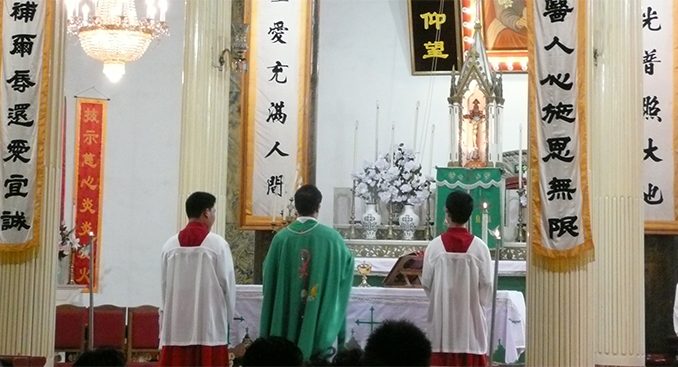
Sitting in the room with Chinese priests and nuns is always an exercise of patient listening and reading between the lines. Sometimes—it is not typically characteristic of Chinese culture to speak directly—someone is blunt. That is when I sit up.
One sister who was addressing the assembly at a meeting I recently attended announced her admiration for the famous Belgian China missionary, Father Vincent Lebbe (雷鳴遠, 1877-1940). She followed her accolades for his “Sinicization” with a telling assertion: “One of the things I admire about Father Lebbe is that he understood that one must be Chinese first and Catholic second. We are Chinese first.”
I had never heard a Chinese Catholic make such an assertion. A Catholic should never place her or his national identity before God. Furthermore, Lebbe never said such a thing!
China’s Catholics are being assailed with such messages in multi-pronged government media campaigns. And these campaigns are having an influence. The evening after the gathering, I met with a few other Chinese Catholics, all of whom were scandalized by the nun’s declaration.
This second group of faithful were clear: We might bend a hundred times, but never break under party pressures.

Memories
China’s Catholics not only survive; they also remember. During my many years in China, I have heard countless stories, many about priests who are illustrious witnesses of endurance and untiring faith. Chinese commonly affirm that “The past is a mirror of the present,” and the stories of some priests who lived during the Maoist era (1949-1976) are actively retold. “This is how we understand our present,” many say, “and this is how we know how to survive into the future.”
One hero of China’s Church is the Jesuit priest, Father Zhu Hongsheng (朱洪聲, 1916-1993). Father Zhu was born into a devout Chinese family, which had been Catholic for more than three centuries. Having been educated in France, Belgium, Ireland, and the United States, Zhu was ordained a Jesuit priest on June 24, 1944, after which he was appointed the Dean of Studies at St. Ignatius High School in Shanghai.2 In 1951, the communist government confiscated all of China’s Catholic schools, and by 1953, Father Zhu was arrested for no other crime than being a priest.
He was released and arrested two more times, spending more than thirty-one years in Chinese prisons, during which he never denied his faith despite unrelenting pressure and persecution. More than 400 Chinese Catholics attended Father Zhu’s Requiem Mass, and his memory is celebrated to the present day.
Another Jesuit, Father Stanislas Shen Baishun (沈百順, 1903-1985), continues to occupy the memories of China’s Catholics. Shen’s arrest and subsequent trials were well publicized in China and around the globe; he was accused of being directed by “hostile foreign forces,” that is, the Vatican.3 China’s Catholics have become conditioned to recognize the way in which communist authorities describe such offences against the party. Father Shen and his fellow priests, the party exclaimed, “formed a counterrevolutionary group,” that “continued to conduct organized and planned counterrevolutionary sabotage activities aimed at overthrowing the people’s democratic dictatorship and the socialist system.”4
One reason Chinese Catholics commemorate the legacies of these two priests is that they “steadfastly refused to join the Patriotic Church.”5 This theme of open or surreptitious resistance to the party or the Patriotic Association is among the bedrock characteristics that China’s faithful have esteemed since the 1950s. That said, the lines between the so-called aboveground and underground communities are, and always have been, porous and elusive. Members from both communities respect priests and bishops from the other group, and there is nearly no sense in China that those in the aboveground are “in another Church” or are “not Catholic.”
It is the government that China’s Catholics today resist, not their fellow faithful.

Realities
During an animated and candid discussion with a Chinese bishop who is unaffiliated with the Patriotic Association (anonymous to protect his well-being), our chat began with the “terrible things happening to Catholics in China, especially in Fujian.” After the 2018 Sino-Vatican agreement was codified between the Holy See and China’s government, Fujian experienced what the bishop has defined as “a state of emergency.”
The faithful of the underground community have grown continually fearful that, as government influence over the bishops increases, “the integrity of the Catholic faith will suffer.” To “assure the survival of China’s Church,” new bishops have been “secretly consecrated.” The number is unknown, but he suggested that “at least ten new bishops” were ordained for the underground community there. This proliferation of surreptitious consecrations, the bishop informed me, represents only Fujian province; he did not discuss other areas of China.
Another point that the bishop wished to underscore was the present influence that the Diocese of Hong Kong plays in the lives of Catholics on the mainland. “The Hong Kong diocese is in terrible shape,” he insisted, “and it doesn’t help matters when Hong Kong’s cardinal visits the Patriotic bishops in China,” who are not favored or trusted by the faithful. The faithful in China also question Rome’s genuine concern for their spiritual well-being when the Holy See approves of government-selected bishops who are suspiciously reliable to the state, especially the elections and ordinations of Father Ignatius Wu Jianlin (吳建林) as auxiliary bishop of Shanghai and Father Francis Li Jianlin (李建林) for Xinxiang that occurred during the papal interregnum.

Even though these two men were selected by party officials during a conclave, Pope Leo XIV approved their consecrations after the fact, a detail that China’s Catholics have not missed. They wonder, who is the pope in China? Xi Jinping (習近平) or Pope Leo XIV? Two other bishops were later ordained in July 2026 with the Holy Father’s approval: Joseph Chang Yanfeng (常彦峰) for the Diocese of Chifeng and Francis Xavier Duan Yongkun (段永昆) as Coadjutor Bishop of Bameng.
After the bishop I was meeting with had finished lamenting the rash of secret episcopal consecrations, the complicated influence of Hong Kong’s hierarchy on the mainland, and the Vatican’s apparent misapprehension of China’s Catholic landscape, we continued to discuss less explosive matters.
Before I describe more “on the ground” conditions for Chinese Catholics, I should acknowledge several overarching realities that have afflicted China’s Church since the election of Pope Leo XIV in May 2025. State policies have further tightened China’s internet restrictions, which were already among the most socially penetrating in the world. This amplified internet oversight has been accompanied by the unabating “Sinicization of religions” that conveys such messages as “One is Chinese first and religious second.”
At a meeting of the United Front Work Department, an organ of the Central Committee of the Chinese Communist Party, in April 2025, President Xi Jinping demanded the increased “Sinicization of Chinese religion.” It is important to note that Catholicism, along with all other belief systems, is to be viewed as a “Chinese” religion—that is, Chinese first. In a three-and-a-half-hour speech that Xi delivered in 2017 at the 19th National Congress, he proclaimed: “We will fully implement the party’s basic policy on religious affairs, uphold the principle that religions in China must be Chinese in orientation and provide active guidance to religions so that they can adopt themselves to a socialist society.”6
Since then, one policy after another has sought to both restrain and radically alter Catholic life and belief within the Great Wall. Study groups have been convened to inculcate such new initiatives as the “Four Introductions Campaign,” which requires valorization of the national flag, the Chinese Constitution, the values of socialism, and the preference for traditional Chinese culture during religious worship.
Another is the “Three Loves Campaign,” which mandates patriotism, love for the party, and love for socialism, all ideals that appear in church bulletins and parish activities. And within the previous year, Chinese Catholic parishes have been compelled to participate in a movement to “study regulations, observe discipline, strengthen practice, build an image,” along with “promoting frugality and combating luxury, maintaining correct faith and practice.”
One of the great successes of Chinese communism has been its strategy to inundate people with a dizzying squall of study sessions, exhibitions, and official reports. In one recent article on Beijing’s recent spate of “strict control” of the Catholic Church in China, a Chinese priest is quoted as saying: “In recent years, we have attended countless meetings and must also write study reports. Pastoral and missionary work is already extremely demanding. If one truly wishes to promote frugality, one should first eliminate these costly exhibitions and meetings, which serve only for year-end reports.”
It has been several years since my last visit to China, but I attend conferences and meetings around the world, most recently in Hong Kong, Germany, and Italy. While in Germany, I sat across the table from a Chinese seminarian. We first spoke in English, and the usual niceties were exchanged. Once we switched to Chinese, the topics grew more unreserved. He was young, energetic, deeply faithful to God and the Church, and obviously exhausted from navigating the waters of China’s “Sinicized and Sinicizing” Church.
He reported almost no spiritual direction in his seminary. Instead, government-mandated courses occupied much of his prayer and study time, and he rarely saw a bishop. We were in a cafeteria surrounded by other Chinese, so he often leaned forward to speak more confidentially. “Some of our priests are party members, you know,” he said, “everyone in China knows that the party permeates the Christian community.” Yes, I had heard that, but the extent to which the government places party operatives within Holy Orders was beyond what I had been told before. I like Fr. Paul Mariani’s neologism to describe this secondary tactic in addition to “Sinicization”: “Partification,” transforming religions in China into a cultural and intellectual parallel of the party.7 But, as the seminarian asked, What, really, is the difference between Sinicization and Partification in China today?

Catholics in China continue to protest the continued arrests of Wenzhou’s underground bishop, Peter Shao Zhumin (邵祝敏). Bishop Shao, whose arrests typically occur before or after he celebrates important Masses, is often reprimanded by the authorities for refusing to join the state-monitored Catholic Patriotic Association. Shao’s life is typical of underground bishops in China.
He was appointed in 2007 by Pope Benedict XVI as coadjutor bishop to succeed Bishop Vincenzo Zhu Weifang (朱維方), who died in September 2016, leaving the See vacant. For refusing to join the Patriotic Association, Bishop Shao continues to endure arrests in order to undergo “re-education” sessions. Also in Wenzhou, the authorities continue to detain Catholic sisters, priests, and laity who acquire tourist visas to leave China and use their travels to make pilgrimages. Once the government learns that the Catholics were on pilgrimage, they insist that their activities “did not correspond” to tourism; therefore, they are arrested for “illegal border crossing” (toudu 偷渡).
Officials informed several sisters and priests that they would be released if Bishop Shao “converts” to the Catholic Church, that is, joins the Patriotic Association. I have heard that as many as 90% of the underground chapels in Wenzhou have been seized and closed in recent campaigns against those who refuse to join the Association.
In more hopeful news, Wenzhou priest Fr. Ma Xianshi (麻顯士) was recently released after serving an eighteen-month sentence for “the public sale of religious books.” As a news site of the PIME (Pontifical Foreign Mission) Fathers reports:
Around 9:00 am, a large crowd gathered in the car park in front of the Yiwu detention center. As the scheduled time for his release had already passed still no one was yet seen exiting, and some people went forward to ask the officers of the detention center for an explanation. Fearing that the crowd outside the entrance might cause public disorder, the prison guards had taken Father Ma to a nearby police station, but after some negotiations the priest was returned to the center in a police car. More than a hundred people present gave him flowers and took him to have his hair cut and change his clothes. A convoy of dozens of cars solemnly escorted him to his hometown of Wenzhou.8
Reports such as this offer glimmers of light in the largely gloomy news about Catholics now coming from China. Father Ma is presently home and has returned to his important ministry in his diocese.
Strategies
When Pope Leo XIV first appeared on the loggia of St. Peter’s Basilica on 8 May 2025, Chinese Catholics were able to watch via livestream in the legal Catholic app Wanyou zhenyuan 萬有真原. The event was particularly celebrated by China’s faithful as Leo is the first pope to have visited China, at least once, while he was prior general of the Augustinian Order.9 Since that day, the pope has noted his concern for China, and Chinese Catholics have, despite their constraints, formulated effective strategies to survive and flourish.10
Perhaps the most publicly notorious religious policy to emerge in China regards the prohibition against children under eighteen from receiving religious instruction or attending religious services. Around two years ago, China’s clergy began to report instructions they received from party sources forbidding minors from entering their churches. While this policy is not codified in national law or the constitution, China’s local authorities enforce it at various levels of severity depending on the region.
I have heard many Chinese priests and sisters discuss how this current reality is confronted by Catholics. One sister told me that since the instructions designate “within church facilities,” priests organize Masses and gatherings for those under 18 at alternative venues. As another sister commented during our discussion, “The government keeps one eye open and another eye closed.” So, functionally, China’s minors are indeed receiving sacraments and living a Catholic life, but usually not within churches. As anyone who lives long enough in China understands, every rule has an exception, and there are rules for most exceptions.
During a separate discussion with Chinese sisters, who are in many ways the vanguard of Catholic teaching in China today, we discussed how the Chinese faithful are educated in their faith. Sister Jiang teaches ten Bible courses per year in China, wherein her theme, as she puts it, is “The Bible is not just a compass; it tells us the meaning of life.”
She notes that most Chinese live within one of the most materialistic nations; she says they acquire a “nourishing wholeness” from the courses she teaches and the Catholic faith they live. The majority of Chinese Catholics are, Sister Jiang relates, part of “the sandwich generation.” They have elders to support on one side and children to raise on the other, and thus are saddled with financial strain and cultural pressures.
Another participant in our discussions was a lay Catholic woman who serves in her church to welcome foreign guests to their Sunday English Mass. She admits that her work is tricky because the authorities both desire Catholicism in China to “appear normal,” while also having concerns about what foreigners see and learn about China’s unique Catholic situation. She reports that some Sundays attract as many as 1,000 foreign attendees at Holy Mass. The French moralist of the seventeenth century, François de La Rochefoucauld (1613-1680), once quipped: “It is a great act of cleverness to conceal one’s being clever.” Each time I spend an hour with my Chinese brothers and sisters in the Church, I am astonished at how ingenious they are at living their Christian faith in communist China.

Beijing and Rome
Two world leaders stand at the helm of Chinese Catholic life: President Xi Jinping and Pope Leo XIV. Less than 900 people can claim to be citizens of the Vatican City State, while nearly 1.5 billion people are citizens of the People’s Republic of China. Politically, they are not at all equivalent, but there are roughly as many global Catholics as Chinese, and this makes the Church an ominous concern for Beijing’s communist policy makers.
The Chinese Communist Party (CCP) under Xi Jinping continues to intensify its control over religion in China. In many areas, the CCP has dispatched local police to remove crosses from churches for being either “too obvious (or non-Chinese)” or “structurally dangerous” to the architecture. Uighurs and in China’s northwest have been relocated to re-education camps where they are subjected to “Sinicization,” or courses that inculcate Muslim Uighurs with support and submission to the party.
Chinese Catholics are not the only people of faith who endure difficulties. Meanwhile, Xi Jinping study groups are mandated for Catholics throughout China. In March 2026, the Shandong Provincial Catholic Patriotic Association and the Shandong Provincial Catholic Bishops Conference required priests to attend party-organized retreats that encouraged political sympathies for the government’s policies toward religion. From Beijing’s point of view, eliminating religion in China is a gradual and carefully crafted program; persecution need not always be physical as long as the state has access to minds.
From Rome’s point of view, the aim is supernatural, although politics are as real in Vatican culture as they are in any other sovereign state. The Holy See and China’s political engine have not had diplomatic relations since 1951, when Mao’s new government finally achieved total dominance. Since then, the Vatican has observed China’s Catholics divide into two communities—the registered (aboveground) and unregistered (underground), and the official Chinese governing body over Chinese Catholics is the Patriotic Association. In the People’s Republic of China, popes have access to the bishops and faithful only through clandestine avenues that are always monitored by party cadres. Pope Leo XIV has inherited a convoluted and unnerving relationship between himself, the universal pastor of the Church, and China’s Catholics, who practice their faith within the soaring bulwark of the Great Wall.
Endnotes:
1 Wen Kang 文康, Biographies of Heroic Sons and Daughters (兒女英雄傳).
2 Blessings of the Divine Bounty of “September 8” (Taipei: Tien Educational Center, 1999), 89. See Washington Post, 9 July 1993.
3 See Blessings of the Divine Bounty, 91, and Mariani, China’s Church Divided, 101.
4 Quoted in Mariani, China’s Church Divided, 101.
5 Blessings of the Divine Bounty, 91.
6 Xi Jinping, Speech at the 19th National Congress, Xinhua News, 18 October 2017.
7 Paul P. Mariani, China’s Church Divided: Bishop Louis Jin and the Post-Mao Catholic Revival (Cambridge, MA: Harvard University Press, 2025), 288.
8 PIME Asia News, 20 August 2026.
If you value the news and views Catholic World Report provides, please consider donating to support our efforts. Your contribution will help us continue to make CWR available to all readers worldwide for free, without a subscription. Thank you for your generosity!
Click here for more information on donating to CWR. Click here to sign up for our newsletter.
Leave a Reply
You must be logged in to post a comment.