
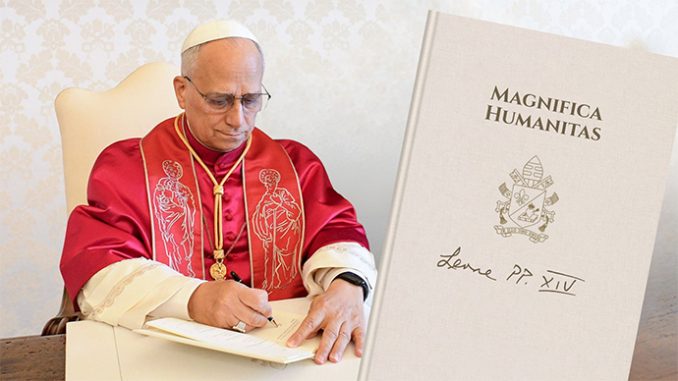
At least for me, Pope Leo XIV’s recent encyclical does little to resolve doubts about how Catholic social teaching should be interpreted and understood.
But I should explain my doubts.
In its modern form, social teaching started with concerns about workers’ problems in industrial society. Since then, its concerns have broadened enormously, and they now include the integral human development of everyone in the world, together with respect and protection for the natural setting on which human life depends.
The basis for doing so seems incontestable: man is a social being, and the point of social life is facilitating human goods. It follows that institutions that affect everyone should advance the common good, emphatically including the good of people who are in a weak position to advance their own interests.
But its extraordinarily broad scope means that it cannot tell us much that’s definite. Goods conflict, and our understanding of how to achieve and balance them is weak. So determining and advancing the common good involves a great many considerations that are ambiguous or point in different directions. Each of us has his own opinion, some better founded than others, but each is subject to legitimate objections.
Human ignorance and the uncertainties of life are not, of course, the only problems. People are often stupid, willful, perverse, or downright evil. And even if they are generally well-intentioned, their dealings with each other are often short-sighted and self-centered.
People usually view public authority as the remedy for these problems. What else can they look to? But government officials are unlikely to be much wiser and better than ordinary citizens. To make matters worse, those who maneuver themselves into positions of power are often much less so.
Even if officials are well-informed and well-intentioned, policies often defeat their purposes through mistakes in implementation or the assumptions—usually implicit—on which they are based. The art of politics is no more advanced today than medicine was in 1300. As such, it is no doubt better than nothing—a system of medicine based on Galen and Hippocrates is still widely practiced in India, and there must be some reason people still accept it. But caution seems called for.
These difficulties are intrinsic to human life. They advise us that while government is necessary and important, we shouldn’t expect too much of it, and should remember that political attempts to build utopia have repeatedly ended horrifically.
Under such circumstances, what can the Church teach people about politics and secular social life?
Actually, quite a lot. She can put them into perspective by reminding us of higher concerns, so that politics does not become our religion. She can promote caution by reminding us of human limitations and sinfulness. And she can remind us of the goals and principles that should order political discussion among people of goodwill and varying perspectives. To the extent she is courageous and maintains her independence of mind, she can also highlight gross errors and breaches of the common good like those that defined the great twentieth-century tyrannies.
These are big contributions, and political life needs all the help it can get. But social teaching cannot resolve many everyday political disputes, and it cannot attempt to do so without the Church being seen—often justifiably—as a partisan political player.
Even so, the Church makes strong claims for its social teaching: she has, we are told, the “right and duty to examine social realities, make pronouncements about them and indicate paths for finding just solutions.” There are a variety of reasons for that. One is the recollection of her political influence during the Middle Ages. The logic of that influence—the Church must somehow be politically supreme because she is the authority on ultimate goals and standards—maintains its hold even though its practical basis in an explicitly Catholic social order has vanished.
Another consideration is that a pope is also a man of his time. Like other people today, modern popes are often tempted to overestimate the ability of government policy—that is, action by political authority backed by organized force—to transform social life for the better. And like all of us, they have political opinions that to them seem unquestionable requirements of the public interest, but to other well-informed and well-intentioned people seem otherwise.
But if all that is so, it is natural for them to view their own strongly held political views as requirements of Catholic social teaching. Such views, therefore, tend to influence teaching documents. These can include dubious ones, like the view that the way to eradicate poverty is for state authority to mandate the sharing of wealth, and that wars are always at bottom about profit-seeking by business, notably the armaments industry.
The recent encyclical begins with a resume of Catholic social teaching as it has developed over the years. Since the topics dealt with are so comprehensive and complex, even a resume soon becomes a maze of distinctions and qualifications. And since the topics are so important, they prompt calls for decisive action that take them into account.
Indeed, so important are the topics that the current pope tends to put social teaching at the heart of the Faith. I commented recently on one comment that points that way, regarding the comparative importance of sexual morality and concerns like equality. The recent encyclical presents other examples, such as his statement that “the spirituality I wish to commend [which is apparently the same as his “Eucharistic spirituality”] is that of the ‘wise architect’ who, driven by hope for the Kingdom of God, is committed to building the world for the common good.”
The result of the complexity of the considerations and the urgency of what they demand is a discussion that emphatically asserts a variety of things that don’t sit easily together. He says, for example, that “building a city founded on the common good implies, first and foremost, building on a firm relationship with God.” But he also emphasizes “the autonomy of earthly realities,” dialogue with “all men and women of goodwill,” and contributing “to every initiative that builds a more just world”—which evidently includes the United Nations and comprehensive systems of regulation imposed by the governments that actually exist, none of which care much about God or even natural law.
All in all, he seems to call for a comprehensive regulatory order that brings the whole world in line with social teaching. That order will apparently be designed and run with the active participation of experts, who evidently know better than others what the situation demands. But it will also be designed and run with the full participation of people (the “excluded” and “marginalized”) who have no experience running anything on a large scale. And it will not inhibit anyone’s freedom and initiative.
The opening section adds to the puzzlement by contrasting the efforts the Pope approves with Babel, and identifying them with its opposite, the comparatively very limited attempt of Nehemiah to get the Jews returning to the Holy Land to rebuild the walls of Jerusalem so they can live securely in accordance with the national traditions they believe embody God’s special will for them. But what he approves seems to be, as a practical matter, an attempt to construct a secular utopia through collective effort led by secular institutions and their ideals, which sounds to some of us very Babel-like.
Nor is he tolerant of claims that social teaching is concerned with ultimate goals, and the realities of human life mean that what can reasonably be attempted will necessarily be much more limited, partial, and ambiguous. Although he insists on acceptance of human weakness, he also insists that “the civilization of love is no naïve utopia, but a demanding project.”
Magnifica Humanitas has eloquent passages, and many people have found it the font of wisdom it claims to be. Many of them no doubt see deeper than I do. With some, though, it may be that they let their own interpretive approaches do a lot of heavy lifting. That is not all bad: the encyclical raises issues that are important and rarely put so much in the spotlight, so we shouldn’t complain when people discuss them from their own point of view.
But much of it seems to me mechanical, contrived, and unpersuasive, so much so that apparently competent people have argued that some of it was almost surely AI-generated. However that may be, I cannot help but hope as a layman that our pastors reconsider at least their presentation of social teaching so that it becomes more comprehensible, both in itself and in relation to its proper function in social life and the total tradition of the Church.
If you value the news and views Catholic World Report provides, please consider donating to support our efforts. Your contribution will help us continue to make CWR available to all readers worldwide for free, without a subscription. Thank you for your generosity!
Click here for more information on donating to CWR. Click here to sign up for our newsletter.
Leave a Reply
You must be logged in to post a comment.