
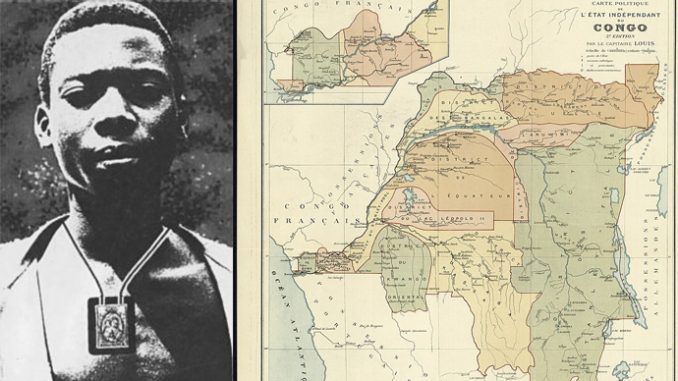
Although his name appears in the Roman Martyrology under the entries for August 15, the Carmelite family celebrates the martyrdom of Blessed Isidore Bakanja on August 12. Blessed Isidore was a young layman, not a Carmelite. It is unlikely that he even met a Carmelite in his short life.
So then why would the Carmelites promote the cause of a Congolese blessed?
To understand Isidore’s life, and especially his death, one must know a bit about the history of the Belgian Congo and the missionary activity within that region. By the time of Isidore’s birth in the mid 1880s (the exact date is unknown; some sources suggest 1885, others 1887, but these are guesses), the European powers had started their process of dividing up the territories of Africa between themselves through a system of colonization. The king of the small nation of Belgium, Leopold II, wanted in on the action. His eyes turned to the vast Congo River Basin in the heart of Africa, and he enlisted the aid of the Welsh journalist and explorer Henry Morton Stanley (of “Doctor Livingstone, I presume” fame) to establish trading posts and infrastructure within the vast territory.
Using his own fortune and an elaborate system of organizations with purported humanitarian aims, the King established a system of treaties between the native chiefs and his International Association of the Congo. Around the time of Blessed Isidore’s birth, in 1885, the international community recognized the so-called Congo Free State, a territory in the heart of Africa with an area of about 900,000 square miles—larger than Texas and Alaska combined. As head of the IAC, King Leopold was effectively sovereign of this new colonial state, roughly a quarter the size of the US.
Leopold spoke of humanitarian goals alongside his commercial and imperial interests in the region. He wanted profit, but he also wanted to bring “civilization” (at least as he understood it) to the region. And in his mind, that meant bringing Catholicism there. The more Belgian the Catholicism, the better, at least in his opinion. There were missionaries in the Congo region in the 1870’s and 1880’s (both Catholic and Protestant), but these came from France or congregations beyond Leopold’s sphere of influence. So the king conscripted an unlikely help to serve as missionaries in his program: a community of Belgian Trappists.
“Conscripted” is an intentional word. The Trappists of the Westmalle Abbey near Antwerp saw their vocation as one of contemplative prayer above all else. So when they politely refused, King Leopold went over their heads and appealed to Pope Leo XIII to order the Trappists to serve as missionaries in the Congo. Out of obedience to the pope, they finally went, establishing missions in several important commercial regions, including Mbandaka in northwestern Congo, where they established the parish of St Eugene in Bolokwa-Nsimba. They learned the dominant local languages and wrote catechisms that could be used to educate native catechists, who would then evangelize the others.
This is how Bl. Isidore became Catholic. His name at birth was Bakanja (though the name can be transcribed in various other spellings). Just shy of age twenty, he traveled the 60 miles from his native village of Bokendela to Mbandaka for work as a mason and construction worker. In the area around Mbandaka, he encountered the Trappist fathers, as well as one of their first local converts, the lay catechist, Boniface Bakutu. Soon, Bakanja was receiving instruction in the Catholic Faith and was baptized on May 6, 1906, with Boniface Bakutu as his sponsor. He was baptized with the name Isidore, perhaps in reference to his work as a laborer (though that is merely my personal conjecture). Confirmation and First Communion followed within fifteen months.
The Trappist missionaries were not seeking to make theologians. Their catechumens learned enough of the faith to receive the Sacraments, as well as basic prayers and Christian morality. The missionaries placed an emphasis on Catholic identity after conversion, and they stressed the Rosary and the brown scapular of Our Lady of Mount Carmel. We have some of the teaching material used shortly after Isidore’s catechetical period that used a very straightforward analogy:
A soldier can be recognized by his uniform. A policeman can be recognized by his uniform. How can you recognize a Christian? By the scapular and rosary worn around his neck. The lesson then teaches that Christians should not be ashamed to show that they are Christians, identifying God as their Father and Mary as their Mother.
Although we cannot know whether Isidore heard teaching like this catechism lesson, his subsequent behavior shows that he had absorbed precisely this understanding of the rosary and scapular. He was enrolled in the Confraternity of the Brown Scapular and wore it constantly.
Sometime around the year 1908, Isidore left the profession of construction worker and entered the service of one Monsieur Reynders as a domestic. Reynders was an agent in one of the companies attempting to gather resources from the Congo Free State and bring them to European markets, the Société Anonyme Belge pour le Commerce du Haut-Congo (SAB). For an American reader, a rough analogy might be the company towns of Appalachian coal country, although colonial Congo allowed considerably greater coercion and violence. The Congolese provided the labor, collecting rubber, ivory, and other raw materials, and brought them (often under the threat of force) to various factories—not factories in the English sense, but trading posts where the raw materials would be tallied and sent down the river.
Isidore’s employer was reassigned to one such factory called Ikili. The head of the SAB at this post was a man named Henri Van Cauter. “Van Cauter was notoriously hostile to the missionaries and regarded their influence as a threat to company discipline. He turned the nickname the Congolese had for the priests, Mamperes (derived from the French mon père), into a term of derision. Even though Van Cauter was not Isidore’s direct superior, as the superior over Isidore’s employer, he had ultimate control of Ikili.
Isidore had all the fervor of a new convert, speaking to the other Congolese in Ikili about his Savior, teaching them prayers, and instructing them in the Catholic Faith. He wore his scapular and prayed his rosary publicly. Van Cauter could not stand this. He viewed missionary activity as at odds with the commercial ends of the SAB. A workforce of Christians like Isidore Bakanja were preaching and praying all the time. Further, the Mamperes defended the rights of the Congolese against the strong-arm policies that the European companies often enforced.
Van Cauter repeatedly ordered Isidore to stop his public practice of Christianity and remove his scapular. When Isidore refused, Van Cauter had him flogged. Later, he caught Isidore praying during a rest period and flew into another rage. This time, he ordered a catastrophic beating with a chicotte, a whip made from hippopotamus hide. Some accounts say that the particular chicotte used against Isidore had nails embedded in it. Regardless, the punishment tore open Isidore’s back and left him grievously wounded. This sequence of events occurred in the spring of 1909.
After the beating, Isidore was chained and confined. Eventually, another company official, Dörpinghaus, discovered his appalling condition and arranged for medical treatment, but the wounds had already begun to putrefy. He knew he was going to die, and he asked a message to be brought to his parents: “Tell them that I am dying because I am a Christian.” In late July, two traveling Trappist priests reached him and were able to administer last rites. One of the priests asked him if he forgave Van Cauter. Isidore said not only that he had forgiven him but also, “I shall pray for him. When I am in heaven, I shall pray for him very much.”
After months of pain, he died from the infection on August 15, 1909. The best estimates put him at about 24 years old at his death, at most.
Within four years after his death, Church officials were already collecting testimonies from eyewitnesses about Isidore Bakanja’s life and death. But the cause stalled for political reasons amid Belgian opposition—unsurprisingly, given the damaging light the testimony cast on colonial labor practices. The Belgian Congo was given its independence in 1960, and in 1976, the Church of Zaire (as the nation was known at the time) again opened Isidore’s cause of canonization. It was the lay faithful, especially, who called for a reexamination of Isidore’s cause.
The new investigation established that Isidore died in odium fidei, or to paraphrase his own words, because he was a Christian. Thus, John Paul II beatified him as a martyr on April 24, 1994, while a special Synod of the African Bishops was meeting with him in Rome. All the popes since have spoken highly of Blessed Isidore Bakanja’s witness. All who know his story pray for a miracle to be recognized through his intercession to clear the way for his canonization.
Blessed Isidore Bakanja is sometimes referred to as the “martyr of the Brown Scapular.” Anyone who wears the Brown Scapular is, in one way or another, associated with the Carmelite order. Isidore’s profound witness as an enrolled member of the Scapular Confraternity led to the Carmelites supporting his cause, with his postulator still coming from the Carmelites. His life and his death are a powerful statement of what sacramentals such as the scapular really are. They are not good luck charms or magic amulets. Rather, they are physical reminders of who we are in Jesus Christ, as well as a reminder that, in some way, an outside observer should be able to tell by looking at us that we are in the service of Jesus Christ.
As important as the scapular was for Isidore, it is an emblem of what was most important to him in his life: his relationship to Christ and His Church. He was so moved by his relationship with Jesus that he wanted to call everyone around him to that same joy he had found. He would not abandon his faith, even when threatened, but he also was among the blessed persecuted spoken of in the Beatitudes, loving and forgiving even the man who ordered the beating that caused his death.
May all of us, young or old, give such a fervent witness to Our Lord.
If you value the news and views Catholic World Report provides, please consider donating to support our efforts. Your contribution will help us continue to make CWR available to all readers worldwide for free, without a subscription. Thank you for your generosity!
Click here for more information on donating to CWR. Click here to sign up for our newsletter.
Leave a Reply
You must be logged in to post a comment.