
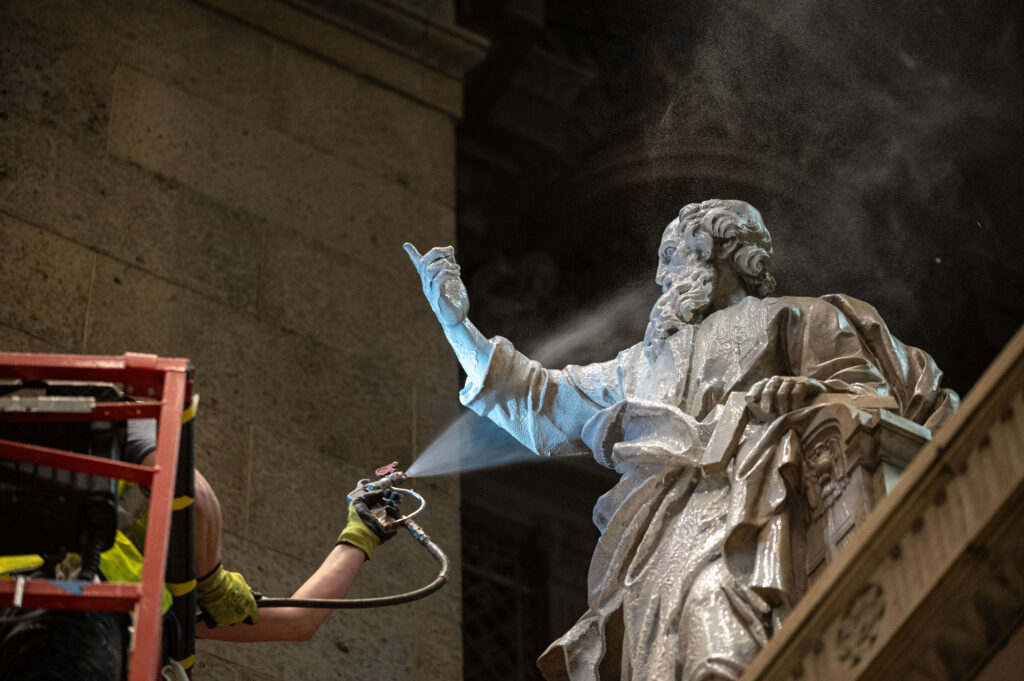
If you want to clean more-than-century-old marble statues of the apostles, you don’t simply use soap and water.
Rather, you must spray the figures with a “specialized conservation material” that subsequently dries into a “latex-like layer,” which is then “carefully peeled away,” thus preserving the statue’s original finish.
The process “is labor intensive and takes significant time,” according to staff at the Basilica of Saint Mary, a towering and historic minor basilica in downtown Minneapolis.
The massive church, which was dedicated in 1915 and became the first basilica in the United States when it was designated as such by Pope Pius XI in 1926, has been undergoing a major restoration project since 2025.
Built in the Beaux-Arts style — what was at the time a popular architectural form in the United States — the co-cathedral boasts a towering flèche-topped central dome and an 82-foot-high barrel vault.
Among its many adornments include the statues of the apostles, which were carved in Italy as half-scale replicas of statues at the Archbasilica of St. John Lateran, the cathedral of the pope in Rome.
Church’s roots stretch back to 1860s
On its website, the basilica says its roots can be traced to 1868, when a simple “shed church” was constructed in Minneapolis. Years later another, more substantial Gothic Revival edifice was built, but burgeoning development in the neighborhood eventually pushed the parish to relocate to its present location on Hennepin Avenue. The cornerstone of the current structure was laid in 1908.
The church, designated a pro-cathedral, celebrated its first Mass in 1914; it was dedicated the following year. It was still being worked on when the U.S. entered World War I in 1917.
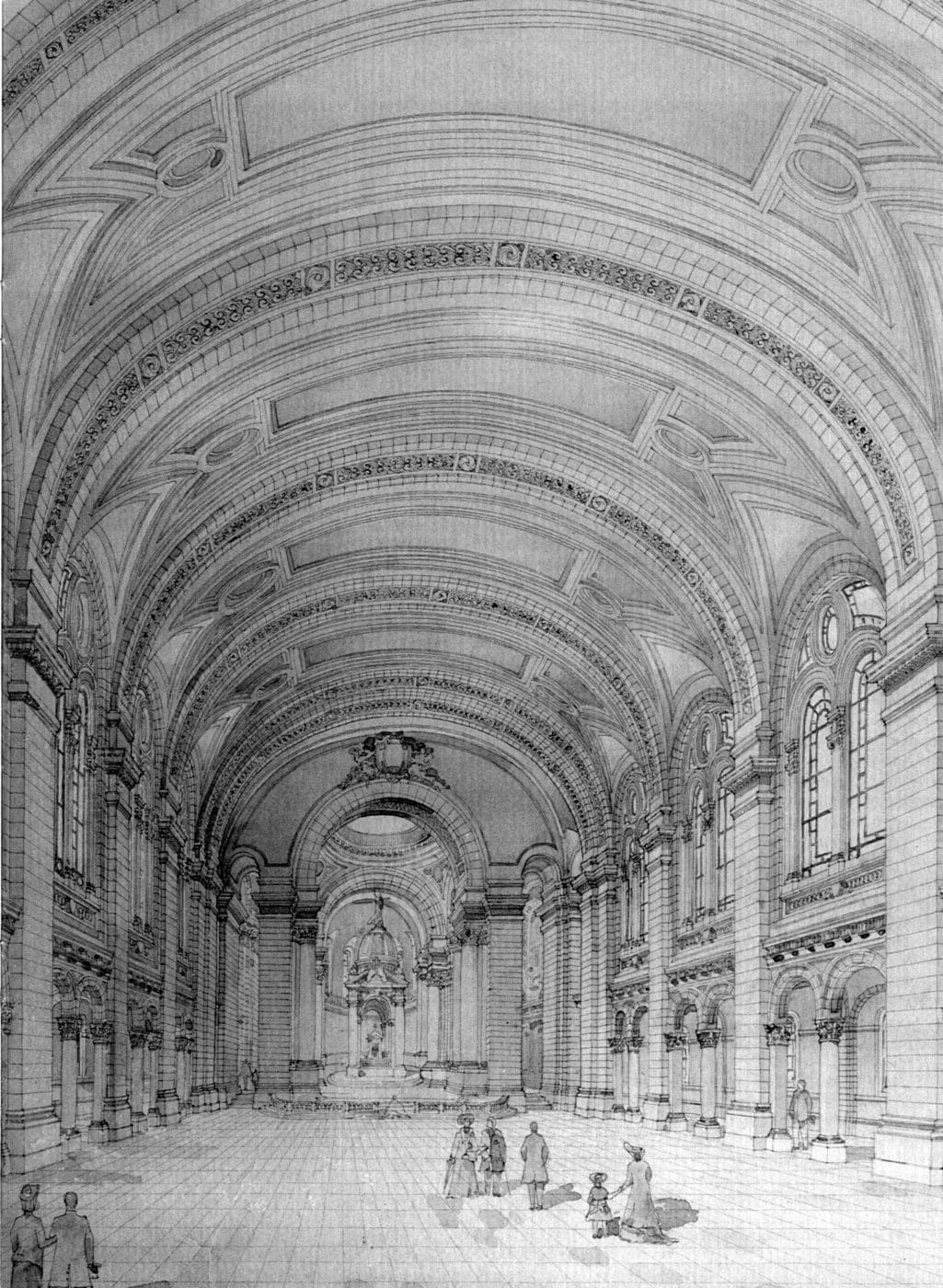
In 1926, Pius XI raised the pro-cathedral to the rank of minor basilica, after which it took on its present name. It would enjoy a vibrant parish life in the following decades, though the construction of adjacent freeways in the 1960s “took a heavy toll” on the building.
The 1980s and 1990s saw parishioners spearheading efforts at ongoing restoration. The latest restoration campaign, titled “Restoring Beauty, Inspiring Hope,” has aimed to raise a total of about $50 million in funding.
Among the project’s goals are masonry repairs, roof repairs, pew restorations with new kneelers, plaster restoration, and numerous other projects.
Johan van Parys, who has served as the basilica’s director of liturgy and the sacred arts since 1995, told EWTN News that the basilica has needed repairs almost from its inception.
“Even from the beginning, the building had issues with moisture intrusion,” he said. The architect who designed the church, Emmanuel Louis Masqueray, was French, and he “didn’t completely understand the challenges of Minnesota summers and winters.”
“He designed flat roofs over part of the building,” van Parys said. He jokingly described flat roofs as “the bane of our existence” due to their tendency to hold water. In existing photographs of the church taken in 1914, van Parys said, water damage is already visible.
“We’ve had to do work on the building ever since,” he said.
The church underwent a “somewhat major” restoration in the 1950s, van Parys said, during which for unknown reasons workers painted over intricate stenciling within coffers and other parts of the structure.
Along with those details, van Parys said, the restoration effort is “bringing back the original look of the basilica.”
The effort was formally launched in 2019 with a master plan for the entire church campus, but the COVID-19 pandemic the next year set the project back. The process resumed after a few years, and the restoration work itself formally began in 2025.
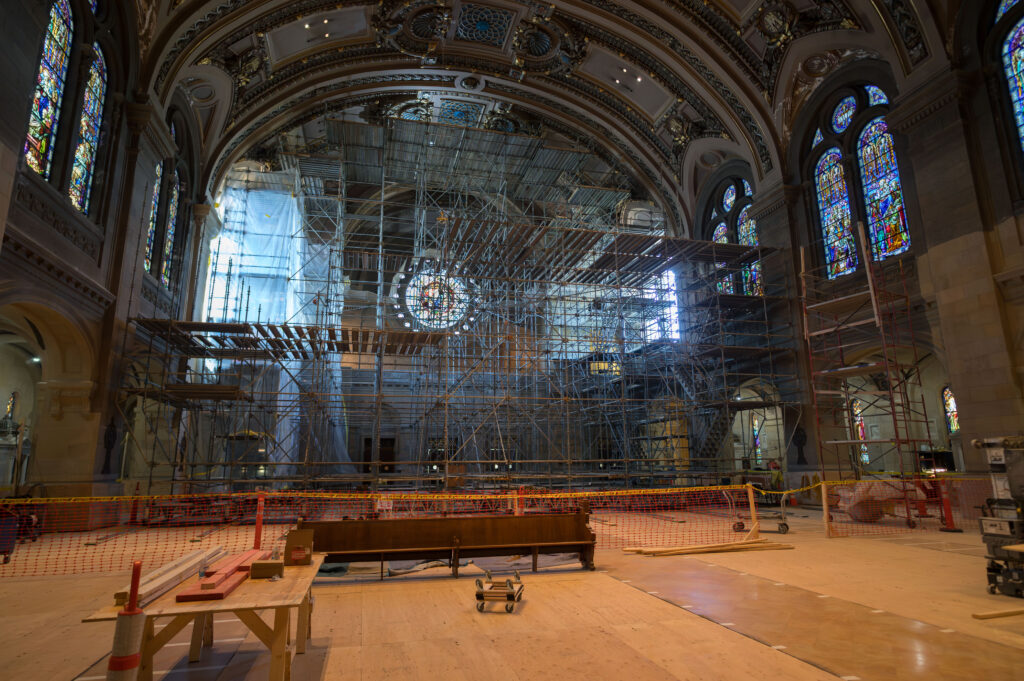
Van Parys said the basilica is being restored both inside and out from top to the bottom, including the plaster ceiling, which has suffered damage over the years and has to be replastered in parts.
Work is also being done on the church’s extensive stained-glass window arrangements. Such windows are generally held in place with a lead matrix, but over time the weight of the glass can weaken the metal frame, leading the glass to bulge outward.
A stained-glass specialist, however, told the restoration crew that the window fixtures were in “great condition,” meaning considerable amounts of work could be avoided. Some of the windows were still in need of repair, however, and were sent to a specialist in Newark, New Jersey.
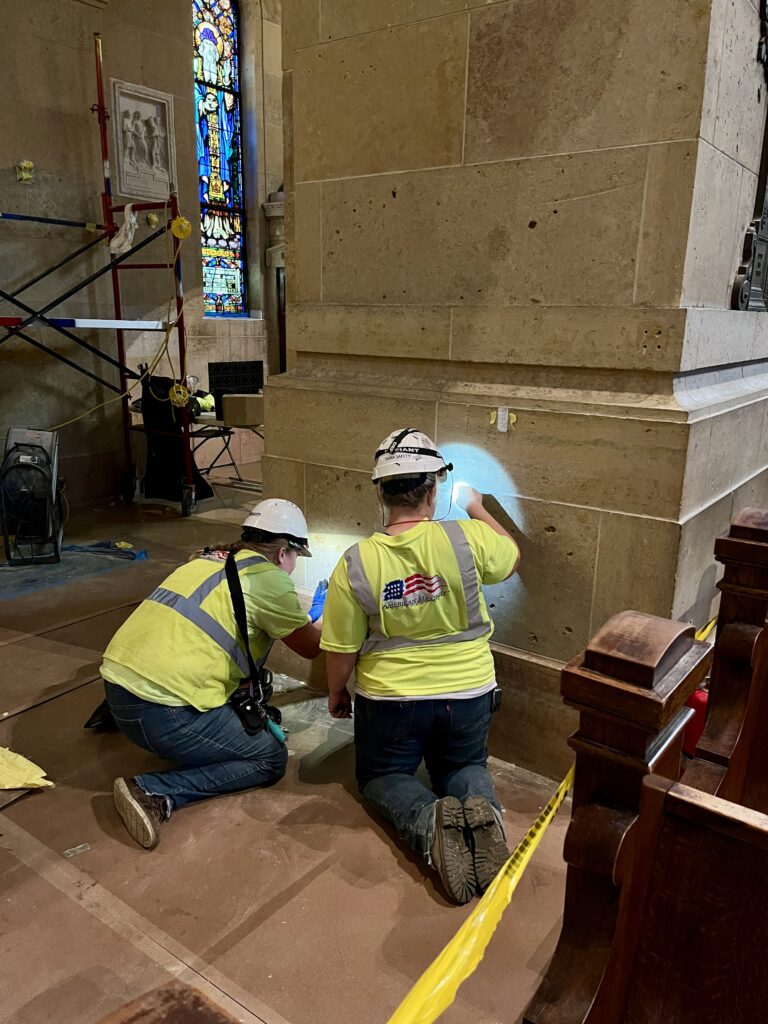
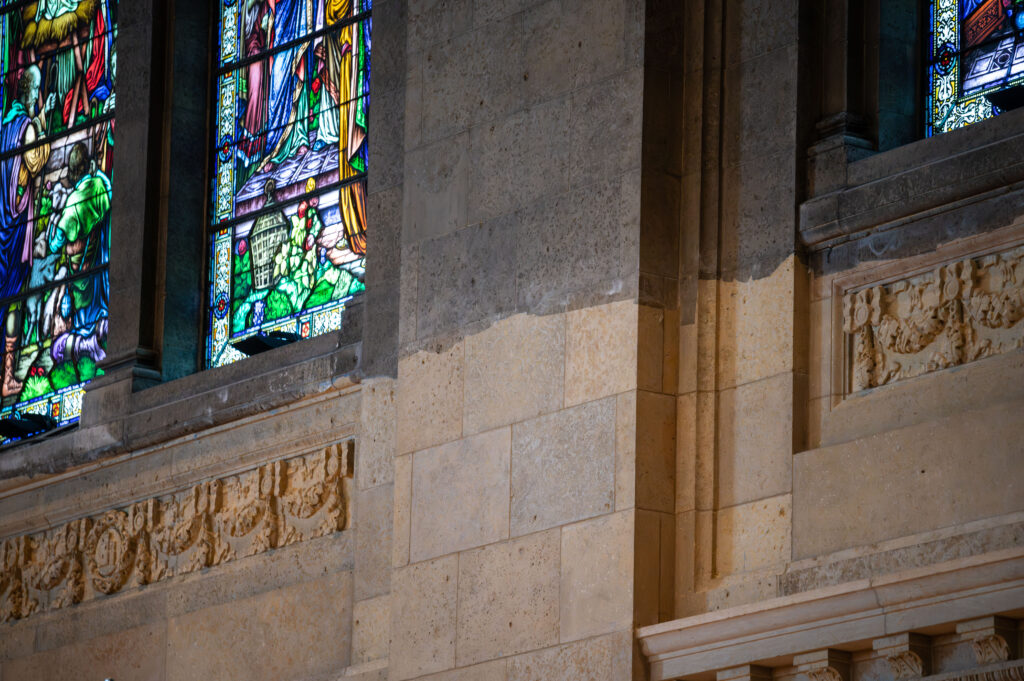
Limestone throughout the building is also being restored, van Parys said. The visible stone throughout the building is bolstered by several inches of reinforced concrete and bricks; moisture often makes its way through this sandwiching of materials, leading to a buildup of salt crystals on the stone, what is known as “efflorescence.”
Removing this blemish beautifies the facade of the stone and also protects it from degradation. Crews use a spray-and-peel chemical similar to the process used on the statues of the apostles.
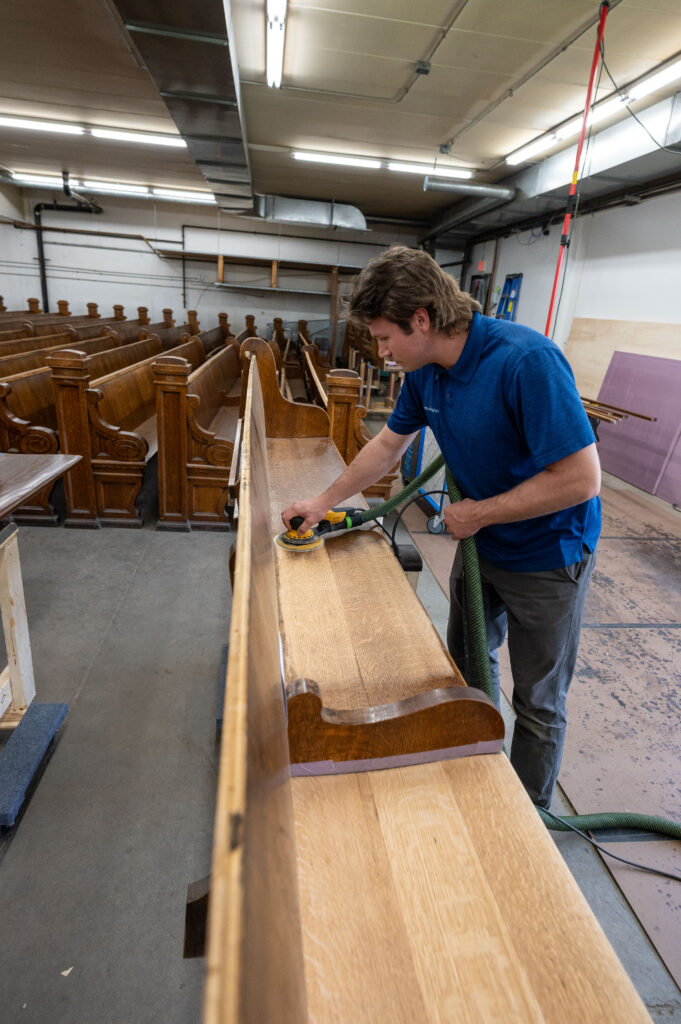
The restoration crews also removed the basilica’s pews in order to have them restored with cleaning, sanding, and shellac finishing.
“We opted to restore the original 1914 pews,” van Parys said. “One of our principles in terms of restoration is that we don’t want to over-restore. We didn’t want it to be a new church. People have worshipped in here since 1914. We want this presence of prayer and generations before us to remain.”
“So rather than have new pews we decided to restore the old ones,” he said. “In doing so we discovered that the people who built the pews in 1914 signed them. So we have the names of all the people who worked on the pews.”
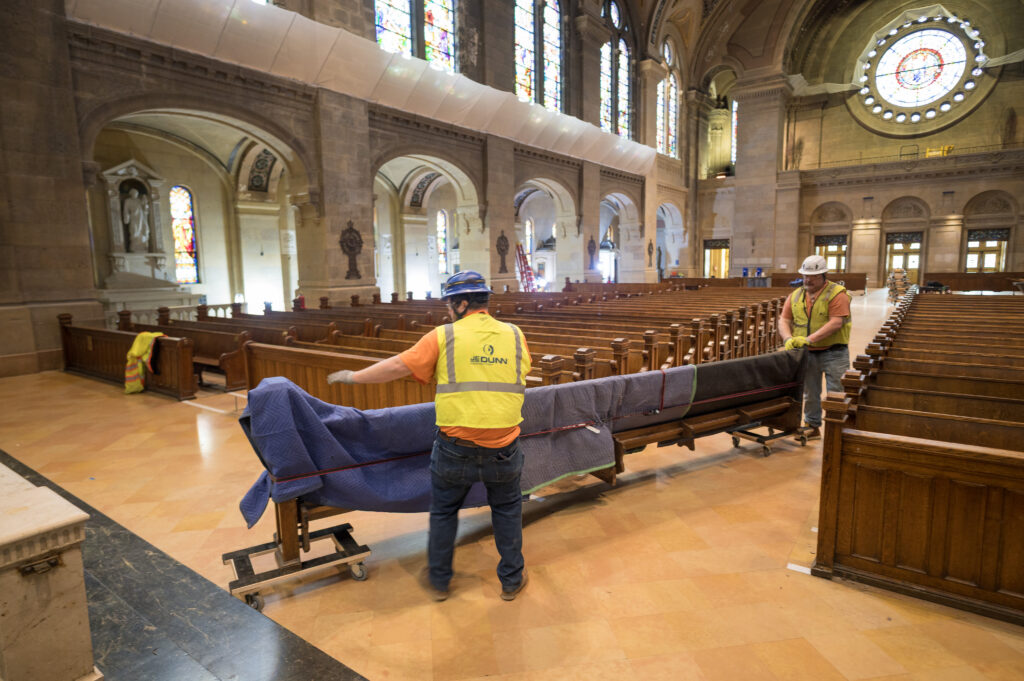
Upon removing the pews, the work crews discovered that the flooring of the nave was not level. “One option was to put shims under all the pews,” van Parys said. “But that would have been a huge operation.”
Since crews were already removing the wood flooring to restore it, they also removed part of the old concrete subfloor and re-leveled it.
Numerous other restoration projects are ongoing, van Parys said, including restoring the church’s bronze doors, which were installed after it was designated a basilica. The church’s rector at the time, Monsignor James Reardon, had traveled to Rome and observed that the basilicas there had bronze doors. “He decided we needed bronze doors as well,” van Parys said.
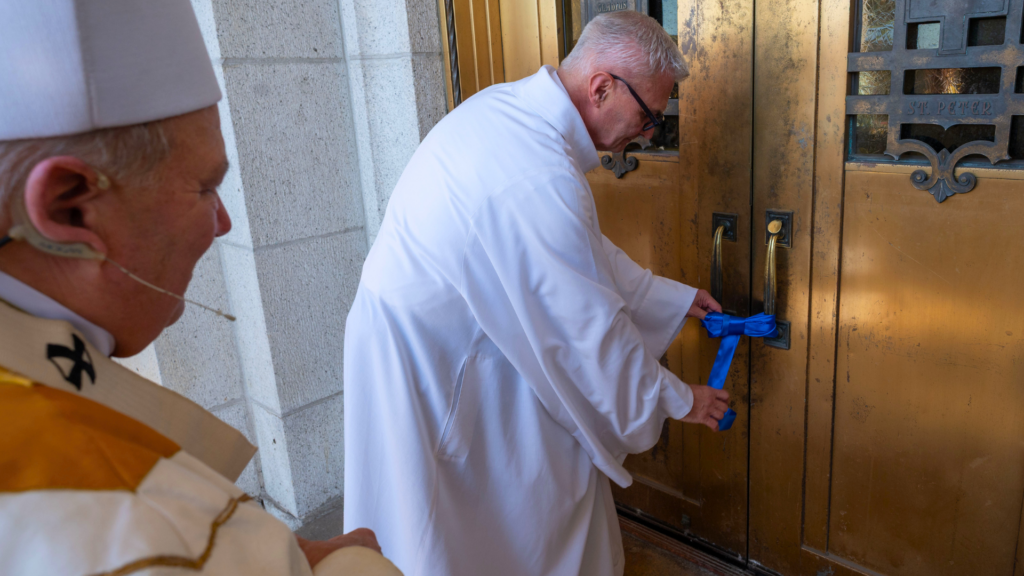
Crews are aiming to be done with the massive project by Palm Sunday 2027. At the moment the parish holds Masses in the building’s undercroft beneath the structure.
“Every week at Mass, I tell people, for instance, ‘Last Sunday was Week 35, which means we have 34 weeks to go,’” van Parys said with a laugh.
He said the work is “quite expedited” and progressing quickly. Ultimately the effort is meant not just to restore the church but to develop a “manual of preservation” for future generations to help protect it.
“Our goal is to restore and to also make sure that everything is cared for in the best possible way, to extend the lifespan of the basilica as long as possible before another restoration is necessary,” he said.
He said the entire project is being conducted “not only with liturgical principles but also historical preservation principles.”
“It is really comprehensive,” he said. “Every square inch of the basilica will be restored.”
Leave a Reply
You must be logged in to post a comment.