
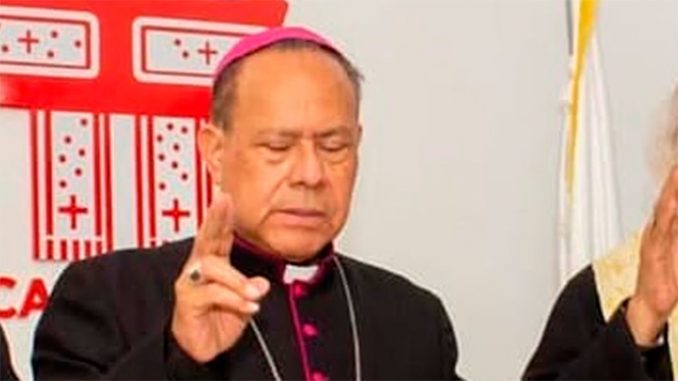
“The forced disappearance of Bishop Juan Abelardo Mata is a serious matter; this constitutes a crime against humanity committed by agents of the Ortega-Murillo dictatorship. He has been missing for 19 days, and the co-dictators have not made any further statements on the matter,” Molina told ACI Prensa, the Spanish-language sister service of EWTN News, on July 18.
“It’s the dictatorship’s practice to inflict the greatest possible harm on priests,” the researcher warned.
“No one in his circle has any news of him, and concern among the laity and the Catholic Church in general is even greater due to the medical conditions he suffers from, conditions that are almost certainly not being treated properly.”
Mata, bishop emeritus of Estelí, Nicaragua, was detained by police on two occasions in late June after praying for the persecuted Church in Nicaragua during a Mass he celebrated on Sunday, June 28.
His whereabouts are unknown, although the dictatorship has stated that he is at home.
The bishops of Central America have called on the regime to allow him to be seen by a doctor, and other notable individuals have expressed concern for the 80-year-old bishop, who suffers from diabetes and vision problems and uses a pacemaker for a heart condition.
Extreme concern over Mata’s disappearance
“Family members, priests, human rights organizations, and the international community including the U.S. State Department and the bishops of Central America, are demanding immediate proof that Bishop Abelardo Mata is alive and a clear response from the regime of Daniel Ortega and Rosario Murillo,” Father Edwing Román, parochial vicar of St. Agatha Parish in Miami, Florida, told ACI Prensa on July 18.
“So far, there has been only official silence and contradictions in an irrelevant statement. We fear for his life; he cannot be yet another victim of a dictatorship that has wreaked havoc on the Nicaraguan people,” Román, who has been living in exile for several years.
On July 4, the Nicaraguan government, through the Ministry of the Interior, issued a statement indicating that Mata had been subjected to a “necessary inquiry regarding the origin of properties and family ties inconsistent with his status as a priest” and that, following this, he “has returned to his home, where he remains in perfect condition.” The text does not specify which properties or ties are being referred to.
Another exiled Nicaraguan priest, who prefers to remain anonymous to avoid reprisals from the regime, told ACI Prensa on July 18 “It is unknown why the dictatorship is so intent on targeting an 80-year-old man. What are they afraid of?”
“Hopefully, the Holy Father will speak up and ask the Nicaraguan government to show signs that he is well, alive, and at peace; that his relatives can visit him without any worry; and that he is in good health and well cared for. That’s what we hope for,” he added.
The Church’s ‘last courageous voice’ in Nicaragua
“Bishop Mata is the last courageous voice of the Church remaining in Nicaragua and that is unafraid of the regime,” Arturo McFields, Nicaragua’s former ambassador to the Organization of American States (OAS), told ACI Prensa on July 18.
“They fear him because he doesn’t fear them. He is an 80-year-old man of God who is not afraid of a cowardly regime and is prepared to face the ultimate consequences,” he added.
“What’s important now is to call for his freedom and protect him in some way not only through the Catholic Church but also by engaging other governments, such as that of the United States, one of the voices the dictatorship fears,” McFields emphasized.
Who is Bishop Juan Abelardo Mata?
The prelate is the bishop emeritus of Estelí, Nicaragua, a diocese he led for over 30 years, from 1990 to 2021, when Pope Francis accepted his resignation upon his reaching the age of 75, the retirement age for bishops.
Mata, who recently turned 80, was born on June 23, 1946. He made his profession as a Salesian in 1966 and was ordained a priest in 1976. In 1988, he was appointed auxiliary bishop of Managua, a position he held until his appointment as bishop of Estelí.
Various notable Nicaraguans agree that Mata is a courageous, beloved, and credible voice in Nicaragua, which is why the dictatorship has it out for him.
A staunch defender of human rights
“Bishop Mata has always been a staunch defender of human rights, both as a priest and a pastor. He has always been active in the country’s public life not only through his interventions and statements but also through his practice of charity and social commitment,” another exiled Nicaraguan priest, who asked to remain anonymous to avoid reprisals, told ACI Prensa on July 18.
This “gives him the moral authority to shed light on the country’s political and social life through his statements. And for a long time, he was a big critic of the government” though he subsequently kept a low profile following his resignation in 2021, only to return to the public stage recently.
“Offering a prayer in Nicaragua for those who have left the country is an act that offends the government and is punishable by imprisonment. Every priest in the country knows this; the bishop knew it too, and he knew it could have consequences,” the priest added.
‘Nicaragua is a prison for priests’
“No one is safe there. Nicaragua is a prison for priests. They have certain freedoms, but they cannot freely exercise their ministry,” the priest warned.
“Any priest in the country, even those who believe they are very close to the dictatorship, could be detained at any moment. Anyone in Nicaragua,” he stated, “can be subjected to violence.”
This story was first published by ACI Prensa, the Spanish-language sister service of EWTN News. It has been translated and adapted by EWTN News English.
If you value the news and views Catholic World Report provides, please consider donating to support our efforts. Your contribution will help us continue to make CWR available to all readers worldwide for free, without a subscription. Thank you for your generosity!
Click here for more information on donating to CWR. Click here to sign up for our newsletter.
Leave a Reply
You must be logged in to post a comment.