
John A. Cuddeback, Ph.D., has been a professor of philosophy at Christendom College for thirty years. He lectures and writes on how to live the good life today, on topics including virtue, fatherhood, friendship, and the household.
His first book was True Friendship: Where Virtue Becomes Happiness (Ignatius Press, 2021. His work at LifeCraft is renowned for applying timeless wisdom to life today.
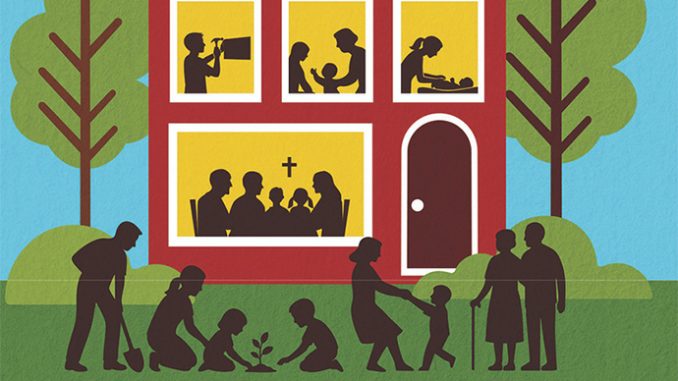
His latest book is The Intentional Household: Living as if People Matter (Ignatius Press, 2026). Here, Cuddeback invokes timeless wisdom to breathe new life into our homes, giving direction about how we can craft the shared life we naturally crave for ourselves and our loved ones. Taking as his starting point the fact that our souls were made for a living community at every phase of life, and that the household is the primary and foundational community, Cuddeback explains why it is important to live intentionally, and how we can do that. This helps not only our own lives at home, but ripples out to affect society as well.
Cuddeback recently spoke with the Catholic World Report about his latest book, the importance of living intentionally, and why our households are so important in our lives and society at large.
Catholic World Report: How did your new book come about?
Dr. John Cuddeback: I have been thinking about and teaching these things for years. But I was especially moved by two things I’ve seen: something bad, and something good.
The bad is how our culture makes it so difficult for people to make their homes what they should be. God’s design for homelife is truly astounding. And our culture works against it in many ways—not least of all by undervaluing homelife and consistently pulling us (all age groups) away from it. So many wonderful, life-giving activities that used to grace our homes are scarce to be seen anymore.
The good—which is truly remarkable—is how a growing number of people know they want something different, something better. But they often find themselves unsure about how to do it and where to turn.
I wrote this book especially with them in mind.
CWR: Why should we reevaluate homelife? And the role of the household? Why now?
Cuddeback: Two reasons: first, it’s at the very center and foundation of God’s plan for human happiness; second, it’s the central issue of our age. I’m convinced that becoming intentional about life in our homes is the key to the New Evangelization, as well as to a deeper conversion and renewal in the life of Christians.
The book offers eight straightforward yet very rich principles for renewing our homes. I explain key terms and distinctions, and I clarify implications and applications using examples. Two key principles concern work and leisure; by a natural design, these have been and should be again the backbone of a rich home life. But good work and true leisure have become extremely rare—in the very place that should be their most obvious and natural context.
CWR: Can the way a society values homelife affect relationships throughout that society? In other words, can this have an effect on friendships, business relationships, the way we treat strangers, the way charities operate, any number of other things?
Cuddeback: Absolutely. For instance, the second of the eight principles in the book is about the crisis of responsibility in our society. I trace this crisis, as well as our addressing of it, to whether we really take responsibility for life in the home.
Similarly, home is where we form habits that make friendship possible, or nearly impossible. Household is also the true home of hospitality and charity, as well as of working, or doing ‘business,’ in a truly human way.
CWR: I’m particularly intrigued by the book’s focus on intentionality in homelife. And intentionality is something that is missing in different areas of our lives these days. Why is it so important to do things intentionally?
Cuddeback: The term comes from a foundational act of the will—when we set our will on some end to be achieved. Intention of various ends is the root of all human actions. It becomes especially crucial in any area of life that requires particular focus. Today, more than ever, we need to be intentional about primary human goods precisely because so many forces in our society are working against them.
In any age, yet especially ours, a flourishing household will be the fruit of a very intentional crafting. But to be intentional, we need to have a clear notion of ends and means to them. The eight principles of this book clarify the main principles of God’s amazing design, written into human nature, for flourishing households.
It also offers concrete examples and suggestions for how to apply them in our challenging times. My goal is to inspire intentionality and give encouragement and direction for enacting it.
CWR: The book addresses many spheres of homelife–responsibility, leisure, technology, sexuality, and raising children. How do we harmonize all these different areas so that our homes and our families function as God intends?
Cuddeback: Great question! Such harmonizing is the fruit of our intentionality, empowered by prayer, and enacted through persevering efforts that require taking counsel with others, and ongoing trial and error.
But it is precisely this that draws us together as spouses and as families and as friends. This is what we are about; we were made for this. The fact that it is very arduous is part of the plan. It teaches us humility and keeps us on our knees as it brings us together with our loved ones. And though it doesn’t always seem this way, the fruits of our efforts will be amazing.
CWR: Of course, this book is not a secular, psychological exploration of the home, but a deeply Catholic one. Considering that, do you have particular patron saints whose intercession or examples you seek and follow when it comes to homelife?
Cuddeback: St. Joseph is always my go-to patron. He was entrusted with first responsibility for the most amazing household ever to exist. He must have felt overwhelmed at times, but he did not shrink from such a profound responsibility. I love to meditate on how he might have thought about and addressed various problems—such as the countless challenges of taking his household to Egypt. The household is an amazingly resilient reality, the more so as we follow God’s plan and trust in His grace.
St. John Paul II is another special patron. He was so profoundly alive and so appreciated the rich, simple aspects of human life. He loved families and has written some beautiful things for our encouragement and direction. And, he always maintained true hope even while being fully cognizant that we are living in a ‘culture of death.’ Like him, we should ‘be not afraid’ even as we strive to have a clear vision of the challenges we face.
CWR: Is this book only for Catholics, or can non-Catholics benefit from it as well?
Cuddeback: I wrote this book for everyone, and I really mean that. I am a philosopher. St. Thomas Aquinas, one of the Church’s greatest theologians, says that philosophy is especially important in how it clarifies key truths by the light of natural reason, which is available to everyone. Throughout the book, I refer to a constellation of thinkers, including pre-Christian philosophers, who give witness to the perennial truths of God’s plan written into human nature.
Catholics find this approach particularly encouraging and enriching—giving them confidence that our faith is well grounded in human nature. It is crucial, again, especially today, to use our minds to have a clear understanding of basic principles. For this reason, the book is also very appealing to non-Catholics and non-Christians; it speaks to something deep in all our hearts. The transcendent importance and universal applicability of the principles in this book mean it serves both those who already know they want something more in homelife, and those who need some convincing.
CWR: What do you hope readers will take away from the book?
Cuddeback: My sincere hope is that readers will be surprised by joy. They will find themselves realizing that there is something wonderful we have been missing—even many of us who have already been intentional. As their intellect is nourished, their heart will be moved, and they will have a new confidence that they can rediscover their own inheritance and craft something truly astounding.
From wherever we stand, we can get started on this epic journey.
CWR: Is there anything else you would like to add?
Cuddeback: Yes, a word of encouragement. Everyone has a part in this all-important project of re-vitalizing our homes: the young, the old, and the in-between; the married, unmarried, and formerly married. Even if we have a household of one or two, what we do in our homes will have repercussions far beyond our own walls.
Further, much of what we need to rediscover was once and can again become ‘ordinary.’ History is on our side. It will take intentionality and trust in God, but by His grace, this is very much in our power. I sincerely hope this book will prove a significant encouragement and aid to many. And God will bless our efforts with fruits far beyond our imagining.
For everything we do in our homes will echo in the halls of God’s own home, forever.
If you value the news and views Catholic World Report provides, please consider donating to support our efforts. Your contribution will help us continue to make CWR available to all readers worldwide for free, without a subscription. Thank you for your generosity!
Click here for more information on donating to CWR. Click here to sign up for our newsletter.
Leave a Reply
You must be logged in to post a comment.