
One of the striking lessons of the past century is that movements seeking to transform society eventually turn their attention to education. Political victories can be reversed, laws repealed, elections lost. But shape the imagination of children, and the future would largely take care of itself.
Education is always, whether consciously or not, an effort to answer deeper questions: What is a human being? What is freedom for? What kind of person should a child become? When education is built on faulty presuppositions about foundational questions, no amount of innovation can fully compensate.
Imagine a greenhouse whose plants are yellowing, brittle, and failing to bear fruit. The gardeners respond by installing sophisticated irrigation systems, monitoring sun exposure and temperature, and hiring consultants. Yet the plants continue to decline. Eventually, someone might wonder whether something more fundamental is amiss. Perhaps the soil should be examined. In what are these plants rooted?
In the ecosystem of education, many have spent decades focused on almost anything except the soil. They’ve launched anti-bullying campaigns, rolled out innovations in phonics and math, distributed laptops to every child, hired more counselors and therapists, redesigned testing standards, and made a curriculum out of social-emotional learning. Each initiative promised to address a real need.
Yet the larger trajectory remains troubling. Students and young adults report far higher rates of mental illness and loneliness than previous generations. Marriage, family formation, religious participation, and civic trust have long been in decline. Political disagreements increasingly fracture friendships and families. And whatever else we may say about the modern educational project, it is difficult to argue that it has succeeded as such. Literacy remains abysmal, with roughly seven in ten students failing to reach reading proficiency. Despite unprecedented spending, interventions, administrative expansion, and technological innovation, many students leave school lacking both the intellectual formation and practical competencies that previous generations took for granted.
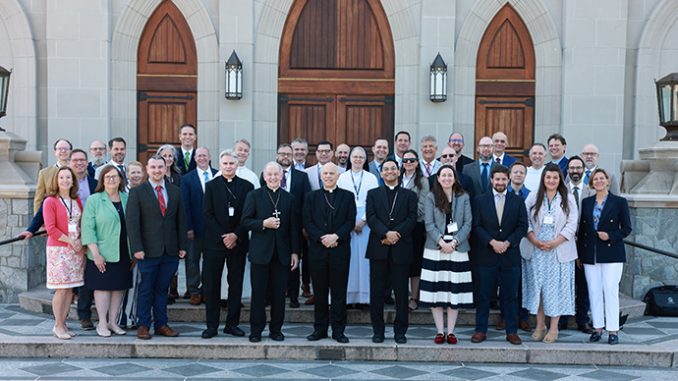
In other words, the education system is struggling not only on its own terms, but on nearly every measure of human flourishing beyond them. A desire to get to the root of this crisis—to address the soil—lay at the heart of the inaugural Front Royal Education Summit at Christendom College, which I was glad to attend. There, bishops, priests, scholars, educators, superintendents, and strategic partners gathered to consider the future of Catholic education. The Front Royal Statement, which is the fruit of the summit, argues that contemporary education, including much of Catholic education, has increasingly been shaped by individualistic, therapeutic, utilitarian, and secular understandings of the human person. The Church’s educational tradition does not merely offer a critique of this crisis; it offers the answer.
The history of Catholic education has periodically been shaped by defining moments that sought to respond to the pressing needs of the age. The Third Plenary Council of Baltimore in 1884 launched one of the most ambitious educational projects in American history, recognizing that ideas require institutions capable of transmitting them. Nearly a century later, the Land O’ Lakes Statement reshaped the course of Catholic higher education, emphasizing autonomy and engagement with the modern academy.
The Front Royal Statement asks a more fundamental question in response to a fundamental crisis: What is a human being, and what is education for? As Bishop Daly observed in his preamble:
Today, we face a different but equally grave crisis: soaring rates of disaffiliation among young Catholics, driven by a culture of skepticism and materialism that undermines faith and the Church’s moral teachings.
He lists several telling metrics over recent decades, including an average of 100 schools closing annually and only 6,000 remaining Catholic schools, serving fewer than 1.7 million students, despite significant growth in the overall Catholic population. Yet the urgency of this moment is not merely institutional. Catholic education remains uniquely positioned to form what he calls a “sacramental imagination,” helping young people understand themselves, their world, and their ultimate purpose in the light of truth.
For decades, too many Catholic institutions attempted to harmonize competing visions of the human person: one rooted in truth, virtue, inheritance, and man’s ultimate end in God; the other rooted in utility, self-construction, and expressive individualism. These two visions are not different emphases within a shared framework; they are rival anthropologies.
One vision sees the child as a person endowed with reason, capable of growing in virtue, created for truth, and born into an inheritance he is called to receive, steward, and pass on. Education, in this view, is most fundamentally about formation. It aims to cultivate wisdom, character, reverence, gratitude, and self-government.
The competing vision sees the child primarily as a self-constructing psychological subject whose identity emerges through self-expression, emotional validation, and liberation from social norms. The role of the educator then becomes that of the facilitator of the child’s self-creation.
This is why educational debates often feel much larger than disputes over curriculum. For much of the twentieth century, schools increasingly adopted this therapeutic model of the person. More recently, that therapeutic model fused with a political one. The results are students encouraged to meticulously monitor their emotional states and to interpret their lives through categories of identity, privilege, oppression, and grievance.
Human beings tend to become what they habitually attend to. A culture that trains children to focus mostly on obligations will produce different adults than one that trains them to focus primarily on injuries. A culture that directs attention toward gratitude, responsibility, and service will produce different citizens than one that directs attention toward grievance, offense, and activism. In many respects, this is an inversion of the Christian habit of the examination of conscience. The modern model of the human person instead habituates students to examine everyone else’s conscience.
The consequences extend far beyond the classroom. A person rooted in a stable understanding of human nature can develop an identity capable of weathering suffering, disappointment, disagreement, setbacks, and sacrifice. A person rooted primarily in psychological states, social recognition, and political or transgressive categories of self-definition remains vulnerable to constant instability because his roots are shallow.
The Front Royal Statement articulates a shared vision for education moving forward while providing a common framework for the renewal already underway in a number of Catholic schools across the country. Its central claim is both educational and civilizational: if we hope to renew our schools, we must first recover a coherent understanding of the human person and help young people understand reality, cultivate virtue, and orient their lives and loves toward their Author.
Many families are fleeing public schools in search of a better and truly human alternative. The Church does not need to simply mimic secular conceptions of the classroom, but having a crucifix on the wall. The Front Royal Statement seeks to recover the spiritual and intellectual foundations of Catholic education. Lasting renewal depends upon those foundations; without them, no reform will possibly endure.
If you value the news and views Catholic World Report provides, please consider donating to support our efforts. Your contribution will help us continue to make CWR available to all readers worldwide for free, without a subscription. Thank you for your generosity!
Click here for more information on donating to CWR. Click here to sign up for our newsletter.
Leave a Reply
You must be logged in to post a comment.