
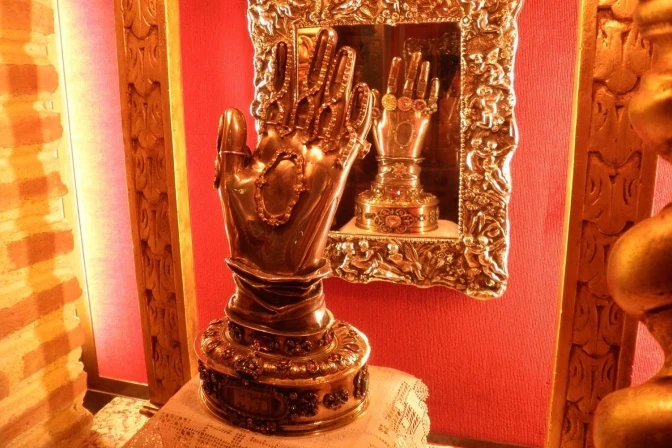
A lack of vocations threatens the closure after more than a century of the Discalced Carmelite monastery in Ronda, Spain, which houses the left hand of St. Teresa of Ávila. The relicʼs final destination will be decided in the coming months.
The monastery’s numbers dwindled in recent years from nine to four sisters — one of them with Alzheimerʼs.
Since the COVID-19 pandemic, five have passed away due to old age and various medical conditions.
According to the apostolic constitution Vultum Dei Quaerere, promulgated by Pope Francis in 2016, the minimum number of sisters required to maintain a community is six; otherwise, the remaining members must join other, larger communities.
The nuns have not been able to find two more sisters despite efforts to publicize their need. As a result, the four remaining sisters from Ronda will move to other communities, and the most important relic housed in their convent will have to be relocated.
Since 1924, the Carmelites have occupied a former Mercedarian convent founded in the 16th century but which was expropriated in the 19th century during the processes known in Spain as “desamortización,” the confiscation and sale of Church properties by the government.
An incorrupt relic after 444 years
The relic of the incorrupt left hand of St. Teresa, a Carmelite reformer and doctor of the Church, was separated from her body in 1582. Following various historical twists and turns, it wound up with a religious community in Portugal.
In 1910, a decree expelled religious orders from that country; consequently, the Carmelites fled to Spain, taking the relic to Ávila. When the Portuguese community was reestablished in Ronda, they requested the relic’s return.
With the outbreak of the Spanish Civil War in 1936, militiamen from the Red Army forced the nuns to hand over the relic. Shortly thereafter, it was recovered by General Francisco Franco’s Nationalist Army and was moved to Burgos, the general’s headquarters, where he kept it until his death.
In January 1976, the relic returned to the convent in Ronda, which now faces closure.
The relic’s final destination remains uncertain, although there has been speculation about its return to Alba de Tormes, the saintʼs birthplace and the location of the rest of her body, which also remains incorrupt after 444 years.
If the left hand were to return to Alba de Tormes, all of St. Teresa’s mortal remains would be reunited once more, after more than four and a half centuries.
However, sources from the Iberian Province of the Discalced Carmelites have told ACI Prensa, the Spanish-language sister service of EWTN News, that a definitive decision has not been made on the matter.
The canonical process for closing the Ronda monastery has not yet concluded and ultimately depends on the Vatican. The process is expected to be completed by early 2027.
Also, the remaining nuns in Ronda, who will determine the fate of the relic, must now discern if they want to remain together and, if so, must ask to join one of the convents of the Our Lady of Mount Carmel Federation to which they belong.
Likewise, they must determine the fate of the other belongings owned by the community.
St. Teresa’s left hand could go to one of the monasteries where the four nuns settle or be entrusted to a diocese or the Carmelite motherhouse.
This story was first published by ACI Prensa, the Spanish-language sister service of EWTN News. It has been translated and adapted by EWTN News English.
Leave a Reply
You must be logged in to post a comment.