
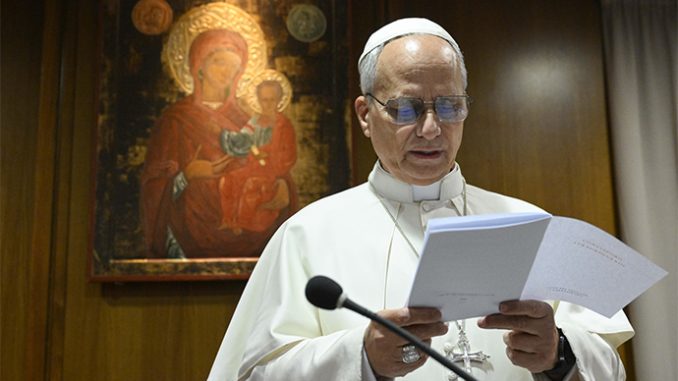
Several topics will be discussed at the consistory of cardinals called by Pope Leo XIV for June 26-29: the international situation and its effects on local Churches; key themes in the encyclical Magnifica Humanitas; the next steps in the Synod on Synodality.
At first blush, these three agenda items may seem a bit disconnected. In fact, they are closely linked by what the Pope rightly identified in his encyclical as the civilizational crisis of the moment: the deep confusions over the very nature and destiny of the human person.
Despite its now being pigeon-holed as “the AI encyclical,” Magnifica Humanitas pointedly asks us to reflect deeply on the question posed in the Bronze Age by Psalm 8: “What is man…?” (Ps 8:4). For that is the ultimate question posed by the development of artificial intelligence: Who are we? Are we simply walking algorithms, about to be outdone in computional, then cognitive, then decision-making capacity by other algorithms? Are our capacities for love, regret, shame, altruism, wickedness, compassion, speculative thought, and learning from our mistakes merely a function of neural connections in our brains that for millennia we mistakenly thought of as “consciousness”–connections that can be replicated, even improved upon, by the development of what is known as General Artificial Intelligence?
The answer biblical religion gives to that question is the answer implied by the key paragraph, #99, in Magnifica Humanitas: algorithms, no matter how refined, do not and cannot have souls, and the immortal soul, created by God, is what differentiates the human person from everything else in creation. It is that “ensouledness” that is the ultimate reason why we can discern right from wrong, distinguish the noble from the base, feel shame when we choose what degrades others and ourselves, repent, and rise from the dust to try to do better in the future with the help of grace.
The defense and promotion of that biblical idea of Who We Are is thus the connection between the three consistorial topics.
The connection is most obvious in the international situation, for the major aggressors in today’s conflicts all wreak havoc because of distorted conceptions of the human person. To jihadist murderers and kidnappers, the Christians they persecute have no claim to human dignity because they decline to chant “Allahu Akbar!” To Vladimir Putin, Russian soldiers are meat to be fed into a meat grinder in the cause of the new Russian imperialism. To Iran and its Hezbollah and Hamas clients, Jews are subhumans to be exterminated (in the case of Hamas, after they have been raped and tortured while iPhone cameras record their brutalization). To Xi Jinping, the people of China (and, in the future, the people of Taiwan) are mere clay to be formed into the desired communist mold by omnipresent surveillance systems that determine who is worthy of education and prosperity.
There is also a strong connection between the defense of the dignity of human personhood taught by Magnifica Humanitas and the future of the Synod on Synodality.
Recently, an international controversy broke out over the report of Synod Study Group #9, which committed an act of calumny against Courage International, the American-founded ministry to those with same-sex attraction who wish to live chastely as the Catholic Church understands chastity. That breach of ecclesial solidarity was made possible in part by what the Synod General Secretary has described as the Study Group’s “valuable work”–a characterization of the report’s theology that deserves serious scrutiny, leading to serious challenge, even repudiation, at the upcoming consistory.
Shortly after the report of Synod Study Group #9 was released, a knowledgeable friend, fully aware of some of the good things that happened at the Synods of 2023 and 2024, nonetheless wrote me that the biblical text that kept coming back to me as he read Study Group #9’s report was, “The sheep will not follow a stranger; they will run away from him because they do not recognize the voice of strangers” (John 10.5). The voice in that report, he continued, “is simply not recognizably Christian. The content is bad, to be sure, but even prior to that, there is something alien about the way [the report] speak[s] of the faith.”
And the reason for that, I suggest, is that Synod Study Group #9’s report is a continuation of the war against Pope St. John Paul II’s 1993 encyclical, Veritatis Splendor. That war has been waged by aggressive parties within the Catholic theologians’ guild and certain bishops’ conferences (notably Germany and Belgium) since the encyclical was issued. The war intensified during the previous pontificate, and the assault on Veritatis Splendor has now been given what some will take as quasi-official sanction, given that Study Group #9’s report was issued by the General Secretariat of the Synod (the official stationery of which does not, it might be noted, refer to a Synod of Bishops.)
Veritatis Splendor was a robust defense of the classic Catholic understanding that some acts are intrinsically evil and can never be justified morally by any calculus of intentions and consequences. That defense was set within the broader context of John Paul II’s call for a renewal of Catholic moral theology centered on the Beatitudes and the virtues, a summons reflecting the influence of Father Servais Pinckaers, OP, and his masterwork, The Sources of Christian Ethics, on the development of Veritatis Splendor.
To the immediate point, however, Veritatis Splendor was a defense of the dignity of the human person, a dignity embodied in our ability to distinguish between good and evil and our capacity under grace to choose the good. In the perspective of John Paul II’s Christian personalism, to deny that there are intrinsically evil acts–acts including rape and torture that in and of themselves degrade and debase the humanity of both perpetrator and victim–is to empty the moral life of its inherent drama, indeed its inherent humanness.
Why would the members of the theologians’ guild and even bishops deny what any person of normal moral sensibilities instinctively understands: that rape and torture are always wrong? One can burrow into the weeds of post-Kantian epistemology to find what are sometimes said to be the reasons for re-thinking the concept of intrinsically evil acts. But such philosophical gamesmanship is more an excuse than a cause: an excuse that seeks to give cover to the determination to declare the Catholic ethic of human love, and particularly its understanding of contraception and same-sex acts, untenable today.
Synod Study Group report #9 is thus in an unresolvable tension with the teaching on human dignity of Magnifica Humanitas. And that raises the most serious questions about the future of the synodal process that began in 2021, five years and tens of millions of dollars ago.
That process has produced some good results–such as an awareness in the most clericalized parts of the Church that all the baptized have been given the Great Commission of Matthew 28.19 and are therefore called into evangelical mission–and those results should by all means be applauded and implemented.
But if, as Synod Study Group #9’s report makes unmistakably clear, the synodal process has also been the occasion for settled matters of Catholic faith and pastoral practice to be unnecessarily called into question, creating the kind of ambiguity that makes evangelization difficult if not impossible, then a hard question should be raised in the June consistory: Why is this vastly expensive and time-consuming synodal process to be continued?
And if the answer to that question is that it is necessary to give unheard voices a hearing, the answer to that, frankly, is “Bosh.”
It is not that the voices that seem to have largely shaped the content of Synod Study Group report #9 were previously unheard. Those voices had been heard for decades. But when the teaching authority of the Church did not agree with those voices, aggressive theologians and some local Churches refused to accept the correction and the call to authentic theological and pastoral renewal given in Veritatis Splendor: in part, because they insisted that the Church’s ethic of human love is an impediment to evangelization, which it manifestly is not in the living parts of the world Church, and in part because of a supine surrender to the cultural Zeitgeist of the West.
I hope that some brave members of the College of Cardinals raise these points of connection among the consistory’s agenda items in their conversations later this month. Doing so might enliven what are too often rather dull exchanges, while drawing attention to the urgent message of Magnifica Humanitas, which is the defense of human dignity.
If you value the news and views Catholic World Report provides, please consider donating to support our efforts. Your contribution will help us continue to make CWR available to all readers worldwide for free, without a subscription. Thank you for your generosity!
Click here for more information on donating to CWR. Click here to sign up for our newsletter.
Leave a Reply
You must be logged in to post a comment.