
On the first day of Pope Leo XIV’s visit to Las Palmas de Gran Canaria — the final stage of his trip to Spain before traveling to Tenerife and returning to Rome on Friday — several deeply moving scenes unfolded.
At the dock of Arguineguín, which six years ago became known as the “dock of shame” due to the abandonment there of thousands of migrants who arrived in precarious boats known as cayucos, the pope threw a wreath of flowers into the sea in memory of those who died during the crossing — just as Pope Francis did on the Italian island of Lampedusa in 2013.
He then prayed before a blue cross made from wooden planks of migrant boats that had reached the Canary Islands and blessed it. Standing nearby was Javier, a volunteer with the Cruz Blanca Foundation, which works directly with migrants there. For him, this papal visit was an opportunity to once again place at the center of public discussion the migration crisis, a human tragedy that he says has become socially normalized.
“The pope gave a strong and moving speech. What he said to the migrants — that they are not numbers or files — really impressed me,” he told ACI Prensa, the Spanish-language sister service of EWTN News.
Later, in the Cathedral of Santa Ana, patroness of Las Palmas de Gran Canaria, Claretian priest Santiago Cerrato Cáceres gave his testimony to Pope Leo XIV, beginning with a heartfelt confession: “Holy Father, those of us inside here… and all those outside: We love you very much.”
Before him, the bishop of the Canary Islands, José Mazuelos Pérez, described to the pope the pastoral challenges facing the local Church.
Mazuelos lamented the “growing secularization that weakens the sense of God, sacramental practice, and the transmission of the faith in families,” especially among young people, where “the Christian experience is becoming increasingly fragile or marginal.”
In the historic cathedral, whose construction began around the year 1500 at the initiative of the Catholic monarchs, Isabel I of Castile and Ferdinand II of Aragon, the pope invited those present to live in unity.
Christians should be “building the Church together, founded on Christ, the ‘cornerstone,’ building up the good, harmonizing our differences, and working united for the good of all,” he said. He also recalled that the life of the Church is built through the communion of its “diverse gifts and ministries.”
Three girls dressed in traditional Canarian costumes welcomed the pope and presented him with a bouquet of flowers. Attentive to every detail despite the fatigue of six days of travel, the pontiff gave them a blessed rosary with a smile.
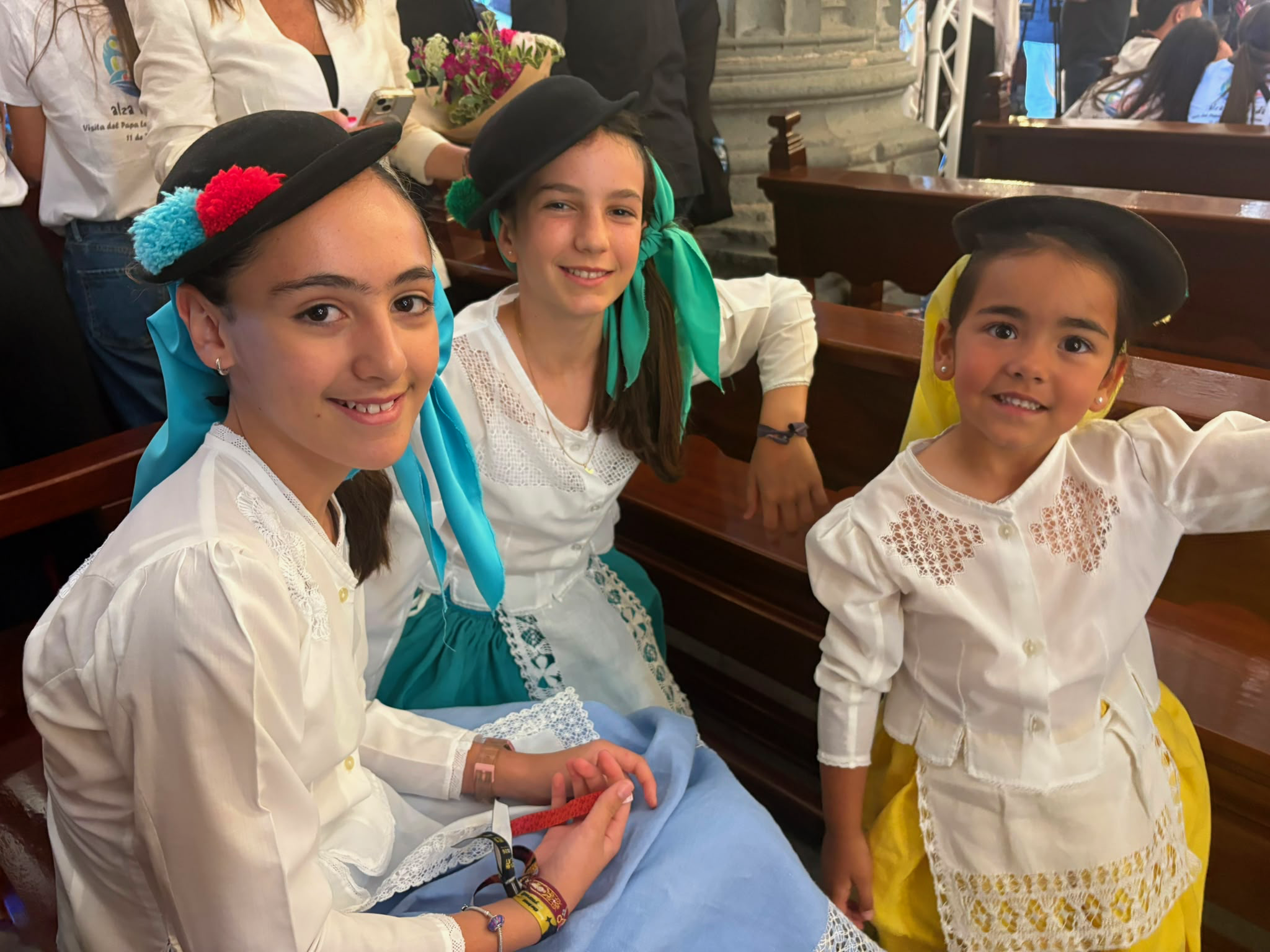
Referring to the sea that surrounds the islands, he said it represents the difficulties of life, quoting St. Augustine: “No one is able to cross the sea of this world unless born by the cross of Christ.”
He also thanked the Catholics of Las Palmas for the help they give to these “crucified brothers and sisters.”
After meeting with bishops, priests, deacons, religious, seminarians, and pastoral workers, the pope was given a genealogical study by the Cabildo, the local governing body, in the hope of finding Canarian roots in his lineage.
Mass in the Canary Islands
In the afternoon, the pope celebrated his first large public Mass at the Gran Canaria Stadium before nearly 40,000 people. “I also invite you to pray together, during this holy Mass, for our brothers and sisters who have lost their lives at sea,” he said.
This is the charity of God, the Holy Father explained, in which our “vocation to love is rooted, which is not based on calculation, nor on mere sentiment, nor reducible to simple philanthropy, but one that invades our entire being: fire for the soul, light for the mind, an irresistible impulse for freedom, peace, and at the same time torment for the heart, which beats in harmony with other hearts, involving the whole person.”
The gratuitousness of the heart of Christ, the pope said in his homily, translates into “helping each person not only to survive but also to recover trust and resume their path, to grow and fully flourish in their uniqueness, for the good of all.”
A fight against cancer, offered for the pope
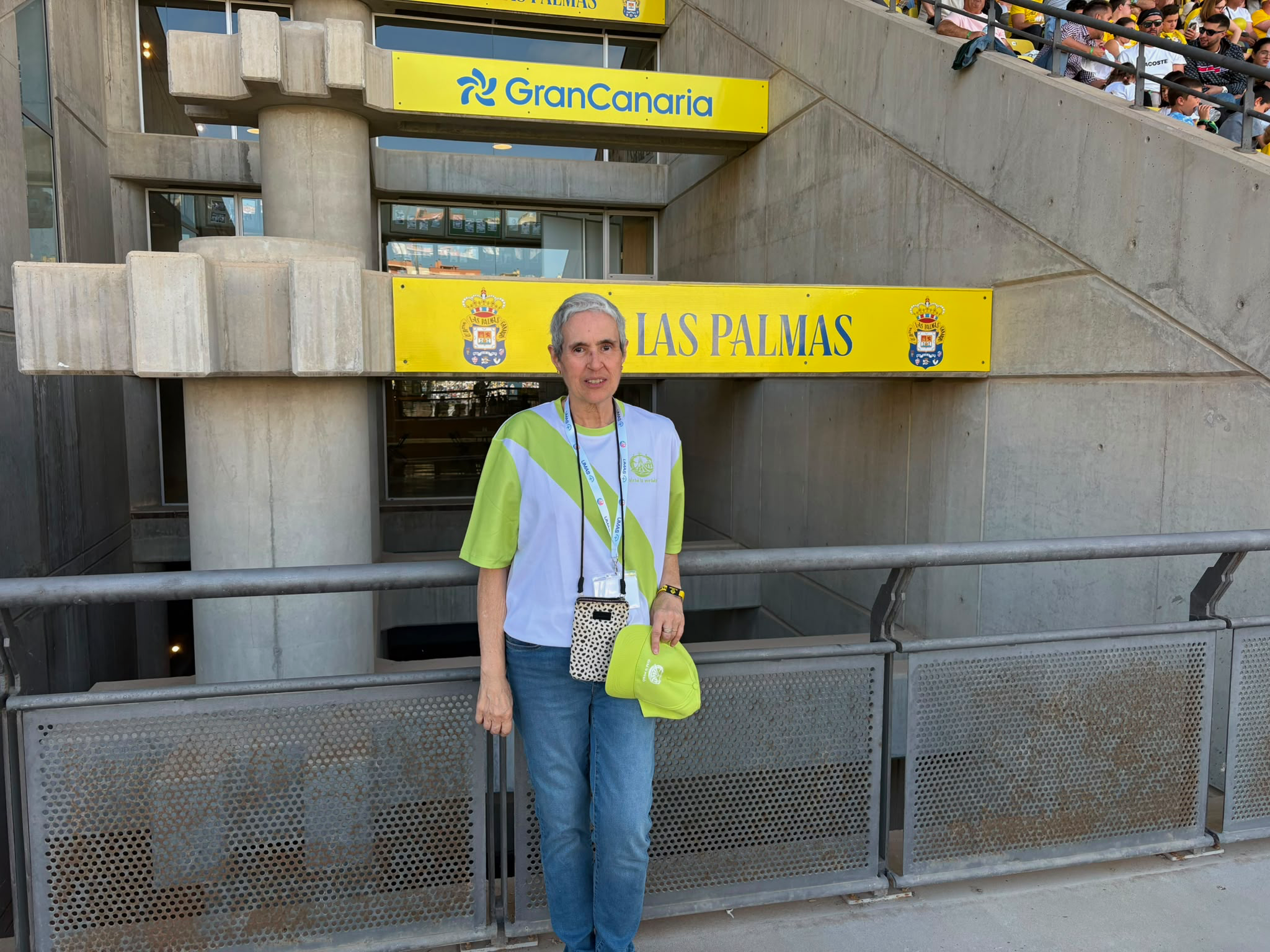
These words seemed especially directed at Yolanda, one of the volunteers helping with the papal visit. She has battled cancer for nearly two decades and, despite this — or perhaps precisely because of it — she chose to volunteer.
“I’m waiting for a miracle… we all always hope for that. And we keep living,” she said with serenity.
Her body has endured immense suffering: 10 years after her first diagnosis and treatment, the cancer has returned and has spread throughout her body. Several vertebrae are affected, and she has undergone many treatments.
“I thought it was over. But it wasn’t, and here I am, eager to see the pope. I have offered all my suffering for him,” she said.
The pope’s visit to Las Palmas also mobilized hundreds of young people. Four friends from the Parish of San Isidro in the north of the island said they are living this event as a unique moment of faith and community.
One of them, Talía, 25, was overcome with emotion as she recalled the last several days. “I’ve been following everything on TV and crying my eyes out,” she confessed. For her, the pope’s presence is not just a religious event but a deeply personal experience.
The message that touched her most was the pope’s invitation to young people not to be afraid to form a family and make a lifelong commitment. “The part about forming a family and not being afraid of marriage really spoke to me,” she said.
“Today many people are scared to get married. It’s true that birth rates in Spain have risen, but they should rise a little more,” she added with conviction.
Carlos Díaz Alonso, 20, said it was an “immense joy” to see the pope up close. “A pope has never come to the Canary Islands before, and that fills me with pride.”
“That the leader of the entire Catholic world is among us… it’s something very great,” he added.
Like many young believers, Carlos said he sees faith as a practical guide. “In all the things where I can fail in my daily life, I try to be a better person — and even more so now after seeing the pope,” he said, saying his goal is “to try to attain the grace of God.”
The pope will conclude his trip on Friday in Tenerife.
Leave a Reply
You must be logged in to post a comment.