
In Barcelona on Tuesday evening, Pope Leo XIV addressed the concerns of three young people who shared their personal struggles in a powerful dialogue marked by sincerity, pain, and hope.
During the vigil held at the cityʼs Olympic Stadium — on the fourth day of his apostolic journey to Spain — the pontiff answered direct, profound, and heart-wrenching questions with the voice of a shepherd, human sensitivity, and moments of stirring intensity.
Discovering one’s vocation in a selfish society
Ferrán — baptized this past Easter — asked Pope Leo XIV for guidance on how to keep his gaze lifted in order to discover his vocation, “when society pushes us to look constantly at the ground or only at ourselves.”
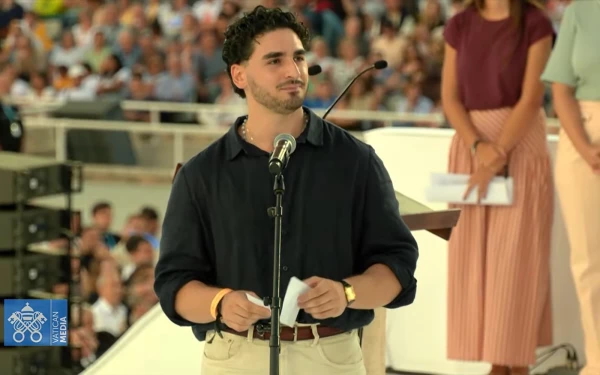
Leo XIV highlighted the fact that “many young people and adults are rediscovering the Christian faith” and noted that “our desire for truth and happiness requires a broader horizon. And this restlessness is a gift that God himself has given us: We are made for the infinite.”
Leo XIV offered two ideas: It is necessary to cultivate that healthy restlessness, and to do so within one’s own specific circumstances.
Regarding the first point, he warned that “the idolatry of profit and performance, the drive to constantly produce and come out on top, as well as the cult of one’s own image, are nothing more than anesthetics” that numb the conscience.
For this reason, he added that those who allow themselves to be enlightened by the Gospel “also develop a critical perspective regarding a social system that does not place the person at the center and gives rise to situations of injustice and existential poverty on various levels.” This critical capacity means that “restlessness — as well as the discovery of one’s inner self, of spirituality, and even more so of the Gospel — can be frightening,” he added.
Secondly, the pope urged everyone to “cultivate this restlessness and make room for it” in their own concrete realities — by creating moments of silence, reading the Gospel daily, speaking with God, and “trying to walk this inner path alongside others, allowing ourselves to be accompanied on ecclesial journeys and engaging in dialogue with priests, religious, and people who, like us, have embarked on this path.”
God neither abandons nor desires human suffering
The second question came from Carmina, a secondary school teacher who described how depression led her to view “the idea of disappearing” as her only way out: “One Friday night, I lost the battle and tried to take my own life.” Yet, she continued, “God gave me a second chance.”
Drawing on this lived experience, she asked — amid the profound silence of those present: “Where can we see God when the darkness is absolute and we can go on no longer? How can we trust in God when it seems that nothing — not even oneself — is worth anything?”

After a pause, Leo XIV responded by expressing gratitude for the effort involved in sharing an experience of such magnitude: “You have risen and resumed your journey, and this is a wonderful miracle that we see in many figures in the Gospel.”
The pontiff highlighted the need to “become aware of how mental health is increasingly threatened within societies considered advanced” — a fact that signals “something deeply amiss” in them, subjecting people “to pressures, expectations, and tensions that compromise fundamental forms of balance.”
Leo XIV then turned his attention to the “hours of darkness, anguish, and pain that Jesus experienced as the hour of his death drew near,” affirming that “this is not merely a matter of personal suffering”; rather, the Son of God takes upon himself, in his own flesh, all the anguish, pain, and suffering of humanity.
“The cross of Jesus tells us that God does not abandon us,” the Holy Father continued, noting that “he remains crucified with us in moments of pain and extreme loneliness.”
“When God seems absent, we must once again entrust to him the burdens we carry in our hearts — even crying out to him,” he added.
He also recommended “opening ourselves to someone who can help us offer a simple prayer, who can accompany us discreetly — without rushing to explain that pain — and who can take us by the hand and help us move beyond that cry.”
Regarding this experience, he warned against the temptation to “spiritualize pain” by superficially reducing it to the “will of God,” as this risks minimizing and silencing suffering. “God does not desire suffering; he bears it with us and invites us to trust in him perseveringly,” he declared.
How can I forgive my father and reconcile with God?
The third young person to address Pope Leo XIV was Desirée, who recounted how her father had tried to kill her mother — an event that drove her mother into drug addiction and landed Desirée in a juvenile detention center, where she gradually opened herself to faith and was baptized.
Her story moved those present to tears; they interrupted her account several times with applause expressing affection and support.
During her adolescence, she had rebelled against God. Now, with a faith renewed following a retreat, she asks God: “Where were you when I was a child?” She posed two questions to the pope: How can I forgive my father? How can I truly reconcile with God?
The pope reframed the first question, encouraging us to ask ourselves how we — as human beings — become “prisoners of evil, to the point of being violent toward others” and “fail to cultivate love” while respecting the dignity and freedom of others.
After condemning “a poisoned atmosphere in family relationships — characterized by abuse, oppression, and, in particular, violence against women” — the pope emphasized that “we cannot attribute to God what has been entrusted to our own responsibility.”
He thus recalled that human beings have been endowed by God with intelligence, will, conscience, and dignity, and noted that God has, above all, “come to meet us to show us — in his Son, Jesus Christ — the path to follow,” in addition to gifting us the Holy Spirit.
Therefore, he affirmed, these questions must be directed “at ourselves, at the dynamics of our society, at the culture of individualism, and at the temptation to violence — not at God.”
Regarding forgiveness, the pontiff emphasized that it is part of a journey. He warned that if one reads the Gospel “as a book of instructions, commandments, and duties,” one runs the risk of “causing ourselves great discouragement and frustration” upon discovering that we are incapable of the forgiveness to which the Lord invites us.
He added that “we must, above all, ask the Lord for forgiveness” so that he may “expand the space for love within us precisely where we have been wounded” and thus, gradually, “transform resentment into mercy and compassion.”
“We must not lose heart: In forgiveness, we advance in small steps,” for it is a gradual process that does not always mean returning to the previous situation “or living in a full relationship with those who have hurt us, especially when the incident involved violence.”
Nevertheless, he noted, it is possible “to maintain a good disposition of the heart toward the person, reject all forms of hatred or vengeance, strive to mend the relationship as much as possible, and perhaps pray for him or her.”
This story was first published by ACI Prensa, the Spanish-language sister service of EWTN News. It has been translated and adapted by EWTN News English.