
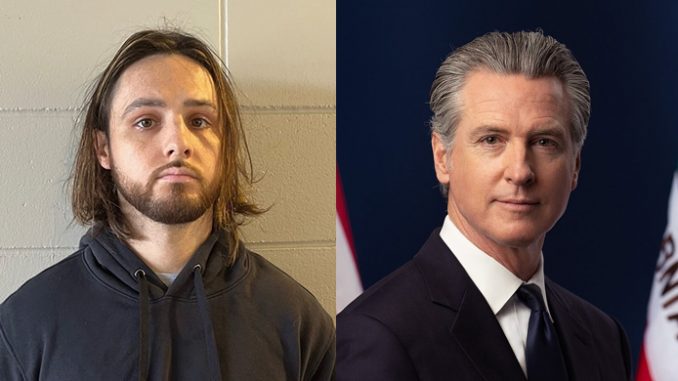
California has always sold itself as the place where people can invent or reinvent who they are. And it is within that culture of “borrowed selves” that both the man accused of starting the deadly Palisades fire and the state’s own Governor Newsom have recently admitted to modeling themselves on figures they believed radiated the powerful and carefully curated persona they lacked on their own.
Federal prosecutors have described the alleged Palisades Firestarter, Jonathan Rinderknecht—the Uber driver charged with setting the blaze that killed twelve people and destroyed thousands of homes—as someone who had become obsessed with Luigi Mangione, the accused killer of Brian Thompson, the CEO of UnitedHealthcare.
According to media reports, Rinderknecht viewed the murderous Mangione—who has himself become viewed as a heroic avenger defending the poor from vicious capitalism—as someone to emulate. Absorbing the Mangione playbook so completely, Rinderknecht began echoing its language in his Google searches by asking for information on “free Luigi Mangione” and “take down all the billionaires.” The New York Times reported that Rinderknecht told investigators that torching the Palisades would be a “symbolic strike against the rich.”
Although extreme, the imitation of a murderous avenger by the man accused of setting the Palisades on fire lies on the same cultural continuum as the mimetic anxieties on display in Governor Newsom’s newly released memoir.
In it, Newsom reveals that in an effort to avoid bullying in high school, he constructed a new persona by echoing the confidence of a handsome and impeccably dressed television character played by Pierce Brosnan. Both Newsom and Rinderknecht, operating at opposite ends of California’s social hierarchy, turned outward to find the models they believed would provide the power they lacked.
The firestarter became obsessed with the murderous Marxist avenger while the governor reached for the cool confidence embodied by Brosnan’s fictional creation, the Eighties television detective, Remington Steele.
In his book, Newsom writes that he was an awkward teen and the target of a bully who called him “Newscum”–the same nickname President Trump has used to mock the governor. Inspired by television detective Remington Steele’s suit-wearing character, the teenage Newsom began to slick back his hair with gel and wear a full-dress suit to high school.
He recalls that the “transformation” changed his reputation and claims that the bullying stopped “almost overnight.”
While their choices differ in scale and consequence, the underlying impulse of both men is the same—an attempt to inhabit a more powerful and commanding persona by modeling oneself on someone who seems to possess the qualities one lacks. In this sense, the distance between arson and ambition is not as wide as it appears, as both are shaped by the same cultural habit of looking outward to decide who to become.
While these dramatic examples are from California, the mimetic impulse is hardly confined to that state. This impulse, which involves “borrowing” a self from someone else, was once a practice of aspiring Hollywood stars. But today it has become a global condition. In a world saturated with TikTok influencers, reality TV stars, and popular podcasters, people everywhere are increasingly looking outward to decide who they should be, what they should desire, and how they should appear.
The late-French theorist, René Girard, warned that modern societies, having lost shared sources of meaning, drift toward a state in which individuals imitate one another with growing intensity, each seeking a model who seems to possess that which they lack. The result is a culture in which identity becomes derivative and purely performative.
What we see in Rinderknecht and Newsom is simply a California version of a much wider crisis.
In places where traditional structures of meaning—including religion—have eroded, people increasingly turn to societal models to fill the void. Some choose the personas offered by celebrities and political figures, but others gravitate toward darker models who promise vengeance or promote transcendence through destruction.
The common thread is a deepening soullessness and a loss of interior life that leaves individuals vulnerable to whatever figure appears to provide purpose in their increasingly meaningless lives.
Girard would say that when societies no longer know what they are for, they begin to imitate whoever seems to know what they want. The consequences can be as ordinary and harmless as an ambitious politician modeling himself on a television detective, or as catastrophic as a man setting fire to a community in an attempt to continue the crusade that was waged by a make-believe vigilante whose violent righteousness became a model he wanted to emulate.
The real lesson is not about California, but about a culture that has forgotten how to form character. What begins as imitation ends as substitution—as a kind of “borrowed self.” This false persona slowly displaces the real one.
And in a culture that prizes superficiality and performance over authentic depth and interiority, the danger is not only that people will choose the wrong models, but that they will forget how to choose at all.
If you value the news and views Catholic World Report provides, please consider donating to support our efforts. Your contribution will help us continue to make CWR available to all readers worldwide for free, without a subscription. Thank you for your generosity!
Click here for more information on donating to CWR. Click here to sign up for our newsletter.
Leave a Reply
You must be logged in to post a comment.