
Church leaders in Pakistan have welcomed the passage of a bill by the Punjab Assembly that classifies underage marriage as a non-bailable offense, while cautioning that enforcement challenges and systemic gaps could limit its impact on girls from minority communities.
The Child Marriage Restraint Bill 2026, passed on April 27, sets 18 years as the minimum legal age of marriage for both boys and girls. Previously, the minimum age stood at 18 for males and 16 for females in Punjab, home to Pakistanʼs largest Christian community.
The House also adopted an amendment directing courts not to treat the mere statement or purported consent of a child to reside with or accompany an adult contracting party as determinative in custody, residence, or protective orders.
Agreement on child protection
Moved by Ijaz Masih, a Christian member of the Punjab Assembly and former provincial minister for human rights and minority affairs, and co-sponsored by 13 members across party lines, the amendment was described as a rare instance of consensus on child protection.
Church representatives linked the law to ongoing concerns over how consent is assessed in cases involving alleged forced conversion and marriage of minority girls.
“In Pakistanʼs forced conversion cases of Christian and Hindu families, the statement recorded before a magistrate is often crucial because it provides a girlʼs testimony under judicial oversight,” Masih told EWTN News, adding that proposals to annul such marriages remain under consideration.
The bill was passed amid renewed concern in Christian circles after the Federal Constitutional Court on March 25 upheld the marriage of a 13-year-old Christian girl, Maria Bibi, to a 30-year-old Muslim man.
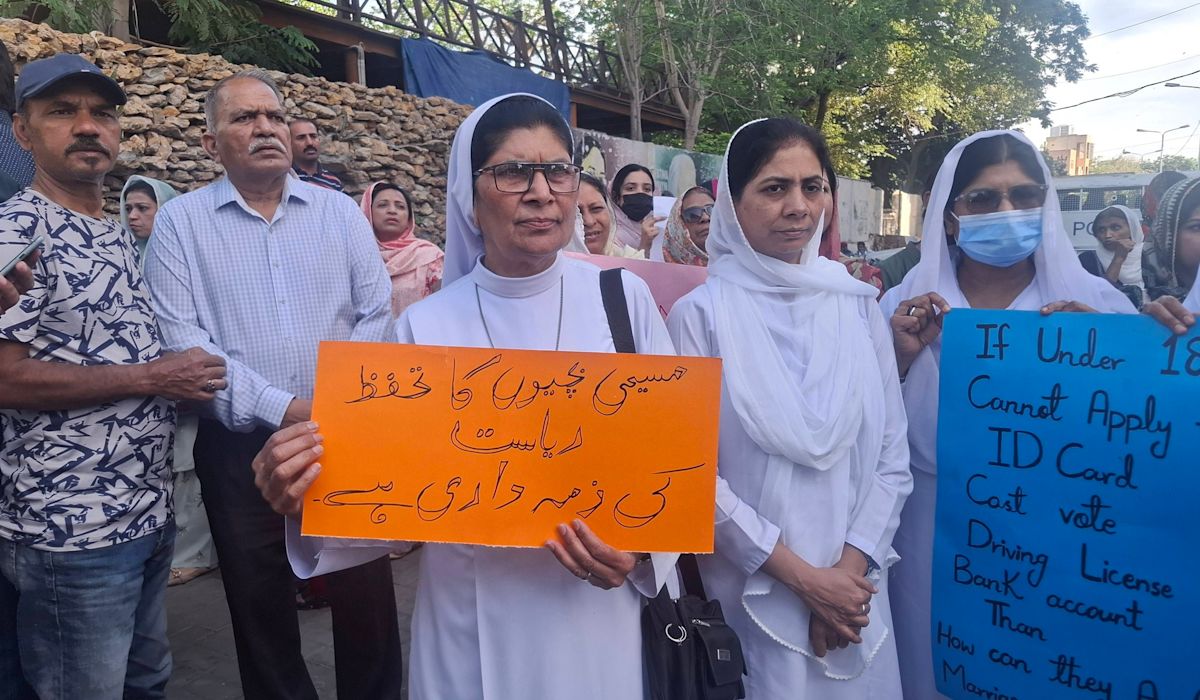
Speaking at an April 30 Bible study session organized by the Ecumenical Commission for Human Development at St. Francis Catholic Church in Kamalpur village in the Faisalabad Diocese, Father Obaid Matthais, dean of studies at St. Thomas the Apostle Minor Seminary, questioned the effectiveness of the reform.
“How can the new law prevent forced conversion when the Muslim nikah [marriage] remains valid?” he said, warning that minority girls studying or working away from home remain at risk.
He added that such rulings “hang like a sword” over vulnerable Christian girls, particularly domestic workers and students in urban centers.
Christian leaders, including Archbishop Khalid Rehmat of Lahore, have also expressed concern that court decisions in such cases risk legitimizing disputed marriages involving minors allegedly abducted and forcibly converted, especially in the absence of updated personal laws governing Christian marriage and family life.
The proposed reform of the Christian Marriage Act of 1872 seeks to raise the minimum marriage age for Christian boys and girls to 18 and require both parties to be Christian for a marriage to be solemnized under the law, replacing current provisions that allow interfaith marriages.
Rehmat has announced the formation of a church committee to draft amendments following an ecumenical consultation held in Lahore on April 24–25.

Qamar Iqbal addresses an orientation session on Christian personal laws at the Catholic Bishop’s House in Lahore, Pakistan, on April 25, 2026. | Credit: Photo courtesy of Jasber Ashiq, director of Catholic TV Pakistan
Qamar Iqbal, assistant professor of political science, described the Child Marriage Restraint Bill as a “protective mechanism,” saying it could strengthen legal safeguards if implemented effectively.
In a joint statement issued on April 29, Bishop Samson Shukardin of Hyderabad, president of the Pakistan Catholic Bishops’ Conference and chairperson of the National Commission for Justice and Peace (NCJP), together with Father Bernard Emmanuel, NCJP national director, and Naeem Yousaf Gill, NCJP executive director, described the legislation as a “defining move” to safeguard childhood and uphold human dignity.
While welcoming the law, they stressed that legislation alone is not sufficient to end child marriage and called for strict enforcement. “Union councils, nikah registrars, and police must be held accountable, and courts must enforce the law without exception,” the statement said.
They urged institutions and families not to bypass the law under the guise of custom or tradition.
“The problem remains due to dual legal systems [constitutional and Sharia]. Judges are often influenced in cases involving minorities,” Gill told EWTN News, adding that equal and consistent implementation could turn the law into a “cornerstone for lasting change.”
Report findings
The NCJPʼs position aligns with findings from its April 11 report, “Captive Souls: The Untold Story of Pakistanʼs Minority Girls,” which documented multiple cases of alleged forced conversion and highlighted recurring issues such as social exclusion, abuse, financial exploitation, and weak legal documentation.
The report recommends a state-regulated conversion process overseen by magistrates, a ban on clerics and madrassas issuing independent conversion certificates, and strict enforcement of a minimum age of 18 for both marriage and religious conversion.
It notes that Pakistan currently has no legal minimum age for religious conversion, leaving a critical protection gap.
Matthais, however, remains skeptical about prospects for reform. “Itʼs tough. The majority will resist such changes,” he said, arguing that proposed safeguards for religious minorities often face ideological opposition.
Iqbal said work on regulating conversion practices must continue, though progress remains slow due to “sensitive majority sentiments” that require careful engagement and dialogue.
Leave a Reply
You must be logged in to post a comment.