
When it comes to saints who were also soldiers, the list is relatively short. There is St. Louis IX, the medieval king of France, who fundraised and led two crusades against the Muslim kingdom in northern Africa. St. Joan of Arc rallied the French people to resist the rapacious brutality of the English and paid for her patriotism by being falsely accused of heresy. St. John of Capistrano, the Franciscan “Soldier Saint” and patron saint of military chaplains, led a Crusade against the Ottoman Empire in what is today Serbia.
And yet, since the Roman emperor Constantine legalized and patronized Christianity, our Faith has regularly been tied up with men (and some women) willing to fight and die to protect the Faith. Indeed, the Feast of the Blessed Virgin Mary of the Rosary, which the Church celebrates every October 7th, commemorates the victory at Lepanto, where the Holy League, a coalition of European Catholic states, defeated an invading Ottoman navy whose ultimate purpose was to further Muslim conquests deep into Italy and beyond. Twice, in 1529 and again in 1683, the great city of Vienna—with help from other Catholic powers—withstood Ottoman sieges that, if successful, might very well have spelled the end of Christianity in western Europe.
Forgotten Christian heroes
These events are known in some circles as part of our Catholic history and identity, though they certainly were not stories I was taught as part of my Evangelical upbringing, nor in history courses when I attended Presbyterian seminary. In truth, there are many other similar feats of heroic Christian virtue in the history of the Church, and as scholar Raymond Ibrahim relates in his recently completed trilogy, much of that heroism was directed at a single foe, militant Islam.
In The Two Swords of Christ: Five Centuries of War Between Islam and the Warrior Monks of Christendom, following his acclaimed Sword and Scimitar (2018), Defenders of the West (2022), Ibrahim presents to readers a long, impressive catalogue of Christian heroes who should be household names for the Catholic faithful.
As Catholic historians such as Robert Louis Wilken have noted, the rise of Islam was very bad for the Christian Faith. Within a century after Islam’s birth in the seventh-century Arabian desert, three of the five patriarchates of Christendom were under Muslim control, as was a majority of global Christians. In 732 A.D., a Muslim army marching deep into present-day France was finally defeated by a Frankish Christian force at Tours; the retreating Muslims would control much of Spain for the next half-century.
By the time of the Crusades at the end of the eleventh century, Christian populations were in significant decline in Muslim-controlled lands; in present-day Algeria and Tunisia, indigenous Christianity all but died out. The few Christians who are there today are largely a result of French colonialism in the nineteenth century. In the Holy Land, the destruction of churches, harassment, and even the murder of Christians and pilgrims were commonplace, especially after the Seljuk Turks arrived in the eleventh century.
Even after the Catholic conquest of the Holy Land in the First Crusade in 1099—led by such pious warriors as Godfrey of Bouillon—pilgrims continued to suffer attacks by Muslims. In 1119, for example, 300 pilgrims were killed, and another 60 taken as slaves when traveling from Jerusalem to the Jordan River. In response to such violence against helpless civilian targets, nine knights, including Hugh of Payns and Godfrey of St. Omer, took views of poverty, chastity, and obedience before the patriarch of the Church of the Holy Sepulchre and formed what would become known as the Knights Templar, because Baldwin II, king of Jerusalem, donated the al-Aqsa Mosque on the Temple Mount as their residence and headquarters.
No less than St. Bernard of Clairvaux, four years later, called for more “fighting knights” in the Holy Land, and at the Council of Troyes in 1129 championed their cause. It was at Troyes that they were formally recognized as an order, the first military order in the history of Christendom. Their religious rule urged recruits “who up until now have embraced a secular knighthood in favor of humans only, and in which Christ was not the cause, to hasten and associate yourselves in perpetuity with the order of those whom God has chosen from the mass of perdition and has assembled for the defense of the Holy Church.”
Piety and masculinity
A “fusion [of] piety and masculinity,” as Ibrahim labels them, they were described by eyewitnesses as, “always foremost in the fight and the last in the retreat; … they proceeded to battle with the greatest order, silence, and circumspection, and carefully attended to the commands of their Master.” In battles across the Levant, the Templars fearlessly fought Muslim armies, their grand masters and other prominent leaders often dying on the battlefield. Acquiring a reputation among their Muslim foes for their tenacity, there were never more than three hundred brother-knights in the Holy Land at any given time (though there were thousands of Templar soldiers, often called sergeants, in the order’s ranks).
The Hospitallers in one sense predate the Templars: the Hospital of St. John was established by Benedictines in Jerusalem in 1060. When crusaders besieged Jerusalem in 1099, brothers running the hospital were allowed to remain in the city because of their good reputation. Afterwards, Raymond du Puy, who became master of the hospital in 1120, established the military part of the Order, which came to be known as the Order of Knights of the Hospital of Saint John of Jerusalem, or Knights Hospitaller. Like the Templars, the Hospitallers’ military presence in the Holy Land was relatively light, though they also provoked fear among their enemies. One contemporaneous Muslim scholar warned that the “sultan should beware of [the Templar and Hospitaller] monks… for he cannot achieve his goals through them; for they have great fervor in religion, paying no attention to the [things of this] world.”
As the Muslims of the Levant and North Africa became more politically (and thus militarily) united, the Crusader states declined and contracted, and by the end of the thirteenth century were eventually limited to a few cities and castles on the Mediterranean coast. At Acre in 1291, a huge Muslim army overwhelmed the small Christian garrison, which included both Templars and Hospitallers, most of whom fought to the death. In the aftermath of the city’s capture, Muslim besiegers massacred approximately thirty thousand Christians and enslaved thousands more; nuns and virgins were given to the Saracens as concubines and slaves.
Following the disaster at Acre—and waning interest in the Crusades in Europe—the Templars and their wealth in Europe became an easy target for political intrigue. French monarch Philip IV, who owed significant debts to the Templars, encouraged salacious (and false) accusations against the military order. More than a hundred of the knights were burned at the stake in France in 1310, and the order was suppressed by Pope Clement V in 1312. Jacques de Molay, the last grand master of the order, was subsequently executed in 1314, declaring his innocence and professing his faith in God, a death that one might rightly call a form of martyrdom.
The Hospitalers, meanwhile, built a new headquarters on the island of Rhodes atop an ancient castle using portions of the Colossus of Rhodes, one of the Seven Wonders of the World. By 1400, it was “arguably the most heavily fortified stronghold in the world,” writes Ibrahim. From Rhodes, the Hospitallers protected and freed many Christians from slavery and operated as a thorn in the side of the Turkish empire.
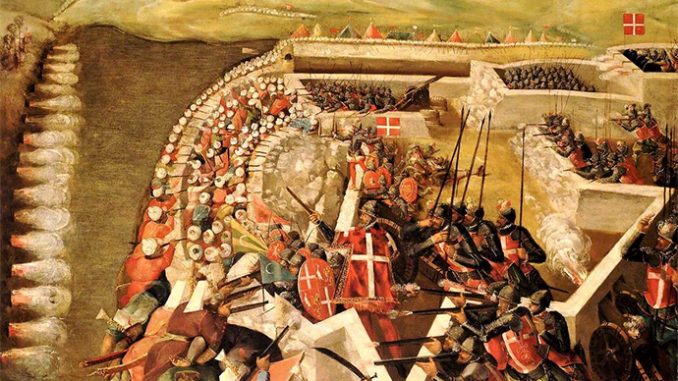
During the 1480 Turkish siege of Rhodes, Hospitaller Grand Master Pierre d’Aubusson exemplified an almost inhuman courage, wounded three times as he led a Hospitaller garrison facing a besieger army at least ten times larger in size. A generation later, in 1523, the Hospitallers finally surrendered the island to the Turks. For a time, under the leadership of Master Philippe Villiers de L’Isle-Adam, the Hospitallers were homeless but, leveraging their naval supremacy, continued to thwart Muslim armies and slavers. Eventually settling on Malta, their master Jean Parisot of Valette defended the island from a Turkish assault in 1565. Despite terrible carnage—a third of the island’s population died in one of the most sustained bombardments in pre-modern history—the Hospitallers held their ground.
Unwelcome aberrations
Yet even with these incredible successes protecting Christendom’s flanks, a divided post-Reformation Europe had little use for warrior monks devoted to fighting Islam, as realpolitik, rather than religious faith, came to inform European foreign policy.
This was so even though Muslim raids continued far into European territory. In 1627, Muslim pirates attacked England, Denmark, and even Iceland, enslaving approximately eight hundred people. Between 1530 and 1780, the Muslims of the Barbary Coast enslaved somewhere between one million and 1.25 million European Christians. Through all of this, the Hospitallers continued their efforts to protect helpless Christians. In the end, it was not Islam that finally defeated the Hospitallers at Malta, but Napoleon’s anti-Catholic revolutionary army, which conquered the island in 1798.
“From once epitomizing all that was good, noble, pious, and manly, the Knights of the Temple and Hospital became strange and eventually unwelcome aberrations,” mourns Ibrahim. “Their entire raison d’etre was rooted in scripture, beginning with the biblical concept of Just War: They fought not for conquest, but to protect the innocent, uphold the sacred, and defend Christian civilization.”
Ninth-century popes such as Leo IV and John VIII, Ibrahim notes, acknowledged that those who die fighting for the Christian faith can be properly called martyrs. Perhaps it is time for the Church to properly recognize the exploits of these great warriors.
The Two Swords of Christ: Five Centuries of War Between Islam and the Warrior Monks of Christendom
By Raymond Ibrahim
Bombardier Books, 2025
Hardcover, 512 pages
If you value the news and views Catholic World Report provides, please consider donating to support our efforts. Your contribution will help us continue to make CWR available to all readers worldwide for free, without a subscription. Thank you for your generosity!
Click here for more information on donating to CWR. Click here to sign up for our newsletter.
Leave a Reply
You must be logged in to post a comment.