
“Indeed it is through chastity that we are gathered together and led back to the unity from which we were fragmented into multiplicity.” — Saint Augustine, Confessions (quoted in CCC 2340)
“I appeal to you therefore, brethren, by the mercies of God, to present your bodies as a living sacrifice, holy and acceptable to God, which is your spiritual worship. Do not be conformed to this world but be transformed by the renewal of your mind, that you may prove what is the will of God, what is good and acceptable and perfect.” — Saint Paul, Romans 12:1-2
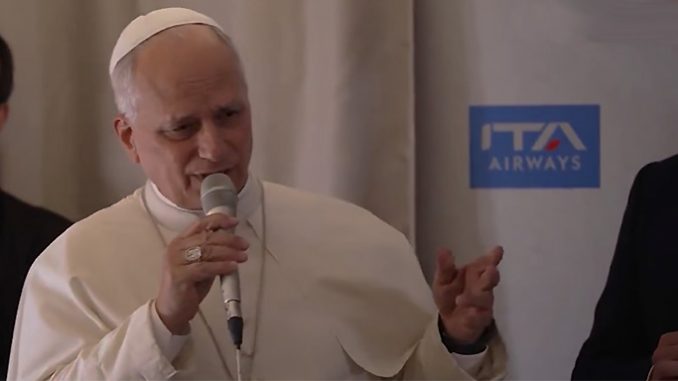
Pope Leo XIV, returning to Rome after a lengthy and undoubtedly exhausting apostolic journey to four African nations, was asked about the April 4th document issued by Cardinal Reinhard Marx of Munich and Freising in Germany, titled “Blessing Gives Strength to Love”.
Verena Stefanie Shälter (Ard Rundfunk): Holy Father, congratulations on your first papal trip to the Global South. We saw a lot of enthusiasm and even euphoria; I can imagine that was very moving for you as well. I would like to know how you assess the decision of Cardinal Reinhardt Marx, Archbishop of Munich and Freising, that he gave permission to the blessing of same-sex couples in his diocese, and in light of different cultural and theological perspectives, especially in Africa, how do you intend to preserve the unity of the global Church on that particular matter?
Note that the question was not about the specifics of the document but about how Pope Leo will try to preserve the unity of the Church. Implicitly, the question appears to accept the logical conclusion that Cardinal Marx’s instructions on giving blessings to “[c]ouples not married in the Church, divorced and remarried couples, as well as couples across the full spectrum of sexual orientations and gender identities” (translations from the German via DeepL).
The question is important because many of the initial reactions (including my own) to Pope Leo’s response overlooked it, and thus, I think, misunderstood to some degree the point he wished to make. Still, his answer raises some questions, not least about how, in fact, he may proceed in addressing the troubling position taken by Cardinal Marx (and others) and the approach being used to advance that position. Here is Pope’s answer in full:
First of all, I think it’s very important to understand that the unity or division of the Church should not revolve around sexual matters. We tend to think that when the Church is talking about morality, that the only issue of morality is sexual. And in reality, I believe there are much greater, more important issues, such as justice, equality, freedom of men and women, freedom of religion, that would all take priority before that particular issue. The Holy See has already spoken to the German bishops.
The Holy See has made it clear that we do not agree with the formalized blessing of couples, in this case, homosexual couples, as you asked, or couples in irregular situations, beyond what was specifically, if you will, allowed for by Pope Francis in saying all people receive blessings.
When a priest gives a blessing at the end of Mass, when the Pope gives a blessing at the end of a large celebration like the one we had today, they are blessings for all people. Francis’ well-known expression ‘ Tutti, tutti, tutti” ’ is an expression of the Church’s belief that all are welcome; all are invited; all are invited to follow Jesus, and all are invited to look for conversion in their lives.
To go beyond that today, I think that the topic can cause more disunity than unity, and that we should look for ways to build our unity upon Jesus Christ and what Jesus Christ teaches. So that’s how I would respond to that question.
First, of course, it is good that the Holy See has spoken to the German bishops and said that the blessings being, well, “blessed” by Cardinal Marx go beyond what was put forth in the December 2023 declaration, Fiducia supplicans. As Christopher Altieri noted here at CWR, the document was a polarizing flop from the start:
The purpose of Fiducia supplicans appears to have been twofold: It was to rein in bishops and bishops’ conferences that have already gone too far—think Belgium and Germany—and also encourage reticent bishops to loosen up. [Cardinal] Fernández has now all but admitted in words that the attempt failed spectacularly on both counts.
Over two years later, it is readily evident (to no one’s surprise) that most of the leaders and entrenched bureaucracy of the German Church are committed to a path of homosophistry and disunity, aka, “The Synodal Way”.
Talk of unity is fine as far as it goes, but talk alone is not going to solve this problem. If anything, it may just embolden the already belligerent prelates and bureaucrats in Germany, who seem to think—and why wouldn’t they?—that nothing is going to happen.
But I think that Pope Leo’s response on the German bishops/blessing issue would have been far better framed as, “It’s about love,” before “sexual matters.” He is right in stating that when many people (alas, even far too many Catholics) think of “morality,” they think of sex, and then it turns into a scrum over rules and commandments. But there is, I’m convinced, a far better and necessary approach to be taken (and, in fact, this was a point made in various and detailed ways by St. John Paul II in Veritatis Splendor).
The April 4th document from Cardinal Marx quite cleverly focuses on “love,” because, of course, no one can be against love! It mentions “love” several times, including in its opening, taken from a 2023 Synodal Way document:
The Church wishes to proclaim the message of the dignity bestowed by God upon every person in word and deed. This message guides her in her dealings with people and their partnerships. Therefore, it extends recognition to couples who are united in love, treat one another with full respect and dignity, and are willing to live out their sexuality in mindfulness of themselves, of one another, and with social responsibility over the long term, and offers them accompaniment. There are couples who ask for a blessing for their partnership. This request is based on gratitude for the love they have experienced and the hope for a future accompanied by God.
This is bureaucratic blarney pretending to describe authentic love, but in fact just outlining secular, bourgeois “love.”
As theologian Tracey Rowland remarked to me in a December 2021 interview, “the place where bourgeois Christianity flourishes is in church agencies. This might explain why the faith in Germany is in such a mess. There seems to be a high correlation between the ethos of bourgeois Christianity and institutions that are nominally Christian but funded by civil authorities.”
This sort of “Christianity,” she added, “is the attitude of people who identify themselves as Christians but define Christianity by a series of markers that are in no way different from the prevailing social fashions.” It is comfortable, self-congratulating, and even narcissistic—or, in the words of the Marx document: “…willing to live out their sexuality in mindfulness of themselves…”
There is no kenosis to be found within it. There is no self-gift, reflecting the mystery of Triune love. Because, to quote the late Cynic philosopher (and singer) Tina Turner, “What’s love got to do, got to do, with it?”
If the Church acts as if “same-sex relationships” are, as the German document states, relationships “united in love,” then it calls into question what the Church has always taught about love. Authentic love (friendship, familial, marital, etc.) must be ordered by and toward truth. And homosexuality, fornication, being civilly divorced and remarried, etc., are not ordered by and toward the truth of the Faith.
Put another way, if homosexual acts are “acts of grave depravity” and “intrinsically disordered,” and homosexual inclinations are “objectively disordered,” then no amount of blessing and language to the contrary is going to make them ordered, good, and loving.
And yet the German document accepts the very bourgeois premises of presentism, affirming that “In our culture and society … human dignity, equality, and self-determination are highly valued, and which therefore has a high degree of acceptance for love and responsibility…” Readers are blithely assured that to “be blessed by God means to walk the path of life under God’s loving gaze.”
Well, no, it’s not. As Christopher Malloy explains, a “blessing is chiefly (as a descending reality) a gift of divine assistance in the present for the ultimate good of the recipient. As such, a blessing is a means to an end. The ultimate end of any blessing is of course eternal salvation, but the proximate end is some present good suitable for the journey to heaven.”
Put another way, a blessing flows from divine love and is ordered to a good through the power and grace of divine life. So, while there’s certainly a need to talk about the sexual aspect of all this, there must first be a clear understanding of the nature of authentic love. There’s a reason, after all, that Benedict XVI’s first encyclical was on love, and that it began with this:
“God is love, and he who abides in love abides in God, and God abides in him” (1 Jn 4:16). These words from the First Letter of John express with remarkable clarity the heart of the Christian faith: the Christian image of God and the resulting image of mankind and its destiny.”
Note that latter part: “…and the resulting image of mankind and its destiny.” There we find unity, freedom, and all the rest. But it begins with a proper understanding of what love is and is not. Because that affects everyone to one degree or another, and has an immediate and grave effect on how people view marriage, sexuality, and ultimately the social order and the divine purpose of our existence.
Since the Catholic Faith, at the heart, is ordered by Triune love and for Triune love, what the Church says and teaches about love—in this case, eros, but also agape—goes to the heart of what it means to be human. Saying “justice” and “equality” are more important than such matters sounds good, but is not complete, because a flawed notion of love undermines authentic justice and equality. Which is why, for example, St. Pope John Paul II, decades ago, wrote:
Not only must human life not be taken, but it must be protected with loving concern. The meaning of life is found in giving and receiving love, and in this light human sexuality and procreation reach their true and full significance. …. Sexuality, which enriches the whole person, ‘manifests its inmost meaning in leading the person to the gift of self in love.’ The trivialization of sexuality is among the principal factors which have led to contempt for new life. Only a true love is able to protect life. (EV 81, 97)
This is essential, fundamental truth. It is not merely about “following rules” or “being moral”; it is about living the truth given by God, which is built into our very bodies and beings. Chastity refers to “the inner unity of man in his bodily and spiritual being” (CCC 2337), a unity that is a building block to unity with others. So, to come full circle, the commandments are not meant to limit us, keep us from freedom, hinder justice, or harm true unity. “For this is the love of God,” wrote the Apostle John, the disciple whom Jesus loved, “that we keep his commandments. And his commandments are not burdensome” (1 Jn 5:2).
If you value the news and views Catholic World Report provides, please consider donating to support our efforts. Your contribution will help us continue to make CWR available to all readers worldwide for free, without a subscription. Thank you for your generosity!
Click here for more information on donating to CWR. Click here to sign up for our newsletter.
Leave a Reply
You must be logged in to post a comment.