
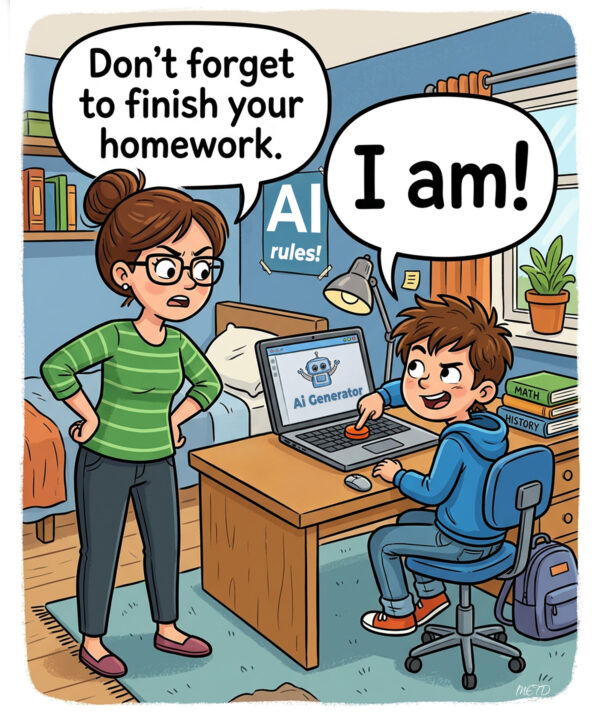
 Consider a first-year university student writing a paper at the end of the term. The task is daunting, and a tumult of emotions besets the young writer as he sits down to do his work. He is excited by the swirl of nascent ideas and by a handful of what sound, in his head, like fine phrases. But as the work gets underway, his hunches about how to approach the paper have only led him down dead ends—and he can now hear his hackneyed phrases for what they are. At this point, reluctance and dread take the place of his initial enthusiasm; in the past, such students might have felt only the strong temptation to procrastinate. But now, they feel a temptation of a different kind: the seductive enticement of AI and its ability to generate, with the click of a button, paragraphs that push effortlessly past the first moment of writer’s block.
In popular discourse, two aspects of artificial intelligence have become familiar. Some techno-pessimists claim that AI will destroy the world. After being immiserated and monitored, humanity will be mercilessly hunted, and anyone lucky enough to survive the swarms of autonomous drones and robot dogs will live in an environment depleted by data centers that have drained the world of water. Techno-optimists, on the other hand, hold that an AI-powered El Dorado is in the offing, and that the gifts of perpetual peace, universal income, and endless leisure will soon be dropping into our laps so long as we don’t delay or encumber the birth of our digital deities with small-minded regulations or a lack of resources. But, despite the prominence of both the apocalyptic and salvific promises of AI, neither of them seems to have much to do with the present-day form of these tools. While the use of AI for writing code and drafting legal documents is likely to expand, these seem like adaptations of an invention whose primary purpose is to help undergraduates cheat on their term papers in ways, at present, that are obvious, inept, and unconvincing. But what does bad writing have to do with the end of the world or its salvation?
Steve Jobs’ once famously described the personal computer as a “bicycle for the mind.” The metaphor could hardly be more attractive, conjuring charming old images of the advent of the first bicycles in the mid-1800s. Nowadays, however, no modern automobile rolls of the assembly line without a screen and map software already built in, so the metaphor has, in a certain sense, been inverted. Our minds themselves have now been mapped, shaped, and warped by the tools we use; the freedom of a bicycle and the illuminated thread of a path on a screen are two very different things. The former demands the development of new skills that facilitate further, freer travel, while the latter, in fact, implies that the basics of orienteering have already been unlearned. Online maps have surely made it easier to navigate unfamiliar places without much hassle, but they have also created a complete dependence which can be easily exploited: the very tools which seemed to enable movement now have the capacity to canalize, constrain, and control our freedom to move. What seems like simply a convenience has eroded a once-vital skill.
What is at stake when a student sitting down to write a paper takes an algorithmic short-cut? What happens when, instead of mastering his emotions and expanding his articulate powers, he simply turns the spigot of AI slop? Why are some of the largest companies in the world desperately seeking to “capture the market”—and the minds—of these same young writers in their most formative years? Amazon, which is now one of the most successful corporations in the world, began simply by delivering books. Thereafter, they expanded from this proof-of-concept and became the world’s largest retailer, which led to the closing of department stores and malls which, in turn, reshaped most North American cities in the process. There may be a race towards super-intelligence happening in secluded, secret labs—but the race we are all witnessing now is for the minds of the young.
It may not seem like it, but the college student producing prose is really creating himself. The thing of which an AI tool deprives the world, therefore, is the very self of that student, the world of unrealized possibilities that a literate citizen possessing the capacity for observation, evaluation, and persuasion represents. While it is certainly true that the power of AI tools will continue to grow in real terms, their exponential growth will seem even larger than it is, due to their relative growth. In other words, we will become dumber, less literate, and more diminished in our capacities for thought and reflection at an even faster rate than these technologies will develop. Past a certain point, we will only know what we are told by the machines—machines which will, in turn, be as powerful as their demonstrated propensity for deception.
Thus are the three faces of AI only an illusion. The optimistic and pessimistic futures about which we are allured and alarmed are really the same path, one that we already see emerging in the present. The machines will not need to entertain and engage a populace which has already lost its capacity to think; nor will they need to oppress a citizenry that has already lost its capacity for self-rule and rebellion. The machines, instead, will increasingly take the form of the enfeebling crutches on which we willingly rest. They are already becoming prosthetics for the organs that we voluntary allow to atrophy through disuse and neglect, our minds most of all.
The image of the future that emerges from the trends we already see is bleak precisely because it is bland. But there is hope to be found even within the rapid disappearance of human capacity. For those who wish to be human—for those who wish to retain their souls and selves in a world which is only too eager to relinquish them—the road is wide open: it stretches back to the past, branching down all the richest and rarest byways of bygone worlds. And it leads forward to a future in which the proudest traditions of culture will continue to flourish. What is artificial will ultimately fade, while what is real and vital cannot fail to thrive.
It remains for us to be reminded of these facts, and to hear the siren songs of techno-optimists and -pessimists for what they are: gross overstatements that seek to incarcerate us in the inevitability of their own prognostications. For their delirious and dire futures alike attempt to remove from us the limitless capacity which is innate in every human person: the endless capacity for action and initiative, for new creations and new beginnings. We have been made in the image of our Creator, and have abilities which no computer models can anticipate. Not to a machine but to a man were the words of the One seated on the throne spoken: “Behold, I make all things new.” (Rev 2:5)
Leave a Reply
You must be logged in to post a comment.