
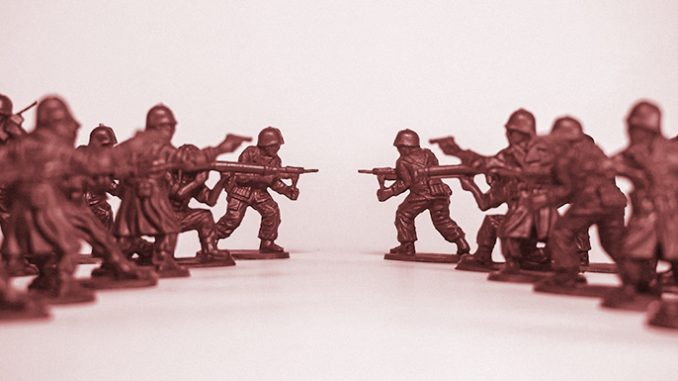
The main point of just war doctrine is to guide public authorities in determining whether a military action they are considering is morally defensible. In a democratic society, it also assists citizens in carrying out their own duties as voters, opinion makers, and so on.
But what of the servicemen who have to fight in the wars their governments decide to wage? Do they have an obligation to make a moral judgment about these wars in light of just war criteria? Must they refuse to fight in an unjust war?
Naturally, the just war tradition has addressed these questions. What follows is an explanation of the basic principles. The first thing to say is that the tradition draws a distinction between two main sets of questions: jus ad bellum questions, which have to do with the conditions under which a war may justly be entered into; and jus in bello questions, which have to do with how a war is to be conducted once it has started.
Where the first set of questions is concerned, the tradition holds that public authorities are to be held to a stricter standard of certainty about the justice of a war than soldiers are. They are, after all, the ones with the authority to go to war, and thus the ones with the primary responsibility to come to a sound judgment about the matter.
The prevailing view in the tradition is that public authorities have to be morally certain of the justice of a war before initiating it. This is a degree of certainty lower than metaphysical certainty but higher than mere probability. Suppose a hunter considers firing into some bushes. Naturally, it would be immoral to do so if he weren’t certain that another person was not standing behind the bushes. That doesn’t mean that he has to have the degree of certainty attaching to mathematical propositions like 1 + 1 = 2. But he has to have a degree of confidence stronger than a bare likelihood that no one is there. He would be guilty of recklessness otherwise.
Since war is, of course, even more dangerous than firing a gun into bushes, governments need to have a similar degree of certainty that a proposed war meets all the criteria of just war doctrine (just cause, reasonable hope for success, lawful authority, and so on).
Soldiers, however, are not ordinarily obligated to make such a determination. For one thing, most of them would not have expert knowledge of the details of just war doctrine. For another, usually they would not be privy to all the relevant concrete facts to which just war doctrine must be applied when deciding upon the justice of some proposed war. Furthermore, they have a general obligation to obey their superiors, and without a strong presumption that they will in fact obey, no military organization would be workable.
Hence, soldiers can and should presume that a war they are sent to fight is just, even if they have doubts. Moreover, even if it is unjust, once a war starts, their country and fellow soldiers are in danger, and it is legitimate to defend them. (Here’s an analogy. Suppose your father foolishly and unjustly picks a fight with another man, who proceeds to start beating him up. You can and should defend your father from this harm, even though he is in the wrong.)
To be sure, the presumption that a war is just can be overridden. As the Scholastic just war theorist Francisco de Vitoria writes, “if the war seems patently unjust to the subject, he must not fight, even if he is ordered to do so by the prince” (On the Law of War, Question 2, Article 2). But what would make a war “patently” unjust? Here, I would argue that the standard has to be a high one. Again, a military organization would simply be unworkable if soldiers could opt out of any war they personally judged to be unjust.
When addressing the issue of what degree of certitude public authorities and soldiers must possess, another Scholastic, Francisco Suárez, emphasizes the just cause condition of just war doctrine (The Three Theological Virtues: On Charity, Disputation 13, On War, Section VI). This seems to me correct. A soldier is not in the best position to make a certain judgment about whether a war meets criteria such as likelihood of success, or right intention on the part of public authorities. But the justice of a cause can, in some cases, be easier to judge.
Consider two concrete examples: driving Iraq out of Kuwait in the 1990-91 Gulf War and taking Greenland by military force, which President Trump at first declined to rule out. I would say that the first was plausibly a just cause for war, whereas the second was manifestly unjust. Of course, some would dispute the overall wisdom or even justice of the Gulf War, but the narrow aim of helping our ally Kuwait to drive the Iraqis out of its unjustly conquered territory, considered by itself, was certainly legitimate.
Hence, a U.S. soldier could and should have obeyed his superiors in that conflict, even if he personally had doubts about it. By contrast, seizing our ally Denmark’s territory by force simply because Trump thinks the U.S. needs it would straightforwardly amount to theft, and any killing that would have been done in the process would have been murder. Hence, had the U.S. actually decided to carry out such an attack, soldiers could legitimately have disobeyed their orders. This was the judgment of Timothy Broglio, the Archbishop for U.S. Military Services, and I think he was right.
However, except in clear cases like this, where the cause for which a war is fought is patently immoral, soldiers can act on the presumption that a war is just. If that presumption turns out to be mistaken, the moral guilt for the unjust war attaches to the public authorities who initiated it, not the soldiers who fight in it.
All of this has to do with jus ad bellum questions. Jus in bello questions are more straightforward. Even when jus ad bellum conditions are all clearly met so that a war is manifestly just, by no means is an “anything goes” approach legitimate in fighting it. Regardless of the justice of the cause, certain methods of warfare are intrinsically gravely evil and may never be resorted to. For example, it is murder deliberately to target civilians, or to kill enemy soldiers who have already been rendered harmless by being wounded or taken prisoner. Hence, orders to carry out such actions must be disobeyed. Indeed, the U.S.’s own Uniform Code of Military Justice requires servicemen to disobey such manifestly unlawful orders.
In short, the general principles that just war doctrine provides for guiding soldiers are: First, in determining whether to participate in a war decided upon by their government, soldiers should presume that the war is just and thus participate, unless the end for which the war is being fought is manifestly immoral. Second, in the conduct of the war, once it begins, soldiers should never obey specific orders to do something that is manifestly immoral.
(Editor’s note: This essay was first published, in slightly different form, on the author’s website and appears here with kind permission.)
If you value the news and views Catholic World Report provides, please consider donating to support our efforts. Your contribution will help us continue to make CWR available to all readers worldwide for free, without a subscription. Thank you for your generosity!
Click here for more information on donating to CWR. Click here to sign up for our newsletter.
Leave a Reply
You must be logged in to post a comment.