
The Religious Liberty Commission’s hearing on health care and social services highlighted legal issues faced by Catholic health care professionals.
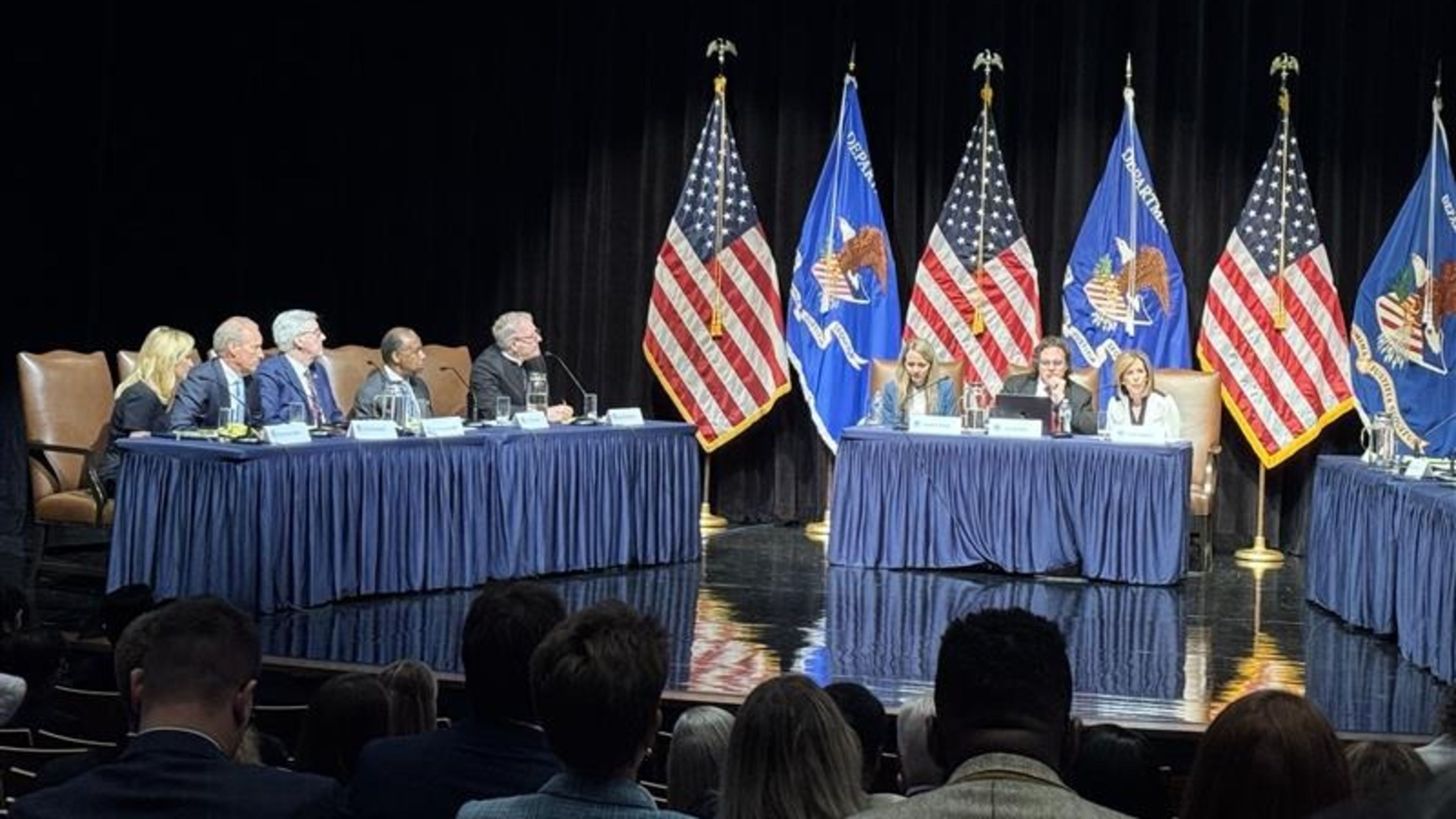
Bishop Robert Barron and Archbishop Salvatore Cordileone spoke out against the U.S. government’s past targeting of pro-life Catholics in health care at the U.S. Religious Liberty Commission’s fifth hearing.
Cordileone, who serves on the commission’s Advisory Board of Religious Leaders, highlighted the ongoing legal battle being fought by the Little Sisters of the Poor over government contraceptive mandates during his remarks at the March 16 hearing.
“These are women who deserve our utmost respect and esteem, and I can vouch for this from personal experience,” Cordileone said. “Why then would these humble, holy, and self-giving women have to find themselves in a multiyear, burdensome litigation with the federal government over a contraception insurance mandate that was part of the Affordable Care Act?”
The prolonged court battle of the Little Sisters of the Poor dates to 2011 when the Obama administration required employers to provide cost-free coverage for contraceptives, sterilizations, and “emergency birth control” in employee health plans under the Affordable Care Act (ACA).
Although the Supreme Court decided in the sisters’ favor in 2020, a federal court ruled against them in August 2025 when the U.S. District Court for the Eastern District of Pennsylvania ruled in favor of both New Jersey and Pennsylvania in finding that the federal government had not followed protocol when issuing exemptions to contraceptive requirements, including for the Little Sisters. They appealed the decision in December 2025.
“The courage of this poor religious community to take on the federal government with its endless resources cannot be overstated,” the San Francisco archbishop said.
Cordileone further highlighted California Attorney General Rob Bonta’s lawsuit against Providence St. Joseph Hospital in Eureka for refusing to perform abortions and a lawsuit against a Catholic hospital in Sacramento that refused to perform a hysterectomy for the purposes of gender transition.
Cordileone warned that if the courts rule against the Catholic hospitals in either case, that “all Catholic hospitals in California will be threatened.”
“Every year there are bills introduced into our state Legislature to expand private insurance coverage for sterilization, IVF, abortion, surrogacy, gender-affirming care, and so forth,” he said. “If these bills include a religious exemption, the exemption usually only covers organizations that fit a very narrow definition: employs people of their same faith, serves people of their same faith, and has the primary purpose of inculcating religious values. So here we have the secular government defining for religious communities what it means to be religious.”
“If we lose this fight, we will have lost the soul of our country,” he said.
Barron, who serves as a commissioner on the religious liberty panel, echoed Cordileone and said Catholics are increasingly being pushed out of health care and social services.
“I think they want us out of health care,” he said. “They want us out of education.”
The bishop of Winona-Rochester, Minnesota, said that for a long time, religious leaders articulated their mission in terms of love, which he defined, citing St. Thomas Aquinas, as “to will the good of the other.” He said that as the faith has been pushed out of public life, religious leaders “have become more reticent” to express the Church’s position publicly.
“We’ve got to come forward in the public space, articulate what is the human good. I think we’ve become more reticent, and we’ve succumbed to the pressures from the secular ideology,” he said. “We’ve got to keep articulating what the good is, because otherwise we won’t know what love really is.”
President Donald Trump established the Religious Liberty Commission in 2025 to advise the White House on threats to religious freedom and ways to strengthen religious liberty protections in the United States. A coalition of multifaith advocacy groups, including the Interfaith Alliance, Muslims for Progressive Values, the Sikh American Legal Defense and Education Fund, and Hindus for Human Rights, have sued to challenge the commission’s creation, arguing its membership is overwhelmingly Christian and not “fairly balanced” as required by the Federal Advisory Committee Act.
If you value the news and views Catholic World Report provides, please consider donating to support our efforts. Your contribution will help us continue to make CWR available to all readers worldwide for free, without a subscription. Thank you for your generosity!
Click here for more information on donating to CWR. Click here to sign up for our newsletter.
Leave a Reply
You must be logged in to post a comment.