
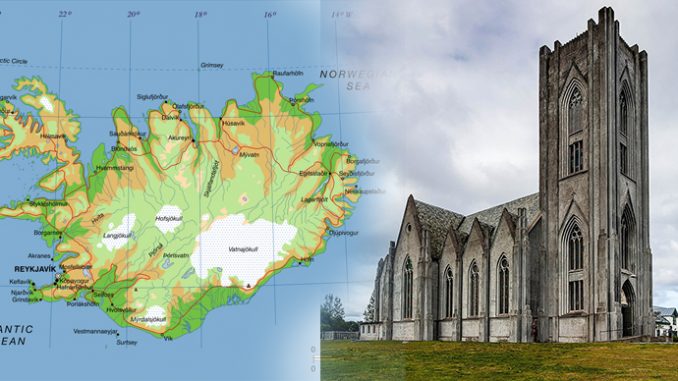
A flashpoint of Catholic faith and life in the Western liberal democracies is occurring in an unusual place: Iceland.
The Church has been in the headlines this month in the North Atlantic island nation, a rather unusual occurrence, after Fr. Jakob Rolland, chancellor of the Catholic Church in Iceland, gave an interview with state broadcaster RÚV that delved into the Church’s position on LGBT issues. Capital [Reykjavík] Region police have announced they will examine the priest’s remarks and determine whether to launch a criminal investigation.
The law in question is a 2023 parliamentary statute banning so-called “conversion therapy” of LGBT-identifying individuals. Critics of Fr. Rolland’s comments assert that the Catholic Church aims to “convert” the sexual orientations of Icelanders, even if the methods do not correspond to a traditional understanding of “therapy.” They claim adherence to Catholic teaching on this topic and refusal of the Eucharist to those living in same-sex relationships represent forms of conversion therapy.
Asked whether he feels compelled to follow the law on these matters, Fr. Rolland responded, “Yes, as long as the laws align with God’s laws, then it’s fine. It has been known in law from the very beginning that when the laws of the land and God’s laws conflict, God’s laws apply.”
Pressed on these matters in 2019, Fr. Rolland told a journalist, “If two women came to us and wanted to marry, then I’d say, ‘Unfortunately, that won’t work for us.’ If they wanted to press charges, I’d say, ‘Do it.’ If I go to prison, then I go to prison, but it won’t change my position.”
North Americans, generally accustomed to the intersection of Catholicism and hot-button social issues, should understand this episode through the lens of a missionary Church. In that sense, the Church in Iceland more closely resembles that of China than that of mainland Europe. One recent article in Icelandic media began by describing the Eucharist and its role in Catholicism to an uninformed audience. The landscape is not comparable to once-Catholic strongholds like Ireland and Spain, where the Church is a frequent punching bag of politicians and other public figures. In Iceland, Catholicism is still a curiosity, a byproduct of the unprecedented inward migration of recent decades.
Fr. Rolland, like most of his counterparts in Iceland, is a missionary priest. A Frenchman who has lived in Iceland for decades, he changed his first name to be more Icelandic–“no one here could say Jacques,” he explained in a 1999 interview. Nearly all Catholic priests in Iceland are foreigners, with the majority coming from Poland and neighboring countries in Central Europe.
Fr. Rolland’s interview comments, then, will strike an American reader as firm but charitable. “Sexual orientation is only one factor among many that concern an individual’s tendencies towards some lifestyle that is not good for the individual and not good for society,” he maintained. “And ‘conversion’—change of heart—this is a key word in the daily life of Catholic people. We are constantly in the position of turning away from what is evil towards what is good.”
He later noted, “Everyone who comes to church has their problems and sins, struggling to some degree with bad tendencies towards something. Everyone is kneeling, sometimes crying before God, before the statue of the Holy Virgin Mary, and asking for help. We are all really in the same position.”
He has affirmed in recent interviews that Catholics with homosexual inclinations may receive the Eucharist, but not if they are engaged in intimate same-sex relationships. “All belong in the Church and may call upon God to receive cleansing of the soul and reach the Kingdom of Heaven,” he stated. On the politically loaded topic of “conversion,” sure to be a focus of any potential criminal investigation, he stated, “No, there are no organized suppression therapies, just people talking together…People talk to a priest and seek advice. Then there are people who want support in their spiritual life. They come to us, come to church, come to prayer services, to Mass. It is primarily in this area that we can help.”
Though Iceland is nominally Lutheran, it has been thoroughly secularized in recent decades, like its mainland European cousins. In a scenario familiar to Catholics, the societal position of the Lutheran Church of Iceland has collapsed, and LGBT advocacy has arguably become the de facto manifestation of an Icelandic state religion. As such, animosity toward Fr. Rolland and the Catholic Church has been severe.
“It’s important to realize that even though he talks about it being just conversations, it is suppression therapy, no matter how organized it is,” asserted Bjarndís Helga Tómasdóttir, chairwoman of Samtökin 78, an Icelandic LGBT-advocacy organization. “This is a crime and should be investigated as such.”
Last week, Sigmundur Ernir Rúnarsson, of the Social Democratic Alliance, raised the issue in the Alþingi (Parliament) and insisted Icelandic society differs from the one the Catholic Church promotes. “What is the message to the gay and transgender people in the country? … It is, ‘Shame on you. Shame on you for your sexual orientation.’”
“I’m sorry if my Church is considering breaking the law,” said Minister of Foreign Affairs Þorgerður Katrín Gunnarsdóttir, who counts among the small number of ethnically Icelandic Catholics. “I appeal to my Church: Don’t get involved in something like this, don’t go against the law, and don’t go against diversity.”
The controversy is intertwined with the topic of migration, as nearly all Catholics are recent arrivals from countries like Poland, Slovakia, Lithuania, and the Philippines. Some defending Fr. Rolland have opined that Islam, another newcomer religion in Icelandic society, with beliefs likely to run afoul of the LGBT establishment, is unlikely to encounter similar criticism.
“Dealing with the clergy of the small denominations, that’s one thing,” remarked political scientist Baldur Þórhallsson in 2019. At that time, the new state religion was finalizing its rout of the old one, Lutheranism. “I can totally apologise on behalf of the Church [of Iceland] for having come out and hurting people this way [previous opposition to same-sex unions],” said Lutheran bishop Agnes M. Sigurðardóttir. “I’m happy to apologise for that.”
Now comprising an estimated four percent of the Icelandic population, Catholicism is becoming too big to ignore. Reykjavík’s Landakotskirkja often draws standing-room crowds for Masses in Polish, Icelandic, and English. It is not uncommon, for example, to see groups of Filipinos attending a Polish-language Mass. In Ísafjörður, the largest town in the secluded Westfjords region, Catholics gather in a small house-turned-church for a trilingual Icelandic-English-Polish Mass.
The burgeoning ranks of the faithful eagerly fulfill their spiritual needs in an Icelandic Church that lay nearly dormant for over four centuries.
In this environment, Fr. Rolland exudes hope. Asked about bucking the trend of LGBT-issue prominence in Icelandic society, he recalled, “Yesterday I had a meeting for people who want to learn more about the Catholic faith and the Church’s teachings. And it was just a large group, and the vast majority were young people. So maybe it’s also part of the zeitgeist to be looking for an anchor, for answers to life’s questions. You want to find security and a sanctuary and community, and that’s the kind of people who come to us.”
If you value the news and views Catholic World Report provides, please consider donating to support our efforts. Your contribution will help us continue to make CWR available to all readers worldwide for free, without a subscription. Thank you for your generosity!
Click here for more information on donating to CWR. Click here to sign up for our newsletter.
Leave a Reply
You must be logged in to post a comment.