
Bishops from the Texas-Mexico border region met to discuss their role on both sides of the border, as well as the recent wave of violence in Mexico.
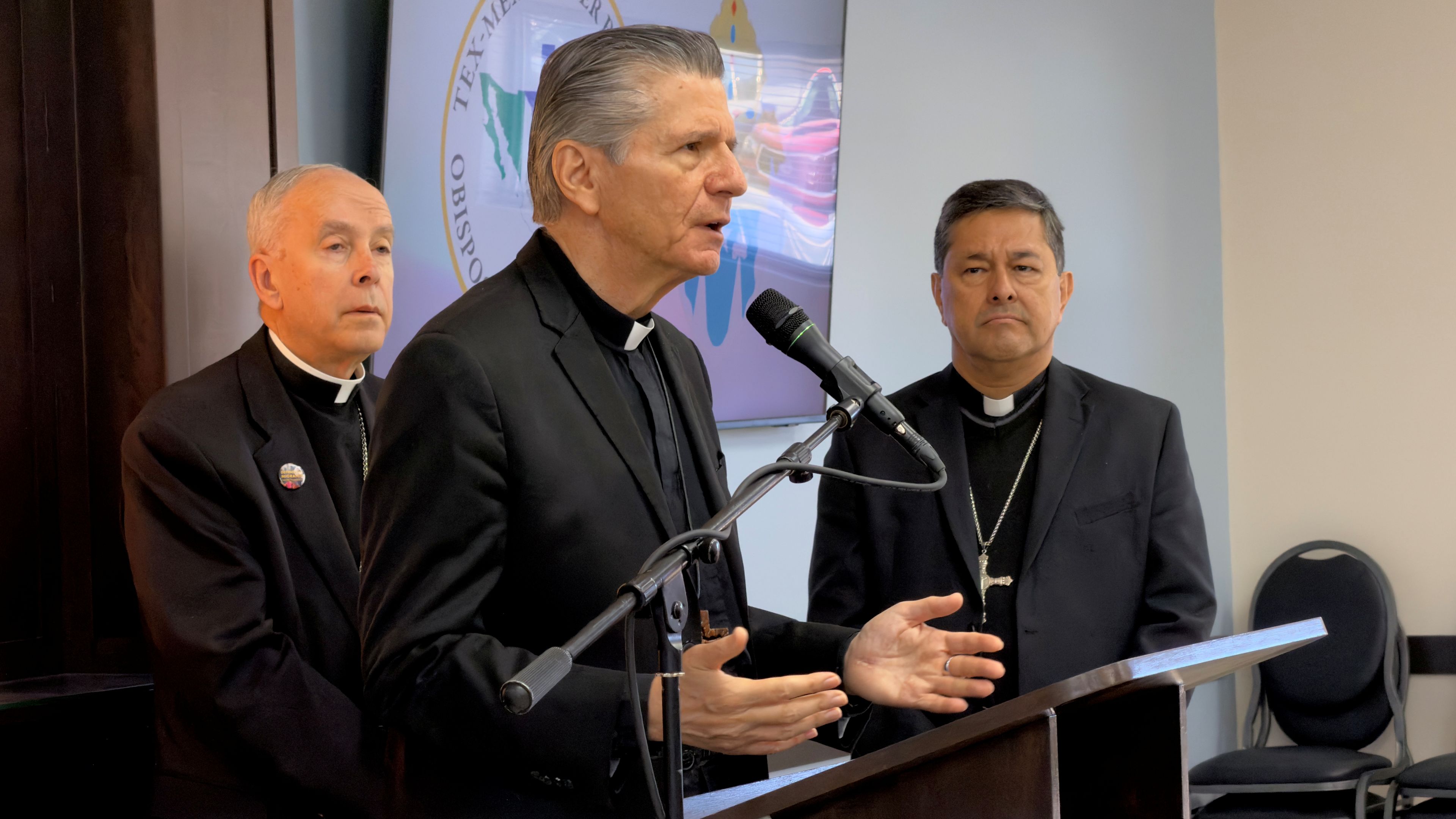
A group of bishops from the Texas-Mexico border region, informally known as the “Tex-Mex bishops” met in El Paso, Texas on Friday to discuss immigration and its effects on both the U.S. and Mexico, as well as recent drug cartel-related violence in Mexico.
The meeting of the Tex-Mex bishops is now “the longest-running international gathering of Catholic bishops anywhere in the world,” according to a press release from the Diocese of El Paso on behalf of the bishops. The group has met twice a year for more than 40 years.
At the press conference, San Antonio Archbishop Gustavo García-Siller, the group’s coordinator, said the bishops were concerned with the “plight of our brothers and sisters, migrants, which are on both sides of the border.”
The prelate said immigration enforcement has “changed drastically” in recent years. Because of these changes, García-Siller emphasized that the bishops “need to learn new ways to serve well” migrants and refugees in order to “bring solutions” and “some solace, some peace, some kind of understanding.”
“You need to know that God loves you, and that we love you, too,” he said before beginning to address his listeners in Spanish.
At their meeting, the bishops were guided by the November Special Message from the United States Conference of Catholic Bishops (USCCB) on immigration, and the recently released statement of 20 U.S. Catholic bishops from border states and others, who recommended immigration enforcement reforms to the Trump administration.
Bishop Mark Seitz of El Paso said, however, that “bishops are not politicians. That is not our role…our role is to be pastors.”
Echoing García-Siller, Seitz said that “Our role is to love the people that we serve. And…it doesn’t matter to us whether they’ve lived here a long time or they’re simply passing through. When we see that other person, we see a person created by God and given a special dignity, a value that is unparalleled and unrepeatable.”
The bishops also discussed ongoing unrest in Mexico after this week’s killing by the Mexican military of cartel leader Rubén Oseguera Cervantes, “El Mencho,” and the violence that ensued. They discussed the necessity of a continued pastoral response for those affected.
Among the bishops who participated in Friday’s meeting were Bishop Brendan Cahill of Victoria, Texas, the USCCB Chair of the Committee on Migration and Refugees, Alonso Gerardo Miranda Guardiola, the Bishop of Piedras Negras, Mexico.
Others in attendance included Bishop Mark J. Seitz of El Paso, Bishop Michael Sis of San Angelo, and Bishop Daniel Flores of Brownsville. Father Francisco Gallardo from the Diocese of Matamoros Reynosa in Mexico and the executive secretary of the Mexican Bishops’ Committee on Migration also participated.
Minnesota Mass in solidarity with migrants
Meanwhile, in Minnesota on Friday, four cardinals, including Cardinal Robert McElroy of Washington, D.C., along with Cardinal Joseph Tobin of Newark, Cardinal Christophe Pierre, the apostolic nuncio to the U.S, Archbishop Bernard Hebda of St. Paul and Minneapolis, along with more than thirty Catholic bishops participated in a Mass said in solidarity with migrants in conjunction with the Way Forward conference at the University of St. Thomas.
In remarks made following the Mass, addressing the recent immigration enforcement-related violence in Minnesota, McElroy said “We all need to engage in healing and reconciliation. It will take a long time.”
Hebda agreed, saying “That ministry of reconciliation has to be ours, in the Twin Cities and around the world.”
In January, following the shooting deaths of two civilian protesters, Hebda called on all “to lower the temperature of rhetoric,” and “rid our hearts of the hatreds and prejudices that prevent us from seeing each other as brothers and sisters,” referring both to immigrants without legal status in the country as well as immigration enforcement personnel who “have the unenviable responsibility of enforcing our laws.”
On Friday, McElroy called ICE’s enforcement actions this past winter “almost a siege” in “the heartland of our country.”
He continued: “Catholic teaching supports the nation’s right to control its border and, in these cases, to deport those who’ve been convicted of serious crimes.”
However, he continued: “Seeking to deport millions of men and women and children — families who often lived here for decades, many children who don’t know other countries — is contrary to Catholic faith and, more fundamentally, contrary to basic human dignity.”
If you value the news and views Catholic World Report provides, please consider donating to support our efforts. Your contribution will help us continue to make CWR available to all readers worldwide for free, without a subscription. Thank you for your generosity!
Click here for more information on donating to CWR. Click here to sign up for our newsletter.
Leave a Reply
You must be logged in to post a comment.