
“The reality is that the government’s campaign against the Armenian Apostolic Church, which has been going on for well over a year, continues unabated to this day,” Ambassador Alberto Fernandez said.
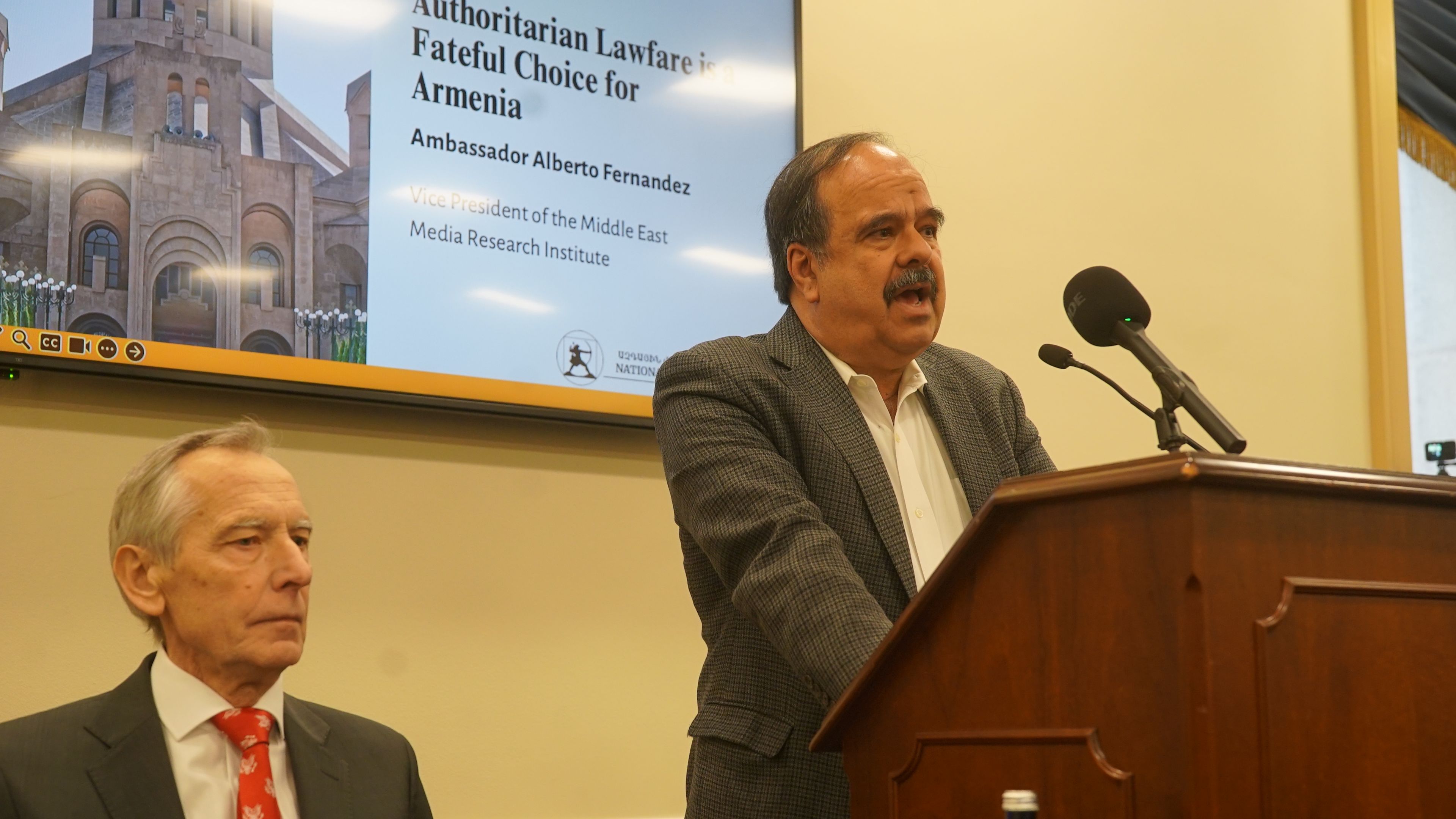
International human rights advocates called on the Trump administration to caution Armenia’s government against veering into authoritarianism amid increased suppression of the country’s Apostolic Church.
“The reality is that the government’s campaign against the Armenian Apostolic Church, which has been going on for well over a year, continues unabated to this day,” said Ambassador Alberto Fernandez during a Feb. 26 briefing organized by the National Defense Alliance on Capitol Hill.
The hearing centered on the aftermath of Vice President JD Vance’s historic visit to Armenia and Prime Minister Nikol Pashinyan’s ongoing crackdown against the Armenian Apostolic Church, which has recently included the indictment of its leader Catholicos Garegin II, the jailing of several bishops, and the restriction on their movements outside the country.
“The reality is that the government’s campaign against the Armenian Apostolic Church, which has been going on for well over a year, continues unabated to this day,” Fernandez said during the hearing. He cited the Catholicos’ prevention from traveling to Austria for a global meeting of Armenian Apostolic Church leaders in Austria as “something that should get a lot more of our attention.”
Pashinyan’s restriction of the Catholicos’ travel to the conference came after the Holy See of Etchmiadzin postponed the meeting, which was originally set to take place Dec. 10–12, 2025, and eventually moved it abroad due to “repressions against clergy,” according to local reports.
Fernandez called on Pashinyan’s government to end its campaign against the Apostolic Church, saying: “They can’t have it both ways — they can’t say that they want to be a part of the liberal West, they want to be pro-American, and [at the same time] imitate the religious standards of the [Turkish Erdoğan regime] or [the Syrian Asaad regime], or pick whatever dictator you want.”
“There’s a basic contradiction here that has to be solved and has to be addressed,” he said.
Fernandez warned that Pashinyan’s stifling approach to the Apostolic Church “is a danger for the regime and for the government itself.”
“There is a clear, direct connection between the freedom given to the Church or to religious bodies and other freedoms of speech and conscience,” he said. “I don’t know of any situation where a regime persecutes religious bodies and then turns around and is open and accepting of secular criticism, political criticism, [or] sarcasm … they go together.”
“Regimes that don’t want to hear criticism from religious authorities tend also not to want to hear criticism from the media or from secular critics,” he said.
John Eibner, president of Christian Solidarity International, called on the Trump administration “to show strength and conviction by defending the Armenian Apostolic Church against this persecution, thereby enhancing the survival of the world’s first Christian nation.”
Eibner told EWTN News that Armenia is in a “very vulnerable situation,” despite the deal forged by President Donald Trump between Armenia, Azerbaijan, and Turkey. The deal, he said, has “yet to be finalized.” Moreover, he said, while there has been “talk of peace,” it remains by no means certain.
With elections looming, Eibner said Pashinyan is presenting himself as “the man for peace,” and saying, “If you don’t go with me, you will have war.” This, he said, is due in part to Pashinyan’s involvement in the Trump-backed peace plan.
“There are all kinds of political problems,” he said. “There are opposition members in jail. Pashinyan, I believe, is feeling very confident because his reelection has just been endorsed by [Vance], showing that the United States is behind him.”
“The European Union is pumping money to support his reelection in the name of fighting Russian disinformation, but it is to support, of course, his campaign,” he said, adding that both Turkey and Azerbaijan “are threatening war” and “see Pashinyan as their man.”
“He’s presenting himself as the only alternative or the only possibility for peace, and this registers, too, with the Armenian public,” Eibner said. “On the one hand, they want to retain their national tradition, their church, their borders, et cetera, their own autonomy. But they’re being threatened with war.”
Ultimately, he said, “the real question for the United States and Armenia is, ‘Are there any guarantees that can be given to ensure that whatever might be signed in time is actually upheld?’”
If you value the news and views Catholic World Report provides, please consider donating to support our efforts. Your contribution will help us continue to make CWR available to all readers worldwide for free, without a subscription. Thank you for your generosity!
Click here for more information on donating to CWR. Click here to sign up for our newsletter.
Leave a Reply
You must be logged in to post a comment.