
Bishop Heiner Wilmer, new president of the German Bishops’ Conference, could take a more conciliatory approach to Rome even as debates continue over the Synodal Way.
WÜRZBURG, Germany — The election of the president of the German Bishops’ Conference (DBK) this week ended in a contested vote once again — and, as in 2020, the progressive Bishop Franz-Josef Overbeck of Essen came up short.
The 56 bishops and auxiliary bishops gathered in Würzburg for the spring plenary assembly of the DBK needed three ballots on Tuesday morning, after neither of the first two rounds produced the required two-thirds majority. In the final round, when a simple majority was enough, Overbeck again finished second.
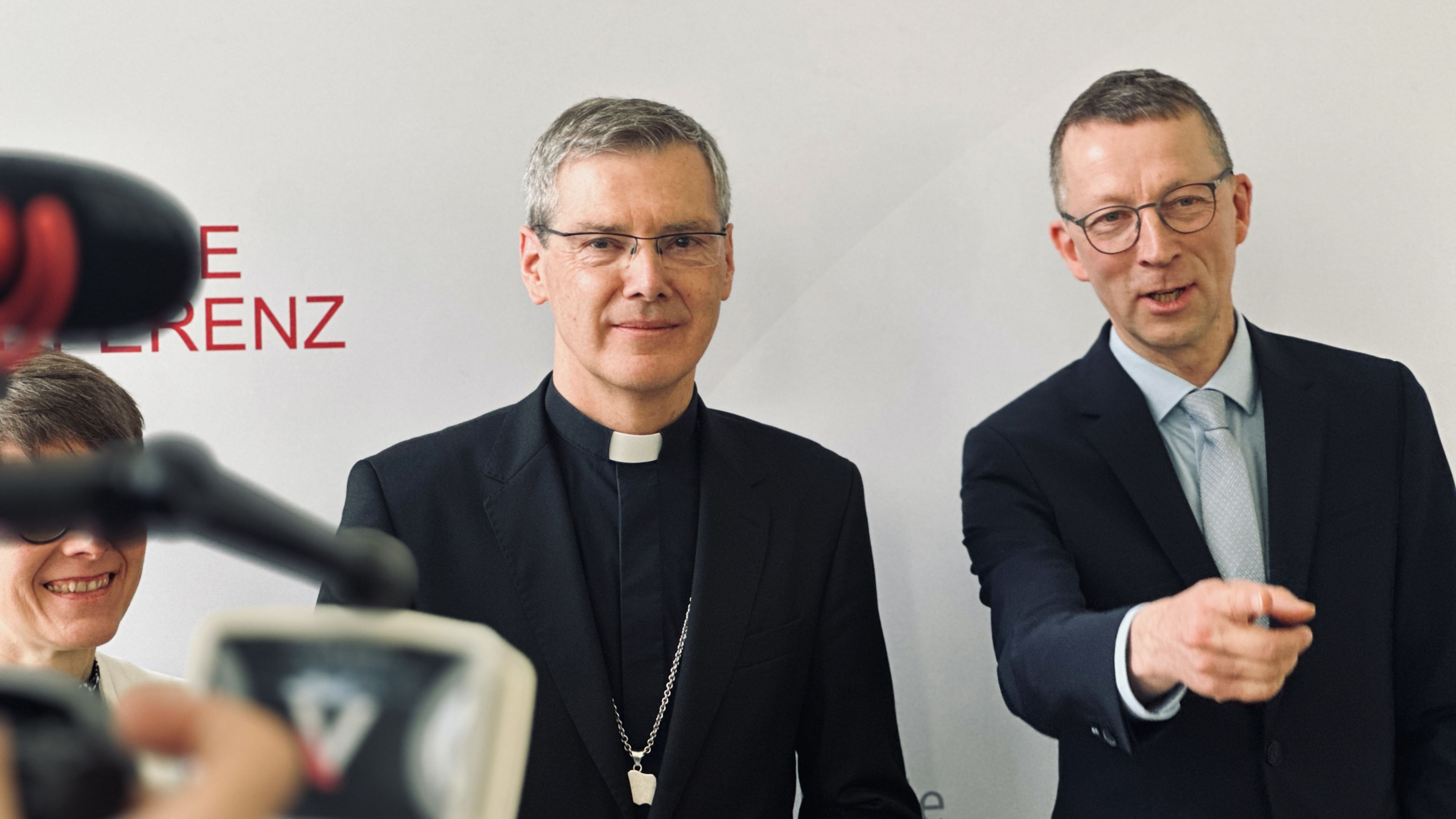
In the end, it was not Overbeck but Bishop Heiner Wilmer of Hildesheim who stepped before journalists as the newly elected DBK president.
“Glory to God in the highest, and on earth peace to people of goodwill,” Wilmer said, opening his first statement to the press with the words of the angel in the Gospel of Luke.
In the brief interval between the third ballot and the obligatory press conference, the new chairman prepared an address of nearly eight minutes, which he read from his mobile phone — prompting some to wonder aloud whether the text had already been waiting on his device. “Synodality remains a spiritual attitude,” Wilmer said, reading from his phone.
Standing to his left was Bishop Georg Bätzing, who had vigorously advanced the Synodal Way, launched in 2019 as a multiyear national process that brought together bishops and lay representatives to debate questions such as power and governance, sexual morality, the priesthood, and the role of women in the Church. In recent years, the rift between the German Bishops’ Conference and the Roman Curia had steadily deepened, and the specter of schism had hung over the Church in Germany.
Plans to institutionalize the Synodal Way, described by its architects as a process of renewal, in the form of a permanent Synodal Council were halted by Pope Francis. In a renewed effort, Bätzing and his allies then sought to entrench the process under the concept of a Synodal Conference, envisioned by critics as a kind of ecclesial parliamentary simulation and supervisory body for bishops — euphemistically termed monitoring. Supporters of the process frequently invoked the need to listen to the voice of the faithful, even as a recent study found that a majority of Germans considered the Synodal Way to be “rather wrong.”
Wilmer, for his part, described his understanding of synodality as “journeying together, sharing responsibility, and bearing decisions together.”
“Christ stands at the center,” he added — a line that drew notice in the room. In the Q&A, a journalist who had covered Wilmer’s three predecessors as conference presidents remarked pointedly that never before at such press conferences had the words “Christ,” “Jesus,” and “faith” been used so often. Asked whether he intended to bring a new style to the bishops’ conference — and whether that explained his election — Wilmer replied simply: “I do not know. I cannot do otherwise. And I am grateful for the support of my fellow brothers.”
Peace, abuse crisis, and Rome
Wilmer emphasized peace — his introduction came on the fourth anniversary of Russia’s invasion of Ukraine — and the ongoing reckoning with the abuse crisis. He also appeared eager to dispel the impression that he would continue the highly public confrontational posture toward Rome associated with his predecessors, often in close cooperation with the controversial Central Committee of German Catholics (ZdK).
“Pope Francis has shown us anew that the Gospel is joy,” Wilmer said, adding: “Pope Leo XIV continues this path with spiritual clarity.”
Asked whether the Catholic Church might one day ordain women to the priesthood, Wilmer did not publicly challenge existing Church teaching. Instead, he responded: “I very much welcome that the world synod has the topic of women in offices and ministries on its agenda. And I remain convinced that the Holy Spirit is at work today. I look forward to the surprises of the Holy Spirit.”
‘God Is Not Nice,’ language debates, and climate-era missteps
Wilmer’s public profile included a 2013 book published by Herder titled “Gott ist nicht nett” (“God Is Not Nice”), in which he wrote candidly about what he called the Church’s pious jargon and his own reliance on clichés. Herder issued a second edition in 2018 after his appointment as bishop of Hildesheim.
In 2019, Wilmer drew criticism after he said in an interview with the German newspaper Kölner Stadt-Anzeiger: “The abuse of power is embedded in the DNA of the Church.” Cardinal Rainer Maria Woelki responded at the time: “If that were so, I would have to leave the Church.” People who knew Wilmer told CNA Deutsch, the German-language sister service of EWTN News, that the comment had been a mistake, even if, they said, his broader point had been understood. Wilmer had worked for many years as a teacher, school chaplain, and headmaster in Germany, Canada, and the United States.
Language controversies also followed him into liturgical territory. In 2021, the Diocese of Hildesheim published guidelines on gender-sensitive language, discouraging exclusive use of the generic masculine and promoting what it called a diverse address to God. The brochure encouraged alternatives such as saying “Christ, our brother,” instead of “Lord Jesus Christ,” and suggested expansions of the liturgical greeting “The Lord be with you.” The head of the Verein Deutsche Sprache (German Language Association), Walter Krämer, accused Wilmer of undignified ingratiation and announced his departure from the Church.
Wilmer also faced criticism for comments in 2019 praising then-16-year-old climate activist Greta Thunberg as like a young prophet and commending the Fridays for Future movement. The German text said Wilmer later refrained from speaking prominently on the topic amid fresh controversies surrounding Thunberg and waning public momentum for the movement — and noted that climate was not mentioned at all in his remarks upon becoming DBK president.
A wind of change — or more of the same?
Bätzing became DBK president in 2020, succeeding Cardinal Reinhard Marx. His tenure coincided with intensifying strain between German bishops and the Vatican, as efforts to formalize the Synodal Way through bodies such as a Synodal Council or Synodal Committee met repeated resistance from Rome. Bätzing ultimately did not seek reelection as conference president.
Wilmer later wrote in the German outlet Communio: “It was right not to adopt the statutes of the Synodal Committee. It was right to take seriously the concerns of the three cardinals and thus also the concerns of the Holy Father.”
Substantively, however, Wilmer did not distance himself from his voting record at Synodal Way assemblies. According to the article, he voted in favor of blessing same-sex unions and supported a text calling for a magisterial reassessment of homosexuality, arguing that same-sex sexuality, even in sexual acts, “is not a sin separating from God” and is not to be judged intrinsically disordered but evaluated according to certain values.
Some critics of the Synodal Way and the planned Synodal Conference nonetheless reacted to Wilmer’s election with cautious optimism, describing him as a very spiritual figure — prayerful and, compared with Bätzing or Overbeck, more a man of the center. In a previous interview with the Rheinische Post, Wilmer said he was absolutely in favor of renewal while also warning against impatience: “In Germany, we sometimes lack perseverance… not everything can be implemented within our own lifetime.”
When he appeared before the press as the newly elected chairman, the vote on the statutes of the Synodal Conference was still pending. Asked about the likelihood of Vatican approval, Wilmer replied: “From Rome I have heard the signals that Pope Francis said: ‘Synodality is the fundamental form of the Church.’ Pope Leo has confirmed this, and in this respect I am confident.”
A few hours later, the bishops’ conference announced in a brief press release that the statutes had been accepted by a majority of bishops. The much-anticipated wind of change, the article suggested, remained uncertain.
Limited authority — significant symbolism
As DBK president, Wilmer presides over the plenary assembly and the permanent council but has no direct governing authority over other bishops. The conference’s statutes state that he represents the DBK externally and is bound by its resolutions.
Even so, the chairmanship carries weight — especially in relations with Rome. Wilmer’s new role suggests a classroom reversal: the former teacher now representing his brother bishops as the conference’s public face, especially in relations with Rome.
Wilmer offered his own metaphor in response to a question at his first press conference as chairman: “I am a pilgrim on the way: in one hand the Gospel, in the other hand the people in view.”
This article was first published by CNA Deutsch, the German-language sister service of EWTN News, and has been translated and adapted by EWTN News English.
If you value the news and views Catholic World Report provides, please consider donating to support our efforts. Your contribution will help us continue to make CWR available to all readers worldwide for free, without a subscription. Thank you for your generosity!
Click here for more information on donating to CWR. Click here to sign up for our newsletter.
Leave a Reply
You must be logged in to post a comment.