
Bishop Heiner Wilmer of Hildesheim struck a spiritual tone after his election. His record shows him as a firm supporter of Germany’s controversial Synodal Way.
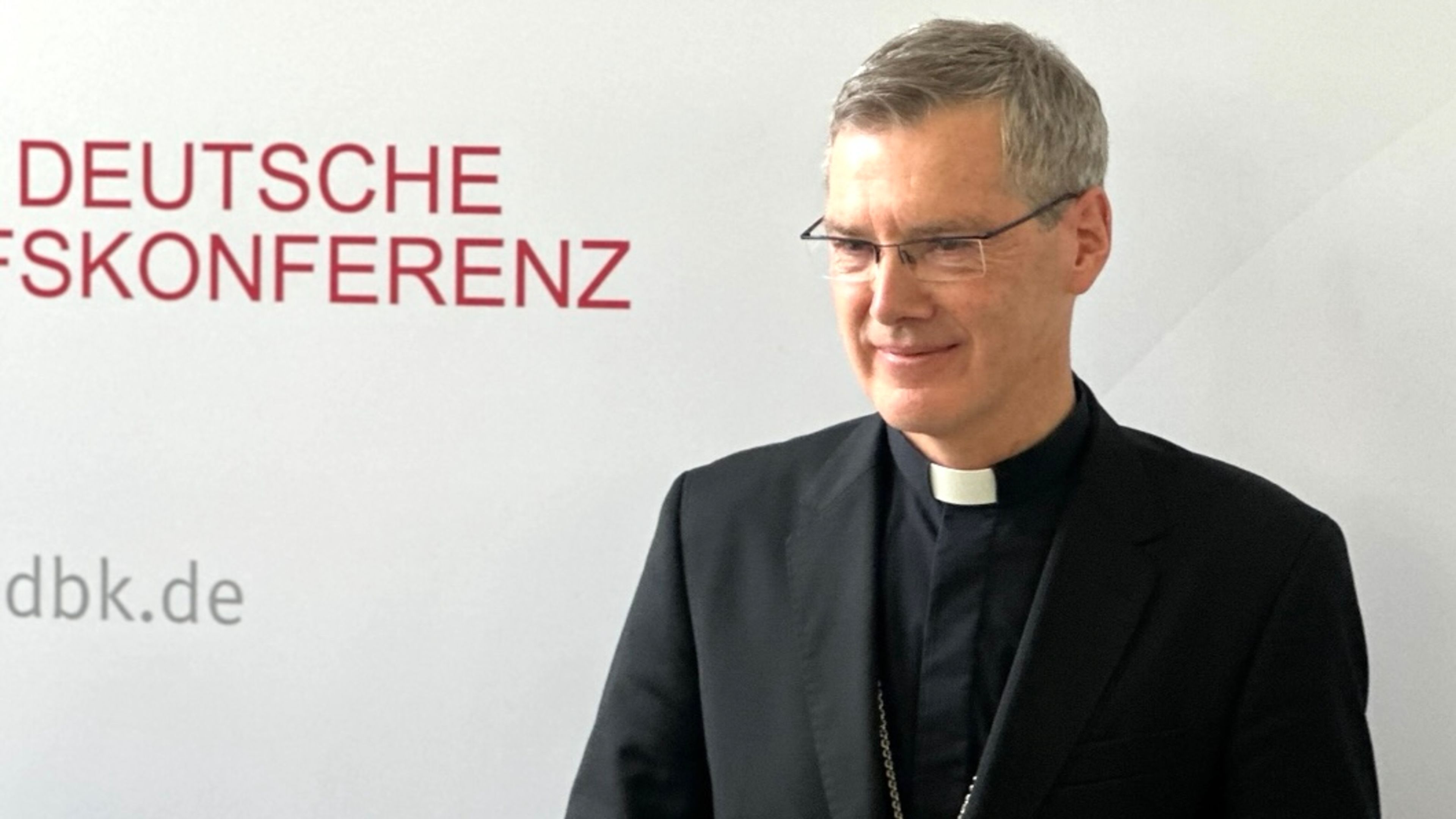
WÜRZBURG, Germany — Bishop Heiner Wilmer of Hildesheim was elected chairman of the German Bishops’ Conference on Tuesday, succeeding Bishop Georg Bätzing of Limburg at the helm of the country’s powerful episcopal body for a six-year term.
Wilmer, 64, a member of the Priests of the Sacred Heart (Dehonians), was chosen during the bishops’ spring plenary assembly in the Bavarian town of Würzburg. He has led the Diocese of Hildesheim in northern Germany since 2018 and previously served as superior general of his religious order in Rome.
Glory to God
In his first remarks as chairman to the press, Wilmer struck a notably spiritual tone, opening with the words of the Gloria — “Glory to God in the highest and peace on earth” — and calling them his “compass.”
The bishop also referred to the bloody conflict in Ukraine on the anniversary of Russia’s full-scale invasion, declaring “this war needs an end — now.”
Asked by EWTN Germany’s Martin Rothweiler about his priorities beyond synodality, he said: “I see my main task as placing God at the center.”
On the question of whether the Vatican might approve the statutes of a proposed permanent synodal conference in Germany, Wilmer said he was “confident,” noting that both Pope Francis and Pope Leo XIV had affirmed synodality as a fundamental form of Church life.
The proposed body represents the latest iteration of plans to establish a permanent body in Germany in the wake of the controversial process, following repeated interventions by Pope Francis and the Vatican.
The election comes as the bishops are expected to vote during the same plenary on statutes for the proposed body, which would give laypeople equal voting rights alongside bishops on matters of Church governance. The Vatican has repeatedly raised concerns about the proposal.
A consistent Synodal Way supporter
Wilmer’s voting record places him firmly among the supporters of the controversial German process, reported CNA Deutsch, the German-language sister service of EWTN News.
The bishop voted consistently with the Synodal Way, the 2019–2023 event that passed resolutions calling for the blessing of same-sex unions and other changes that drew sharp criticism from Rome and bishops’ conferences around the world.

According to the National Catholic Register, Wilmer was also considered — but ultimately not chosen — by Pope Francis in late 2022 to head the Dicastery for the Doctrine of the Faith.
Nuncio warned of schism risk
A day before Wilmer’s election, the apostolic nuncio to Germany, Archbishop Nikola Eterović, delivered a greeting to the bishops that carried a pointed warning about reform leading to division.
Eterović recalled Marcantonio de Dominis (1560–1624), a Croatian archbishop who championed Church reform but broke with Rome, had his teaching condemned, and met a tragic end.

Archbishop Nikola Eterovic, apostolic nuncio to Germany. | Credit: Roberta F/Wikimedia (CC BY-SA 3.0)
“I recall the controversial figure of my countryman to show that the goodwill to carry out Church reforms, and even the use of formulas that are valid in themselves, can at times lead to division and even schism,” the Croatian prelate said.
To avoid such consequences, the nuncio said, it was necessary to remain “firmly rooted in the one, holy, catholic, and apostolic Church,” with the pope as guarantor of unity.
Bätzing defends legacy
At a press conference Monday, outgoing chairman Bätzing defended the German Synodal Way, declaring there are “points where I believe we may change Church teaching for the sake of people without touching the core of what is Catholic.”
He argued the Church’s sexual morality was “to a large extent simply ineffective” because Catholic faithful “just leave it aside and live their lives.” At the same time, Bätzing insisted: “I stand by the teaching of the Catholic Church. This is my Church.”
If you value the news and views Catholic World Report provides, please consider donating to support our efforts. Your contribution will help us continue to make CWR available to all readers worldwide for free, without a subscription. Thank you for your generosity!
Click here for more information on donating to CWR. Click here to sign up for our newsletter.
Leave a Reply
You must be logged in to post a comment.