
Editor’s note: This review contains some strong language and descriptions relating to sex.
Last week, I attended the New Year’s celebration at the Chinese Embassy in Washington, D.C. It was paradoxical: the cultural program included a majority of works from classical and operatic Western music (as well as traditional Chinese songs). It was paradoxical to hear faithful and highly artistic renditions of works, including The Barber of Seville’s “Largo al factotum,” in a Communist Chinese setting.
If a Western artist were to perform them, they would likely be severely mutilated—that is, “adapted”.
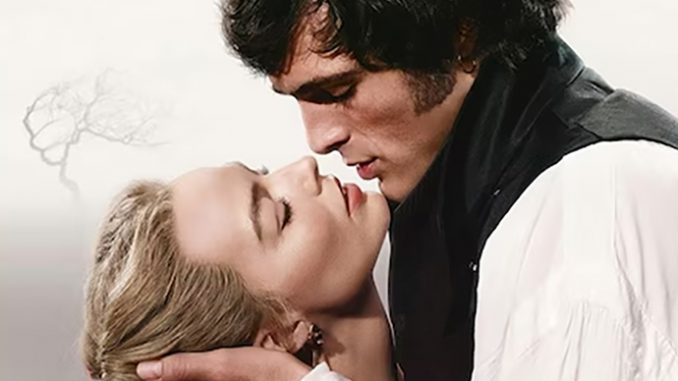
Which brings us to British director Emerald Fennell’s Wuthering Heights.
Dare I say that if Emily Brontë had originally written what Fennell did to her novel, it likely would not still be read 179 years later.
Many people today reduce Wuthering Heights to a love story. It is–but not just. It is also a moral and a spiritual story. Brontë was, after all, a vicar’s daughter. But those elements get lost in this retelling according to modern criteria.
For one, Brontë’s love story is turned into Fennell’s sex story. San Francisco Chronicle film critic Mike LaSalle calls it a “sexed up” Wuthering Heights. No doubt the fictional Cathy and Heathcliff had their sexual moments: it is, after all, a novel about a woman married to one man but desiring another. But the denizens of Fennell’s Yorkshire clearly need a cold shower, regardless of how many rainstorms they get soaked in.
From the opening scene where little Cathy is turned on by a hanged man’s erection to her masturbating on the moors, from Isabella’s bondage pet play as a dog to Joseph and Zillah’s kinky copulation in the stable, the viewer endures all manner of sex.
Why? To criticize the “Victorian hypocrisy” (to which even the author succumbed) by outing the raging hormones of everyone but Edgar Linton, who manages to limit himself to marital sex on the marital bed? To normalize all manner of sexual excess? To suggest the author’s perspectives were stunted because she grew up in a vicarage? Or to insist that, according to today’s norms, a “love” story cannot be a “love” story absent lots of sex?
Wuthering Heights is arguably a 19th-century embodiment of a very 20th-century idea: the “soulmate.” When Heathcliff curses Cathy post-mortem, begging her to haunt him, he does so because, “I cannot live without my life! I cannot live without my soul!” And, arguably, the novel highlights the tensions between the love of a “soul mate” and a marriage entered into out of other considerations.
But the most cursory reading of Brontë’s novel, even if indulgent of that romantic theme, does not show indifference to the betrayal of marriage, which regularly is cited as leading to the lovers’ perdition. The difference is that Brontë and her readers took that idea seriously, even if they might have grappled with la logique du coeur. Fennell, citing the same line, treats it almost as a throwaway. How can anybody take it seriously?
Of course, the idea of marital betrayal is also toned down in the film. Cathy and Edgar’s marriage serves primarily as a problem in the face of “love.” Indeed, Edgar Linton appears practically clueless in the face of his wife’s increasingly blatant infidelities, which one would assume would have been better covered up in the 1840s. Unlike Gary Puckett’s certainty that “a woman wears a certain look when she is on the move//and a man can always tell what’s on her mind,” Edgar seems not to notice that look all over Cathy.
Fennell’s shift to sex reflects other shifts in the moral focus of Wuthering Heights, as many of the novel’s underlying moral themes are gone.
There is an undercurrent that money-focused capitalism makes for unhappy lives. Most importantly, Heathcliff’s destructive anger and revenge are toned down rather than central to his character: he sets out on vengeance only when Cathy starts cutting off sex with him, and he learns she is pregnant. It is only then that the film Heathcliff turns Isabella into a tool to punish Cathy.
And when Heathcliff’s centrality to Wuthering Height’s moral gloom is reduced, it shifts to others, including Cathy’s father, who becomes an abusive and gambling drunkard who, like Ebenezer Scrooge’s dad, seems to get blamed for his son’s misanthropism.
We will not even ask where Fennell’s Nelly comes from—except that perhaps we needed another villain to lessen responsibility for Cathy’s decision to marry Edgar and to check a DEI box.
Finally, the spiritual element is missing or, more accurately, shrunken. The original endures because it envisions a love beyond this time and world, a Cathy that “haunts” Heathcliff beyond the grave. That mirrors something of the spiritualism in vogue in the mid-19th century. Fennell instead feeds us the attenuated “spirituality” of modernity: a Heathcliff who arrives when Cathy is dead, not dying, one whose “forever love” seems rather to consist of a journey down memory lane. No cold arms through shattered windows here.
One more observation about Cathy’s death. In the novel, Cathy dies after childbirth, but her baby (also Cathy) survives. In the film, the baby is miscarried, and the mother dies of sepsis. Is this a feint to the post-Dobbs orthodoxy that 21st-century pregnancy is inherently dangerous?
So, why “trading in a name?”
Because so much of modernity wants to trade in the names and ideas it inherits, even as it eviscerates them of their content. A Western culture that is “reinterpreted” by Westerners to attack the West. A novel rewritten to accommodate moderns’ narrower apertures.
Ideas such as “love,” “justice,” “right,” and “marriage,” whose names are taken from tradition but whose content is emptied and replaced. The contemporary Polish philosopher Zbigniew Stawrowski warns of this when he insists that today’s primary rift is not “the West versus the rest,” but the West versus itself: what the West inherited from Rome, Athens, and Jerusalem versus what the post-Enlightenment West does to that inheritance.
But one must still trade in the names, because Wuthering Heights will sell tickets, even if it is an ersatz Wuthering Heights.
If you value the news and views Catholic World Report provides, please consider donating to support our efforts. Your contribution will help us continue to make CWR available to all readers worldwide for free, without a subscription. Thank you for your generosity!
Click here for more information on donating to CWR. Click here to sign up for our newsletter.
Leave a Reply
You must be logged in to post a comment.