
Here are key things to know ahead of the pope’s trip to Equatorial Guinea, which will be part of his 2026 visit to Africa.
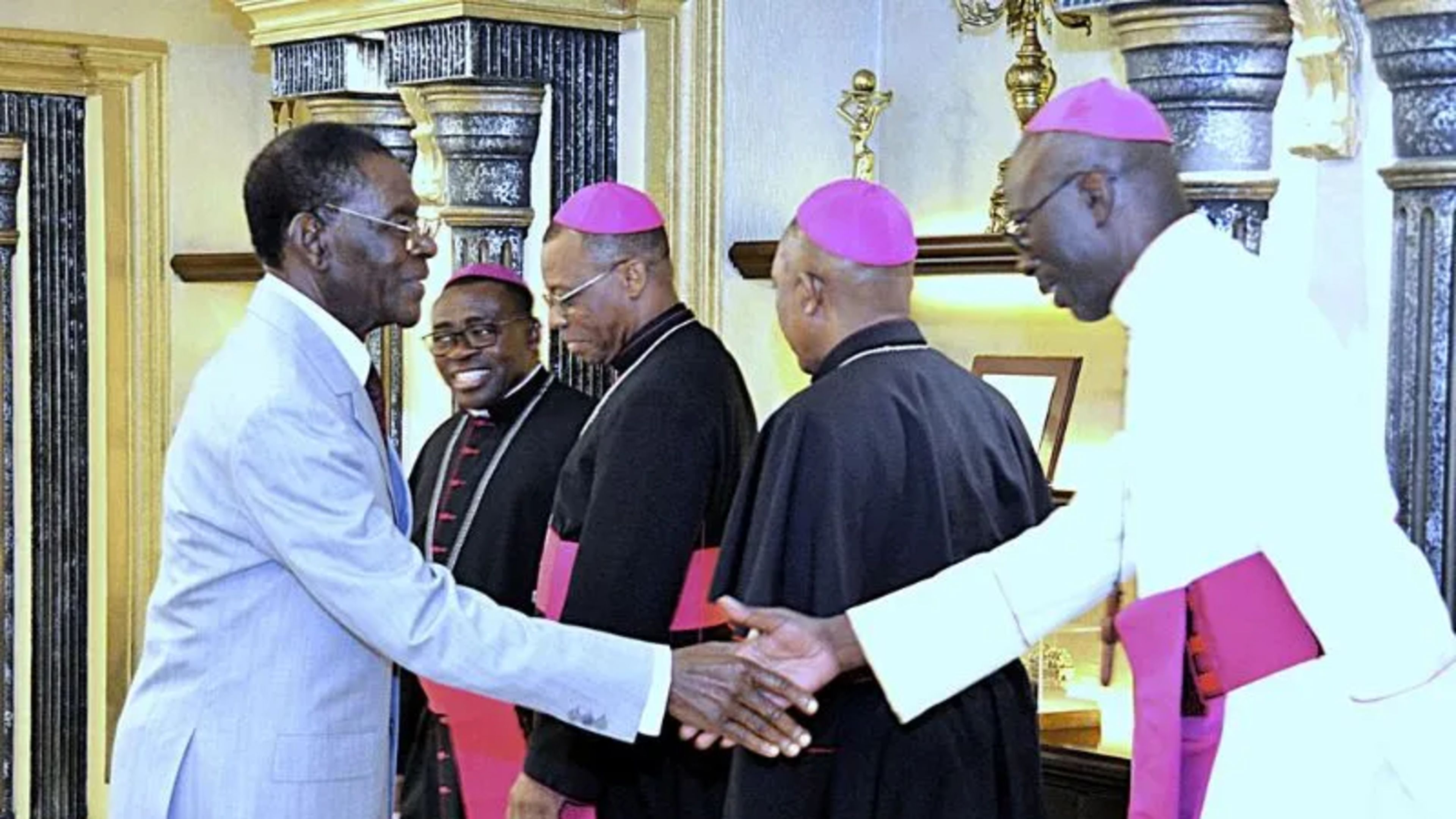
Pope Leo XIV is expected to visit the Republic of Equatorial Guinea in what will be his first pastoral journey to Africa since his election as pontiff in May 2025, a visit officially confirmed by both the country’s government and the Episcopal Conference of Equatorial Guinea (CEGE).
The announcement, which the press department of Equatorial Guinea (PDGE) published Jan. 23, has generated anticipation in a nation where Catholicism is deeply woven into culture, language, and public life.
Although no official schedule has yet been released, the confirmation itself indicates a high level of coordination between secular and ecclesial authorities.
As preparations begin for the pope’s visit to the Central African nation, which is comprised of the Rio Muni mainland and five volcanic offshore islands, the visit is to be viewed as both a moment of spiritual renewal and an affirmation of the local Church’s growing maturity.
Here are seven key things Catholics around the world should know ahead of the anticipated papal visit:
1. Equatorial Guinea is Africa’s only Spanish-speaking country with a distinct Catholic identity.
Equatorial Guinea is unique in Africa as the only country where Spanish is the primary official language, a legacy of nearly two centuries of Spanish colonial rule that ended in 1968.
This history significantly shaped the Catholic Church in the country. Evangelization was largely carried out by Spanish missionaries — especially members of the Congregation of the Missionary Sons of the Immaculate Heart of Mary (CMF/Claretians) — whose pastoral methods, Marian devotion, and catechetical structures continue to influence parish life. Spanish remains the dominant language of Catholic liturgy, Church administration, and theological formation.
At the same time, Equatorial Guinea is officially multilingual. French and Portuguese were later adopted to facilitate regional and diplomatic integration, while Indigenous languages such as Fang, Bubi, Ndowe, and Annobonese remain central to everyday life and are increasingly used in local pastoral contexts.
This blend of Hispanic Catholic heritage and African cultural expression makes the Central African nation unique within sub-Saharan Africa.
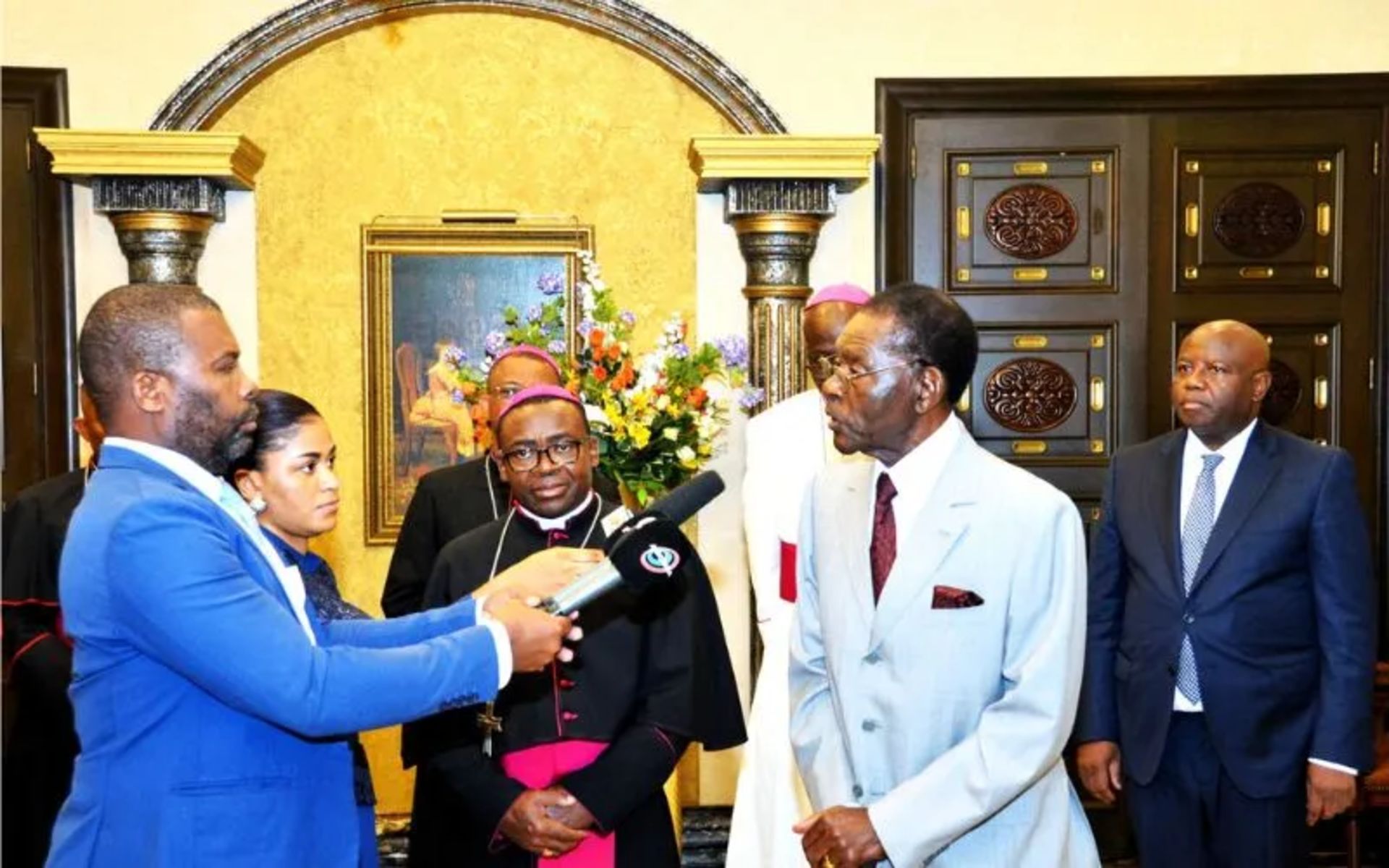
President Teodoro Obiang Nguema Mbasogo speaks to the press following an audience with members of the Episcopal Conference of Equatorial Guinea (CEGE). | Credit: Photo courtesy of Press Department of Equatorial Guinea (PDGE)
2. Catholics in Equatorial Guinea form one of the largest majorities on the continent.
Equatorial Guinea remains one of the most Catholic countries in sub-Saharan Africa — not only in cultural identity but also in measurable ecclesial terms.
According to Vatican Church statistics, as summarized by the Catholics & Cultures initiative drawing on the Holy See’s Statistical Yearbook of the Church, approximately 74.8% of Equatorial Guinea’s population is Catholic.
While this figure refers specifically to baptized Catholics — a standard metric used by the Vatican’s Central Office for Church Statistics — it underscores the depth of Catholic presence in a country of just over 1.6 million people. In practical terms, this translates into a Church that permeates national life, with parishes serving not only as places of worship but also as centers of education, health care, and social organization.
Church-run schools and health facilities continue to play a critical role, particularly in rural and island communities where public services are unevenly distributed. As Vatican-aligned mission reporting has repeatedly noted, the Catholic Church remains one of the most visible and trusted institutions in Equatorial Guinean society.
3. The country has a young but structurally expanding local Church.
Although Catholicism has deep historical roots in Equatorial Guinea, the local Church hierarchy is relatively young and continues to evolve.
The country currently has one Metropolitan See, the Archdiocese of Malabo, with four suffragan dioceses: Bata, Ebebiyin, Mongomo, and Evinayong. The dioceses of Mongomo and Evinayong were erected in April 2017.
Leadership is now largely Indigenous, marking a shift from missionary administration to local ecclesial responsibility. This maturation is a key backdrop to Pope Leo XIV’s visit, which can be interpreted as recognition of a Church that has come into its own.
4. A strong missionary legacy still shapes Church life in Equatorial Guinea.
Members of Institutes of Consecrated Life and Societies of Apostolic Life (ICLSAL) continue to play a defining role in Equatorial Guinea’s Catholic life. The Claretians in particular remain influential in parish ministry, education, and the formation of the clergy, alongside other ICLSAL.
According to a June 2024 report by Agenzia Fides, the Church in Equatorial Guinea has drawn strength from its missionary past, even after periods of hardship. Reflecting on this history, the president of CEGE, Bishop Juan Domingo-Beka Esono Ayang of the Mongono Diocese noted that the Church has entered “a period of new dynamics” following earlier challenges.
This enduring missionary presence has helped sustain vocations, catechesis, and social outreach, especially in rural and island communities of the Central African nation.
5. More than four decades have passed since the last papal visit.
Pope Leo XIV’s trip will be only the second papal visit in the country’s history. The first took place on Feb. 18, 1982, when Pope John Paul II visited Equatorial Guinea.
During that visit, the late pontiff presided over Mass in Bata and encouraged Catholics to live “in loyalty to Christ and the Church.”
For many Equatoguineans, particularly those born after 1982, the upcoming papal visit will mark their first encounter with a reigning pope.
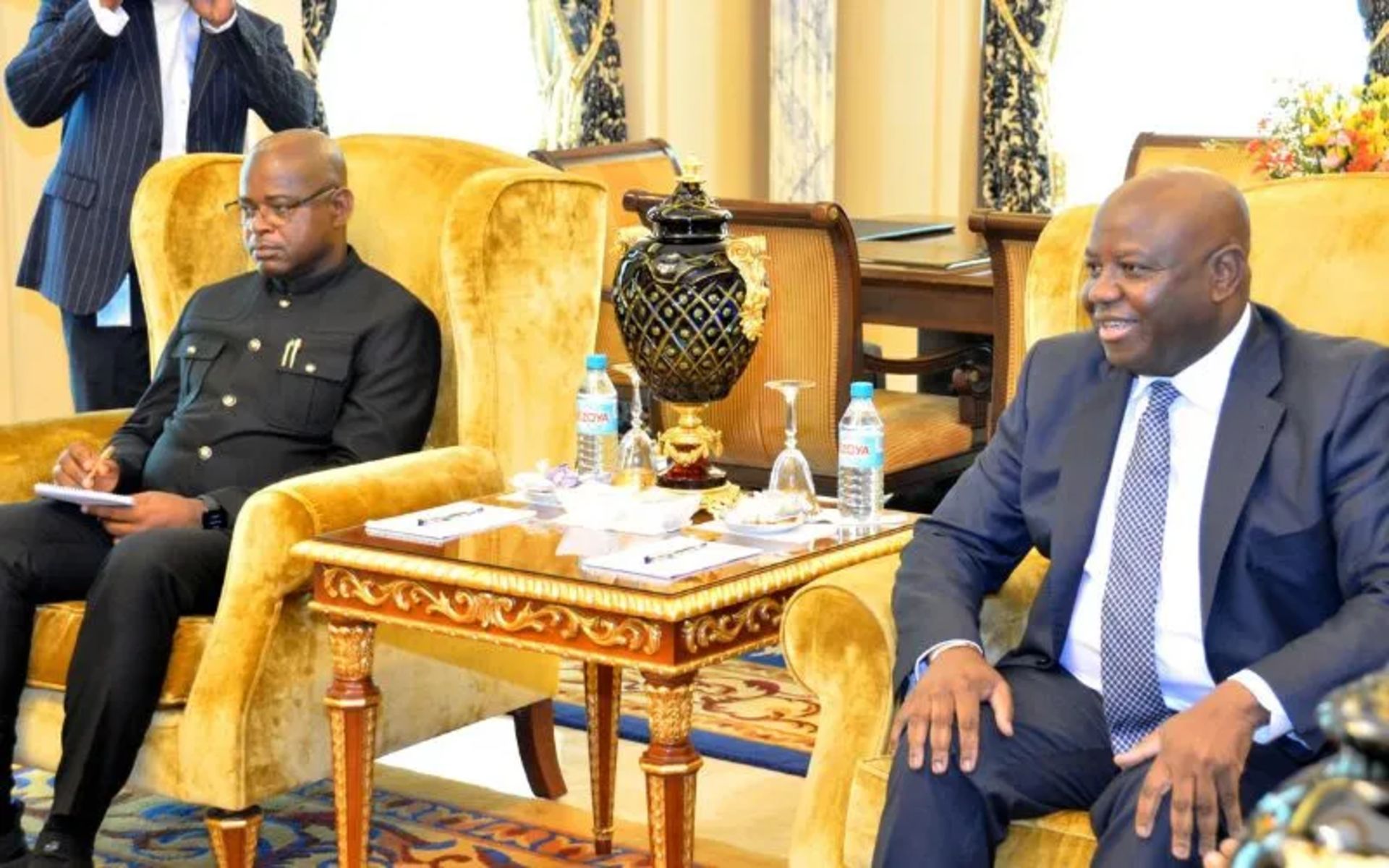
President Teodoro Obiang Nguema Mbasogo with CEGE President Bishop Juan Domingo-Beka Esono Ayang of the Mongono Diocese. | Credit: Photo courtesy of Press Department of Equatorial Guinea (PDGE)
6. Church–state relations are close but contextual in the country.
Relations between Equatorial Guinea and the Holy See have remained consistently cordial. President Teodoro Obiang Nguema Mbasogo has met successive popes and has repeatedly expressed the government’s desire to host a papal visit.
According to a June 28 Vatican News report, Teodoro, accompanied by his wife and government officials, met with Pope Leo XIV in what was the Holy Father’s first formal audience with an African president following his election.
Meeting at the Apostolic Palace in Vatican City, Pope Leo XIV and Teodoro discussed, among other topics, “the contribution of the Catholic Church in the fields of education and health care, and for the human, social, and cultural development of the population.”
The Equatoguinean president also held a meeting with the Vatican Secretary for Relations with States and International Organizations, Archbishop Paul Richard Gallagher, during which the two leaders noted “the good relations between the Holy See and Equatorial Guinea.”
At the same time, the Church in Equatorial Guinea operates within a broader social context marked by political longevity, oil-driven wealth, and persistent inequality — realities that frame local expectations of the papal message, when he visits the country.
7. The pope’s stop in Equatorial Guinea is part of a linguistically and culturally symbolic African itinerary.
Equatorial Guinea’s confirmation of the papal pastoral visit follows Angola’s announcement, positioning Hispanic and Lusophone (Portuguese-speaking) Africa at the forefront of Pope Leo XIV’s first African journey as pontiff.
In Angola, Church leaders linked the anticipated papal visit to major national and ecclesial milestones, while the apostolic nuncio confirmed that the invitation had been accepted.
In December 2025, Pope Leo XIV reportedly indicated that he would visit Africa in 2026, naming Algeria as a possible initial destination. Apart from Angola and Equatorial Guinea being confirmed, Cameroon was also mentioned as a potential stop.
Together, when realized, these destinations reflect the pope’s emphasis on the Church’s universality across languages and cultures: Spanish, Portuguese, and potentially French, English, and Arabic in possible future African papal visits.
Pope Leo XIV is the first pontiff in modern history with firsthand knowledge of Africa. Unlike his predecessors, he had already been to Eastern, Western, Southern, Northern, and Central Africa in person before his May 8, 2025, election.
This story was first published by ACI Africa, the sister service of EWTN News in Africa. It has been adapted by EWTN News English.
If you value the news and views Catholic World Report provides, please consider donating to support our efforts. Your contribution will help us continue to make CWR available to all readers worldwide for free, without a subscription. Thank you for your generosity!
Click here for more information on donating to CWR. Click here to sign up for our newsletter.
Leave a Reply
You must be logged in to post a comment.