
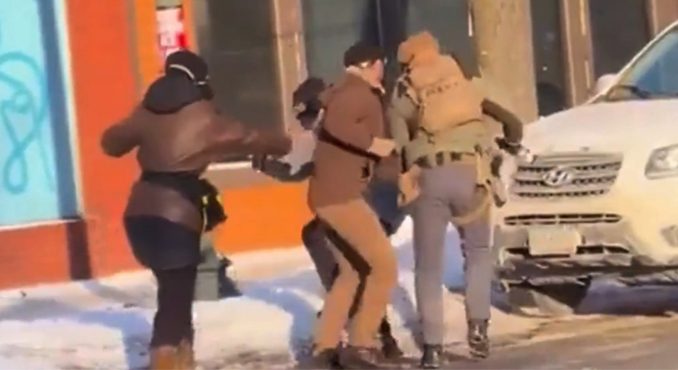
By now, the death of Alex Pretti in Minneapolis has been converted into a digital spectacle, parsed, dissected, meme-ified, and moralized across social media platforms.
One side is casting Pretti as a canonized martyr against federal tyranny, while the other is presenting Minneapolis as a city fast collapsing under activist recklessness and indulgent political leadership, and these narratives function less as explanations than as signals of political tribal affiliation.
In the midst of this rhetorical chaos, the U.S. bishops have attempted to speak with some moral sobriety. Archbishop Bernard Hebda of Minneapolis reminded the faithful that every human person bears the image and likeness of God, whether elected official, federal agent, or illegal immigrant, while Archbishop Paul Coakley called for calm, restraint, and respect for human life, emphasizing that public authorities bear a grave responsibility for safeguarding the common good. These statements represent an attempt to slow the socioemotional tempo of a culture addicted to outrage and instant judgment, even as many voices remain uninterested in listening.
At present, the public record remains partial and fragmentary; we need to be very honest about that. Video footage circulates widely, but until a formal inquiry, that just means no one has full moral knowledge of what transpired, since framing, perspective, and context shape interpretation in ways unseen by the casual viewer. Accordingly, exercising restraint in assigning legal and moral culpability remains the Christian moral obligation. Even the Scriptures demand verification of evidence, multiple witnesses, and careful inquiry before judgment, recognizing that justice collapses when haste replaces discernment (cf. Dt 19:15). Nevertheless, Christian moral reasoning does not require complete forensic clarity before speaking to the broader ethical issues of a situation.
What can be stated with confidence is that the deaths of Alex Pretti and Renee Good were eminently avoidable. They emerged from volatile circumstances where passions ran high, authority was challenged at close quarters, and prudential judgment failed on multiple levels. They arose from a sequence of human choices, each carrying foreseeable risks, each narrowing the space for peaceful resolution. Christianity has always insisted that moral agency entails responsibility, since human beings act as reasoning creatures capable of deliberation rather than as passive instruments of historical forces.
Scripture situates human life within an intelligible moral order where actions generate consequences, and where freedom carries weight rather than immunity. Let every person be subject to the governing authorities. For there is no authority except from God, and those that exist have been instituted by God” (Rom 13:1). In fact, from Genesis through the prophets, covenant life presupposes accountability. Ezekiel insists that each person bears responsibility for chosen actions. Moses places life and death before the people and urges them to choose wisely. This framework rejects the modern temptation to dissolve agency into grievance narratives that absolve individuals of responsibility once a political cause has been invoked.
In Good’s case, driving toward a protest zone where armed federal officers are conducting enforcement operations constitutes a moral choice. In Pretti’s case, closing physical distance with agents operating under heightened threat assessments while carrying a firearm (even though carrying a firearm lawfully is a constitutional right) constitutes another moral choice. Intervening physically or verbally in an active enforcement operation introduces predictable dangers, regardless of how seemingly good one’s intentions or motives. Moral seriousness requires acknowledging these realities without sentimental evasions.
Alex Pretti and Renee Good made profoundly unwise decisions. Their intentions may have been sincere. Their hearts may have been compassionate. Even so, wisdom evaluates actions according to foreseeable outcomes rather than interior sentiment alone.
At the same time, law enforcement carries grave moral duties. Officers swear oaths, wield coercive authority, and must exercise proportional judgment under stress. The Catechism affirms the legitimacy of public authority while demanding restraint and respect for human dignity in its exercise. (CCC 2238) “Those subject to authority should regard those in authority as representatives of God, who has made them stewards of his gifts.” These demands apply especially in chaotic environments where fear, confusion, and adrenaline impair judgment. We need to acknowledge honestly the potential for error in judgment in this environment. Accordingly, investigations must proceed with genuine seriousness and transparency, since the public trust now depends upon accountability grounded in truth that, one hopes, will transcend political ideology.
Yet the deeper fault line does not reside with the agents on the scene. Federal officers were executing lawful immigration enforcement within a jurisdiction rendered combustible by sustained activist agitation and irresponsible political rhetoric. Over months and years, activists, influencers, and elected officials have urged ordinary citizens to confront, obstruct, and resist federal authorities, often cloaking this encouragement in moralized language that disguises risk beneath slogans of social justice. In doing so, leaders with platforms insulated themselves from consequences while placing apparently well-intentioned citizens directly into danger.
When rhetoric escalates to the point where confrontation with law enforcement has become a civic virtue, tragedy is increasingly likely. Good intentions become instruments of chaos. Agents are forced into split-second decisions amid crowds primed for chaos and defiance. Citizens find themselves in life-or-death encounters they never fully anticipated. This dynamic represents moral negligence at the leadership and media level, where applause is constantly being harvested by spokespersons from afar while mortal consequences unfold on the ground in the lives of real people.
The Catechism speaks with clarity regarding the authority of nations to regulate borders and enforce laws for the sake of the common good, affirming that political communities possess the right and duty to govern migration according to justice and prudence. (CCC 2241) “…Political authorities, for the sake of the common good for which they are responsible, may make the exercise of the right to immigrate subject to various juridical conditions, especially with regard to the immigrants’ duties toward their country of adoption.”
While methods of enforcement allow for prudential debate, the underlying legitimacy of the United States’ immigration laws is undebatable. Accordingly, civil disobedience lacks moral footing whenever it is directed against laws that serve public order and the common good. There is nothing intrinsically unjust about the immigration laws of the United States.
This distinction matters greatly. Civil disobedience is only morally permissible when resisting genuinely unjust laws, since an unjust law ceases to have the authority of law in itself. In the case of just laws, however, protesting enforcement officers and ignoring legislative processes is morally misplaced. The agents do not write statutes. The officers do not set policy. If anything, they execute the law under oath, often at great personal risk of life. Directing hostility toward them represents a profound category error, and when this is encouraged by political leaders who prefer spectacle over responsibility, it is morally abhorrent.
As Bishop Robert Barron stated verbatim:
As a resident of Minnesota and as bishop of the Diocese of Winona-Rochester, my heart is breaking over the situation in my home state. Violence, retribution, threats, protests, deep suspicion of one another, political unrest, fear all of it swirling around all the time. May I make a modest proposal for exiting this unbearable state of affairs? The Trump Administration and ICE should limit themselves, at least for the time being, to rounding up undocumented people who have committed serious crimes. Political leaders should stop stirring up resentment against officers who are endeavoring to enforce the laws of the country. And protestors should cease interfering with the work of ICE. And everyone on all sides must stop shouting at one another and demonizing their opponents. Where we are now is untenable. There is a way out.
His prudential proposal regarding only enforcing actions on violent illegal immigrants may invite legitimate moral debate, since moral doctrine allows for disagreement concerning application and emphasis in this area. Nevertheless, the remainder of Bishop Barron’s appeal expresses moral principles that are binding upon all Catholics, particularly the call to cease demonization, halt incitement, and restore rational dialogue within civic life.
Ultimately, mourning Alex Pretti requires sincerity and honesty. His death deserves sorrow, prayer, and remembrance, to be sure. A creature of God died. That is a sad affair.
But the situation also deserves truth. Bishop Barron is right: accountability belongs to where the flames were fanned, where the rhetoric deliberately displaced wisdom, and where moral responsibility was outsourced to political spectacle. In fact, peace will emerge only when leaders cease treating human lives as instruments of political, ideological theater and when citizens recover the courage and virtue to consistently choose restraint over knee-jerk performative confrontation.
If you value the news and views Catholic World Report provides, please consider donating to support our efforts. Your contribution will help us continue to make CWR available to all readers worldwide for free, without a subscription. Thank you for your generosity!
Click here for more information on donating to CWR. Click here to sign up for our newsletter.
Leave a Reply
You must be logged in to post a comment.