
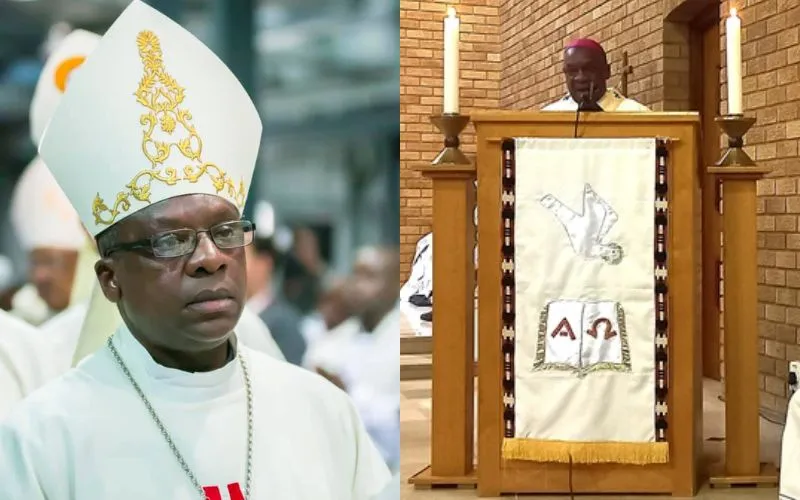
Archbishop Dabula Mpako of the Archdiocese of Pretoria. | Credit: Photos courtesy of Southern African Catholic Bishops’ Conference (SACBC)
Jan 18, 2026 / 07:00 am (CNA).
Archbishop Dabula Mpako of South Africa’s Catholic Archdiocese of Pretoria has issued a canonical decree requiring a group of parishioners who reportedly incited a series of protests at the Cathedral of the Sacred Heart in the archdiocese to undergo a “rehabilitative process” or be penalized — including the possibility of excommunication.
In the decree circulated on Jan. 11, Mpako described the events of December 2025 in which some parishioners of the cathedral are said to have organized demonstrations, inciting other parishioners to participate in them. He said that they disrupted Mass to protest a pastoral decision that was made by the bishop concerning “a pastor of the archdiocese.”
The actions of Dec. 7 and Dec. 28, Mpako said, “seriously harmed ecclesial communion and the good name of the Church” as well as the freedom of the archbishop in the legitimate exercise of his pastoral office.
He said that penalties will include possible excommunication that “is reserved for those who, after due warning, persist in the schismatic behavior of inciting revolt against the lawful authority of the bishop.”
Parishioner protests
On Dec. 7, a group of approximately 42 parishioners are said to have unlawfully assembled in front of the cathedral and conducted a public protest “denouncing the diocesan bishop for a legitimate pastoral decision concerning the pastor.”
The group is said to have made false and defamatory public assertions regarding the reasons for the bishop’s decision and to have incited opposition, resistance, and hostility against the bishop.
Mpako said the protesters caused public scandal and disturbance to the ecclesial order. He claimed that prior to the Dec. 7 event, the same group “instrumentalized” the celebration of Mass by engaging in coordinated protest actions during the sacred liturgy, thereby gravely violating the sanctity of divine worship and the reverence owed to the Eucharistic celebration.
Afterward, the individuals are said to have disseminated photographs and videos of the demonstration through social media platforms, further propagating false accusations and aggravating scandal among the faithful.
The same group reportedly wrote and sent letters of appeal to certain Church authorities based on what the bishop claims are false and defamatory public assertions regarding his decision.
The parishioners are said to have encouraged others to attach their digital signatures to the allegations.
On Dec. 28, a smaller number of the same individuals reportedly staged another protest at the conclusion of Pretoria’s jubilee year celebration.
Mpako said these actions seriously harmed the reverence owed to sacred worship and that in their conduct, the parishioners violated 11 canon laws, including failure to preserve communion with the Church.
He said the parishioners also violated the law that speaks about “illegitimate and harmful expression of opinions contrary to reverence toward pastors and the common good of the Church.”
Among the canonical penalties that may be given, the archbishop highlighted interdict, meaning that protesters may be barred from receiving the sacraments and sacramentals, and from participating in liturgical actions as ministers.
The other penalty falls under Penal Remedies and Penances, and includes public reprimand, withdrawal of permission to hold ecclesiastical office, and the imposition of pious or charitable works.
Other penalties include suspension from ecclesiastical offices, excommunication, as well as “just penalties for sacrilege” given the sacrilegious abuse of the Mass the parishioners reportedly may have committed.
The archbishop, however, proposed a corrective and rehabilitative process, saying that he desires “the conversion, reconciliation, and pastoral restoration of the offenders.”
The process he suggested includes a public retraction and apology requiring those responsible to retract the false accusations made publicly; remove scandalous content from social media; and issue an apology “in a manner determined by the diocesan authority.”
He also advised that for a determined time, participants in the protests may be barred from liturgical ministries, leadership roles, and public ecclesial functions. The parishioners are also to refrain from organizing or participating in public demonstrations related to ecclesiastical governance.
Mpako further directed mandatory participation in sessions on ecclesiology, the theology of episcopal authority, the nature of obedience and communion, as well as the sacredness of the liturgy.
As for “spiritual rehabilitation,” the archbishop said the protesters must engage in mandatory spiritual direction, acts of penance, and prayers for ecclesial unity, as assigned. “If any step is refused or neglected, the ordinary will proceed to impose canonical penalties as warranted.”
Further, he added: “This decree takes effect immediately upon notification and is to be communicated to the individuals concerned in the most expedient manner.”
This story was first published by ACI Africa, the sister service of EWTN News in Africa.
Leave a Reply
You must be logged in to post a comment.