
A 2005 curial document notes that “canonization is the supreme glorification by the Church of a Servant of God raised to the honors of the altar with a decree declared definitive and preceptive for the whole Church, involving the solemn Magisterium of the Roman Pontiff.” Canonization is typically preceded by the papal approval of a miracle attributed to the saint’s intercession.
Beatification, the document continues, “consists in the concession of a public cult in the form of an indult and limited to a Servant of God whose virtues to a heroic degree, or martyrdom, have been duly recognized.” Beatification is thus typically preceded by (a) the papal recognition of martyrdom or (b) a decree of heroic virtues declaring the Servant of God “venerable,” followed by the papal approval of a miracle. The document notes that the liturgical cult of the blessed, according to the formula of beatification, is of limited scope, in locis ac modis iure statutis (“in places and modes established by law”).
—
The last beatification of Pope Francis’s pontificate was that of Father Giovanni Merlini, C.PP.S. (Dicastery for the Causes of Saints, Missionaries of the Precious Blood, Fides, Wikipedia), which took place in the Lateran Basilica on January 12 (video).
Born in 1795 and ordained to the priesthood in 1818, Merlini sought admission to a new religious community, the Missionaries of the Precious Blood, in 1820. He devoted himself to spiritual direction and to preaching missions within Italy amid opposition to the Papal States. From 1847 until his death in 1873, he was the religious institute’s third moderator general and served as a spiritual advisor to Blessed Pius IX. In 1849, at Merlini’s request, Pope Pius extended the Feast of the Most Precious Blood to the universal Church.
Pope St. Paul VI declared Merlini venerable in 1973. The miracle that preceded his beatification, as recounted by the dicastery, took place in 2015, after a second-class relic was placed on a patient who suffered from “severe multifactorial anemization secondary to anticoagulant treatment, with subsequent hemorrhagic syndrome, hematoma of the iliopsoas and digestive hemorrhage; acute renal failure; severe heart failure … permanent atrial fibrillation; [and] Marfan syndrome.” The patient’s healing was “rapid, complete and lasting” and “cannot be explained scientifically.”
“Devoted to the missions of his people, he was a prudent advisor to many souls, and a messenger of peace,” Pope Francis said on the day of his beatification. “Let us also invoke his intercession as we pray for peace in Ukraine, in the Middle East and all over the world.”
—
The first beatification of Pope Leo XIV’s pontificate took place on May 17 in the cathedral in Chambéry, France (video).
The fifth of eleven children of a French statesman and scholar, Father Camille Costa de Beauregard (1841-1910) abandoned the practice of the faith briefly in his late teenage years, until he was inexplicably drawn to enter Chambéry’s cathedral—at which point, he was given the grace to return to the practice of the faith and the grace of a priestly vocation (Dicastery for the Causes of Saints, Salesian Bulletin).
Ordained a diocesan priest in 1866, he refused an invitation to enter the Vatican diplomatic service and instead devoted himself to the care of orphans whose parents died in a cholera epidemic. As the number of orphans in the area grew, he founded an orphanage where students received education and vocational training. He twice refused invitations to become a bishop and remained the orphanage’s director until his death.
Pope St. John Paul II declared Father Costa venerable in 1991. The miracle that paved the way for his beatification, as recounted by the dicastery, took place the autumn after Father Costa’s death, when a boy at the orphanage threw burrs into a ten-year-old classmate’s eye. The eye became inflamed, and despite the care of an ophthalmologist, the vision in the eye grew steadily worse. A nun bandaged a relic to the boy’s eye, and after nine days, the eye was completely healed.
At the conclusion of his May 18 papal installation Mass, Pope Leo hailed Blessed Costa as a “witness of great pastoral charity.”
—
On May 24, Father Stanisław Streich (Dicastery for the Causes of Saints, OSV News) was beatified as a martyr outside the cathedral basilica in Poznań, Poland (video).
Born in 1902 and ordained to the priesthood in 1925, Streich became pastor of a parish in Luboń, Poland, in 1935. “Here he undertook the construction of a new church and dedicated himself with great commitment to pastoral care, creating catechesis and prayer groups for children, young people, and adults,” the dicastery recounted. “He did much to help workers, the unemployed and needy families, from whatever social and political background. This industriousness of his was frowned upon by the followers of Communist ideology.”
Streich persisted in his ministry despite threatening letters and the desecration of his church. In 1938, five days before his martyrdom, his Communist assassin was seen entering the confessional, and the priest left the confessional visibly upset. He was shot to death during Mass the following Sunday. Twenty thousand people attended his funeral.
Blessed Stanisław Streich was “killed in hatred of the faith in 1938 because his work on behalf of the poor and workers irritated followers of the Communist ideology,” Pope Leo said the day after the beatification Mass. “May his example inspire priests in particular to give themselves generously in the service of the Gospel and their brothers and sisters.”
—
Blessed Maria Krzysztofa Klomfass and her 14 companions (Dicastery for the Causes of Saints, OSV News), martyred in 1945, were beatified outside the basilica in Braniewo, Poland, on May 31 (video).
These 15 sisters of the Congregation of Saint Catherine, Virgin and Martyr, died at the hands of invading Soviet Communist soldiers over a period of ten months. Some died of typhus in Russian prison camps; others died of wounds from torture and repeated rape.
“The Sisters remained faithful to their vocation by accepting the risk, in order to remain close to the sick, children and orphans,” the dicastery stated. “Although they had the opportunity to flee, as did other religious even of the same Congregation, they remained at their posts doing their utmost for the good of others.”
“Despite a climate of hatred and of terror against the Catholic faith, they persevered in their service to the sick and orphans,” said Pope Leo. “Let us commend to the intercession of the new Blessed Martyrs all those women religious throughout the world who devote themselves generously for the sake of God’s Kingdom.”
—
Floribert Bwana Chui (Dicastery for the Causes of Saints, Community of Sant’Egidio, AP, BBC, Vatican News, Wikipedia) was beatified as a martyr on June 15 at the Basilica of St. Paul Outside the Walls in Rome (video).
Born in 1981 into a wealthy family in Goma, a major city in the Democratic Republic of the Congo, Floribert was received into the Church at the age of 11 and became active in the Community of Sant’Egidio while studying law. He became known for offering assistance to street children.
After taking a job as a customs official, he refused repeated bribes to permit the importing of substandard and potentially poisonous food. He told a religious sister, “What will happen to the people who eat those products? If I accept this money, am I living in Christ? Am I living for Christ? As a Christian, I cannot allow people’s lives to be sacrificed. I would rather die than accept that money.” In 2007, just three months after starting his position, he was kidnapped and tortured to death. In 2024, Pope Francis approved the decree recognizing his martyrdom.
“He was killed at the age of 26 because, as a Christian, he stood up to injustice and defended the vulnerable and the poor,” Pope Leo said on the day of his beatification. “May his witness grant courage and hope to the young people of the Democratic Republic of Congo and in all of Africa!” Pope Leo again paid tribute to Blessed Floribert Bwana Chui the day after his beatification.
—
On July 12, Brother Lycarión May, F.M.S. (Dicastery for the Causes of Saints, Marists of Champagnat), was beatified as a martyr at St. Francis de Sales Parish in Barcelona, Spain.
Born in 1870 in a rural Swiss farming community, May entered the Marist Brothers at 18, was sent to Spain, and was asked in 1906 to found a school in a poor neighborhood of Barcelona.
“Brother Lycarión lived his educational and pastoral mission with the awareness of the widespread hostility in his surroundings, without wavering in his commitment and Christian witness offered during the three years of his presence in Barcelona,” according to the dicastery. During the Tragic Week of 1909, when “public order collapsed, and anarchists and Radical Republicans burned churches and convents” (Encyclopaedia Britannica), Brother May’s school was burned down. He was lured into the street by an acquaintance who said it was safe for him to leave; instead, he was shot by revolutionaries and died forgiving his killers, who then mutilated his body.
In January 2025, Pope Francis approved the decree recognizing his martyrdom. The day after Blessed May’s beatification, Pope Leo said that “in hostile circumstances, he lived his educational and pastoral mission with dedication and courage. May the heroic witness of this martyr be an inspiration to all of us, especially those who work for the education of young people.”
—
Mária Magdolna Bódi (Dicastery for the Causes of Saints, Archdiocese of Veszprém, Wikipedia) was beatified as a martyr at an outdoor Mass in Veszprém, Hungary, on September 6 (video).
Bódi was born in Hungary in 1921 to two agricultural servants. According to the Archdiocese of Veszprém, her Czechoslovakian father “arrived in the country as a prisoner of war, without papers, so the parents could not enter into either civil or church marriages.” Bódi and her siblings were thus considered illegitimate children.
Bódi’s father was an atheist alcoholic, but her mother saw to it that she received the sacraments. According to the archdiocese, “she would have liked to embrace religious life but, since no congregation could welcome her due to the irregular situation of her parents, during a spiritual retreat, she consecrated herself to Christ the King, making a private vow of perpetual chastity.” She was 20 at the time and worked in a factory.
Bódi dedicated herself to the corporal and spiritual works of mercy and was influential in several conversions. When Soviet troops entered her town in 1945, a soldier attempted to rape her; she stabbed him with a pair of scissors in defending her chastity. The wounded soldier then shot her six times. Her dying words were “O Lord, my King, take me to Yourself.”
Pope Francis approved her decree of martyrdom in 2024.
—
On the same day as Blessed Bódi’s beatification, Archbishop Eduard Profittlich, SJ (Dicastery for the Causes of Saints, Diocese of Tallinn, Society of Jesus, Wikipedia) was beatified as a martyr at an outdoor Mass in Tallinn, Estonia’s capital (video).
Born in Germany in 1890, Profittlich entered the diocesan seminary after high school and entered the Society of Jesus in 1913. During the First World War, he was drafted into the German army and worked in medical service.
Ordained to the priesthood in 1922, he was assigned to undertake further studies at the Pontifical Oriental Institute in Rome and Jagiellonian University in Kraków. After parish ministry in Poland and Germany, he became parish priest of the cathedral in Tallinn. Pope Pius XI named him apostolic administrator of Estonia in 1931 and a titular archbishop in 1936.
In 1941, invading Soviet troops imprisoned and tortured him. Before his execution, he died in prison in 1942 from exposure.
The day after the beatifications of Bódi and Profittlich, Pope Leo paid tribute to the two martyrs. He concluded, “Let us praise the Lord for these two martyrs, courageous witnesses to the beauty of the Gospel!”
—
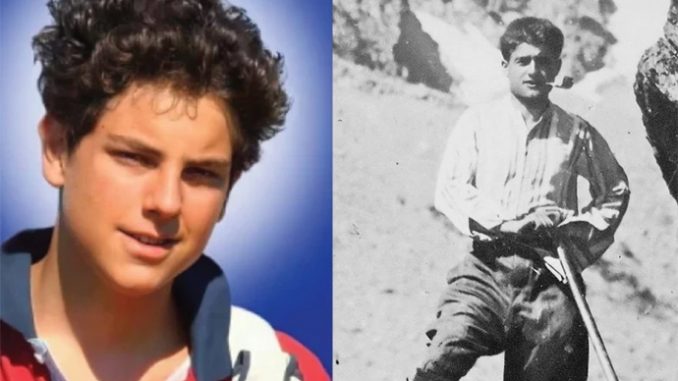
In the first canonizations of his pontificate, Pope Leo XIV canonized two beloved blesseds in St. Peter’s Square on September 7 (video).
The son of an agnostic newspaper founder and ambassador, St. Pier Giorgio Frassati (Dicastery for the Causes of Saints, New Catholic Encyclopedia, Wikipedia, Associazione Pier Giorgio Frassati, FrassatiUSA) was born in Turin in 1901. As an adolescent, he developed an active spiritual life that included daily Mass, frequent Confession and Scripture reading, devotion to the Rosary, and quiet, generous charity to the poor. He joined various Catholic organizations and became a Third Order Dominican in 1922, taking the name Girolamo in honor of the controversial fifteenth-century friar Girolamo Savonarola.
Convinced he was called to serve God in the lay state rather than in the priesthood, Frassati studied mechanical engineering. In the words of the dicastery:
He is passionate about the mountains and sports … He often organizes trips with friends … which become an opportunity for apostolate. He goes to the theater, to the opera, visits museums, loves painting and music, knows entire passages of Dante by heart. He is always attentive, however, to the needs of others, in particular the poor and the sick, to whom he gives time, energy, and life itself.
Frassati died suddenly of polio in 1925, was declared venerable in 1987, and beatified in 1990. In his beatification homily, Pope St. John Paul II hailed Frassati as a “man of the beatitudes.” The miracle that paved the way for Blessed Frassati’s canonization was the healing of a Los Angeles seminarian’s torn Achilles tendon.
St. Carlo Acutis (Dicastery for the Causes of Saints, Encyclopaedia Britannica, Wikipedia, Associazione Amici di Carlo Acutis), also canonized on September 7, was born in London in 1991 to Italian parents who soon returned to Italy. Although neither parent was devout, Acutis began to attend daily Mass and pray the Rosary daily after he received his First Communion.
Acutis “frequently defended schoolmates who were bullied, and he spent money he had earned on items for people experiencing poverty, such as a sleeping bag for a man without a home whom he encountered on the way to his church,” Encyclopaedia Britannica recalled. “He also sought to help elderly and disabled people in his community as well as refugees. His devotion inspired his parents to become practicing Catholics.”
Acutis’s interest in computers led him to develop websites for Catholic organizations and exhibits devoted to Marian apparitions and Eucharistic miracles. Devoted to Our Lady of Fátima, he consecrated himself to her Immaculate Heart.
In October 2006, his parents, believing their son was sick with the flu, took him to the hospital. It was actually leukemia, and Carlo died within days, offering his life for the Pope and the Church.
Acutis was declared venerable in 2018 and beatified in 2020. The miracle that paved the way for his beatification was the rapid and complete healing of a young woman who suffered head trauma in an accident.
“Both Pier Giorgio and Carlo cultivated their love for God and for their brothers and sisters through simple acts, available to everyone: daily Mass, prayer, and especially Eucharistic adoration,” Pope Leo preached in his canonization homily. “Another essential practice for them was frequent Confession … Finally, both had a great devotion to the saints and to the Virgin Mary, and they practiced charity generously.”
“Dear friends, Saints Pier Giorgio Frassati and Carlo Acutis are an invitation to all of us, especially young people, not to squander our lives, but to direct them upwards and make them masterpieces,” the Pope added.
—
On September 27, Bishop Petro Oros (Dicastery for the Causes of Saints, Wikipedia), a Ruthenian Greek Catholic bishop, was beatified as a martyr in Bilky, Ukraine (video), where he had served as a parish priest.
The son of an Eastern Catholic priest, Oros was born in Hungary in 1917, ordained to the priesthood in 1942, and consecrated an auxiliary bishop only two years later. Oros refused pressure to join the Russian Orthodox Church, and in 1949, the Soviet Union suppressed his eparchy, after which he ministered in secret. In 1953, a police officer shot him as he was attempting to escape arrest.
“When the Greek Catholic Church was outlawed, he remained faithful to the Successor of Peter and courageously continued to carry out his ministry clandestinely, aware of the risks,” Pope Leo said on the day of his beatification. “Let us invoke the intercession of this new Blessed, so that he may obtain for the dear Ukrainian people to persevere with fortitude in faith and hope, despite the tragedy of war.”
—
On World Mission Sunday (October 19), Pope Leo XIV canonized seven saints during Mass in St. Peter’s Square (booklet, video).
Born in 1869 in Mardin in what is now Turkey, St. Ignatius Moloyan, I.C.P.B. (Dicastery for the Causes of Saints, 2001 Vatican biography, SaintIgnatiusMaloyan.com, Wikipedia) was an Armenian Catholic who made his profession as a member of the Patriarchal Congregation of Bzommar in 1891. He was ordained to the priesthood in 1896 and ministered in Egypt.
Appointed archbishop of the Armenian Catholic Archeparchy of Mardin in 1911, St. Ignatius Moloyan was martyred during the Armenian Genocide. Pope St. John Paul II formally recognized his martyrdom in 2001 and beatified him that year.
At the time of Maloyan’s beatification, the Vatican published an account of his martyrdom, including the torture he suffered and his repeated refusals to convert to Islam.
The son of a tribal chief who converted to the Faith, St. Peter To Rot (Dicastery for the Causes of Saints, Wikipedia) was born in 1912 on the island of New Britain in Papua New Guinea. He entered a school for catechists at 18 and married at 24; the couple had three children.
When Japanese forces invaded Papua New Guinea in 1942, they imprisoned foreign missionaries. The dicastery recounts:
At that crucial moment, the young catechist, who was then only 30 years old, set himself up as a giant of the faith, taking on the responsibility of keeping alive the hope and faith of his people. Despite the prohibitions imposed by the Japanese on religious practices, Peter To Rot carried out an exemplary apostolate in his village and also in the neighboring communities, because many catechists, seized by fear, had abandoned their ministry. Dedicated to service, he spent all his time visiting the sick, baptizing children, praying with the community, preparing couples for marriage, burying the dead and distributing Holy Communion [consecrated by imprisoned priests].
In 1944, the Japanese legalized polygamy in an attempt to gain the favor of indigenous chiefs. To Rot spoke out strongly against polygamy and was imprisoned in 1945. His wife then, for the first time, asked him to stop his catechetical work. He replied, “Don’t stop me from doing my job. It is the work of God.” Japanese physicians martyred him by lethal injection.
Pope St. John Paul II formally recognized To Rot’s martyrdom in 1993 and beatified him in Papua New Guinea in 1995. In his beatification homily, St. John Paul preached, “Because the Spirit of God dwelt in him, he fearlessly proclaimed the truth about the sanctity of marriage. He refused to take the ‘easy way’ of moral compromise.”
The last of 12 children of a grocer and his wife, St. Vincenza Maria Poloni, I.S.M. (Dicastery for the Causes of Saints, Wikipedia) was born in 1802 and grew up in Verona, Italy. As a young adult, she sought spiritual guidance from Blessed Charles Steeb and devoted herself to the care of the poor and sick. At 38, she and Steeb founded what became the Institute of the Sisters of Mercy of Verona.
Her spirituality “was based on a profound union with God, nourished by prayer and devotion to the Eucharist,” according to the dicastery. “Charity, the central virtue of his life, was manifested in concrete gestures of love for the poor and the sick, whom she considered ‘our masters.’”
Polini died in 1855, was declared venerable in 2006, and was beatified in 2008. The miracle that preceded her canonization was the complete and inexplicable recovery of a Chilean woman with a torn aorta.
Born in Venezuela in 1903 without an arm, St. Carmen Elena Rendiles Martínez, S.J.D. (Dicastery for the Causes of Saints, Wikipedia, AP, Archdiocese of Miami) sought admission as a young woman into different religious institutes but was refused because of her disability. The Servantes de l’Eucharistie (Servants of the Eucharist), a French institute newly established in Venezuela, admitted her, and in time she became the regional superior.
“Mother Carmen had a predilection for the poor, the sick and priests, in whom she had no difficulty in seeing the face of Christ,” according to the dicastery. “Eucharistic adoration and suffering were the experiences that brought her closer to God.”
Amid significant changes in her French religious community in the 1960s, St. Carmen led the Venezuelan and Colombian sisters in founding a new community, the Siervas de Jesús de Venezuela (Servants of Jesus of Venezuela, Instagram), to preserve her former institute’s original charism. She died in 1977, was declared venerable by Pope Francis in 2013, and beatified in 2018. The miracle that preceded her canonization was the healing of a hydrocephalic woman.
Born in 1883 in St. Maria Troncatti, F.M.A. (Dicastery for the Causes of Saints, Salesians, Wikipedia) grew up in the Italian Alpine village of Corteno Golgi. A teacher gave her a copy of the publication of the Salesian sisters, helping inspire her, to enter the institute at 22.
Troncatti suffered from illnesses, including typhus, during her early years in the order; she persevered and trained to be a nurse. Beginning in 1915, she felt called to be a missionary, and in 1922, the order’s mother superior sent her to Ecuador. There, she served for decades as a medical missionary to the Shuar people. She died in a plane crash in 1969, at the age of 86, as she was flying to Ecuador’s capital for a spiritual retreat.
Troncatti was declared venerable in 2008 and beatified in 2012. The miraculous healing of a Shuar man from a head injury paved the way for her canonization.
The second of seven children, St. José Gregorio Hernández Cisneros (Dicastery for the Causes of Saints, Wikipedia) was born in 1869 in Isnotú, a small Venezuelan town. He attended high school, university, and medical school in Caracas, the nation’s capital. In the words of the dicastery, he was known for his “piety, prayer, virtue and strict fulfillment of duty.”
As a young physician, Hernández was so distinguished that the nation’s president sent him to Paris for further studies. Upon his return from France, he became a medical school professor. He began each day with Mass, became a Third Order Franciscan, and offered free medical care to the poor.
At 39, he briefly entered the Carthusian order in Italy, until health problems led him to leave. He then entered the diocesan seminary, until health problems again led him to resume his medical career. In 1919, as he was delivering medicine to a sick person, he was hit by a car and died. Hernández was declared venerable in 1986 and beatified in 2021.
Born in 1841, St. Bartolo Longo (Dicastery for the Causes of Saints, Dominican Friars Foundation, CWR, Wikipedia) became interested in spiritualism as a law student and then became a Satanist priest. Following his repentance, he became a Third Order Dominican and an ardent apostle of the Rosary.
In 1875, he established the Shrine of the Virgin of the Rosary of Pompei. The Order of the Holy Sepulchre, of which he was a member, recalls that “around the shrine, Bartolo Longo established a network of charitable and educational institutions. These included orphanages for girls, homes for the children of prisoners, a printing press to publish religious materials and promote devotion to the Rosary, housing for workers, and a music school.”
In 1885, Longo married Countess Mariana di Fusco, the widow with whom he founded the shrine; he died in 1926. He was declared venerable in 1975 and beatified in 1980. Pope St. John Paul paid tribute to Longo in Rosarium Virginis Mariae, his 2002 apostolic letter on the Rosary:
As a true apostle of the Rosary, Blessed Bartolo Longo had a special charism. His path to holiness rested on an inspiration heard in the depths of his heart: “Whoever spreads the Rosary is saved!”
As a result, he felt called to build a church dedicated to Our Lady of the Holy Rosary in Pompei, against the background of the ruins of the ancient city, which scarcely heard the proclamation of Christ before being buried in 79 A.D. during an eruption of Mount Vesuvius, only to emerge centuries later from its ashes as a witness to the lights and shadows of classical civilization.
By his whole life’s work and especially by the practice of the “Fifteen Saturdays,” Bartolo Longo promoted the Christocentric and contemplative heart of the Rosary, and received great encouragement and support from Leo XIII, the “Pope of the Rosary.”
“They are not heroes or champions of some ideal, but authentic men and women” and “faithful friends of Christ,” Pope Leo XIV said of the seven saints he canonized on October 19. “May their intercession assist us in our trials and their example inspire us in our shared vocation to holiness.”
—
Born in 1831 to wealthy parents in Ochanthuruth, in the southern Indian state of Kerala, Blessed Eliswa Vakayil (Dicastery for the Causes of Saints, MotherEliswa.org, Wikipedia) was beatified outside the National Shrine Basilica of Our Lady of Ransom in Vallarpadam, India, on November 8 (video).
Vakayil married at 16, had one daughter, and was soon widowed. According to the dicastery, she then “chose a life of prayer and solitude, marked by frequent participation in the sacraments and care for the poor, living in a simple hut.” In 1866, she and two other women founded what became the Congregation of Teresian Carmelites.
“She showed love for God above all for her commitment to prayer and for the punctuality with which she carried out her duties, first as a wife and mother, then as a nun and founder of a religious institute,” according to the dicastery. “The expression of her love for God was manifested in love for her neighbor, for whose sake she founded a new religious congregation for the education of poor or orphaned girls, the assistance of the marginalized and the most needy.”
Vakayil died in 1913 and was declared venerable in 2003. The miracle that preceded her beatification was the healing of an unborn child from a cleft lip seen in two ultrasounds; the baby was born without the condition.
Blessed Vakayil’s “courageous commitment to the emancipation of the poorest girls is a source of inspiration for all those who work, in the Church and in society, for the dignity of women,” Pope Leo said after her beatification.
—
On November 15, Father Carmelo De Palma (Dicastery for the Causes of Saints) was beatified in the Bari Cathedral in Italy.
Born in 1876 in Bari, De Palma, an orphan, was ordained to the priesthood at 22. He ministered for over 50 years at the Basilica of Saint Nicholas and became known as a “hero of the confessional.” When the Holy See entrusted the basilica to the Dominicans, De Palma was appointed spiritual director of Benedictine nuns and oblates. He died in 1961.
De Palma “nourished the virtue of faith with an intense life of prayer, with the Eucharist, celebrated and adored, at the center, and devotion to Our Lady,” according to the dicastery. “He lived the virtue of charity heroically. He was generous in helping the material poverty of the people. He spent all his energy in the ministry of confessor and spiritual director.”
De Palma was declared venerable in 2020. The miracle that preceded his beatification was the healing of a Benedictine nun from foramen magnum stenosis.
De Palma “was a diocesan priest who died in 1961 after a life generously spent in the ministry of Confession and spiritual accompaniment,” Pope Leo said on the day after his beatification. “May his witness inspire priests to give themselves unreservedly to the service of God’s holy people.”
—
On December 13, 124 martyrs were beatified in Jaén Cathedral in Spain: Blessed Manuel Izquierdo Izquierdo and 58 companions and Blessed Antonio Montañés Chiquero and 64 companions (Dicastery for the Causes of Saints, Diocese of Jaén, video). All were killed out of hatred for the Faith between 1936 and 1938 during the Spanish Civil War.
Also on December 13, 50 martyrs were beatified in Notre-Dame de Paris: Blesseds Raymond Cayré, Gérard Martin Cendrier, Roger Vallée, Jean Mestre, and 46 companions (Dicastery for the Causes of Saints, The Pillar, video). These priests, seminarians, and laity engaged in a clandestine mission to Frenchmen who were forced to work in Germany following the Nazi invasion of France. Their mission was discovered, and they were killed in 1944 and 1945.
Father Bernard Ardura, O. Praem., president emeritus of the Pontifical Committee for Historical Sciences, noted that “some were executed, some even massacred, many were tortured. Still others died because typhus was causing considerable damage, and they were not treated, or worse: those who were infected were put in the ‘infirmary’ and the so-called Nazi doctors conducted ‘experiments.’ Some lost their lives during the ‘death march.’”
“Let us praise the Lord for these martyrs, courageous witnesses to the Gospel, persecuted and killed for remaining close to their people and faithful to the Church,” Pope Leo told pilgrims in St. Peter’s Square on the day after the beatifications.
If you value the news and views Catholic World Report provides, please consider donating to support our efforts. Your contribution will help us continue to make CWR available to all readers worldwide for free, without a subscription. Thank you for your generosity!
Click here for more information on donating to CWR. Click here to sign up for our newsletter.
Leave a Reply
You must be logged in to post a comment.