
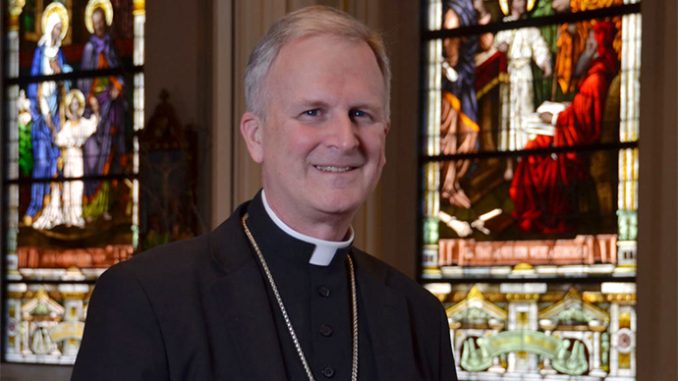
Bishop James V. Johnston, Jr., 66, was born in Knoxville, Tennessee, the oldest of four children. He attended Catholic schools through high school, and then earned a B.S. in Electrical Engineering from the University of Tennessee in Knoxville. He worked as an electrical engineer for three years before opting for the seminary in 1985. He was ordained a priest for the Diocese of Knoxville in 1990.
He served in a variety of roles in the Knoxville diocese and earned a Licentiate in Canon Law from Catholic University of America in 1996. He was named Bishop of Springfield-Cape Girardeau in 2008. In 2015, he was named Bishop of Kansas City-St. Joseph, Missouri. The diocese serves 151,000 Catholics with more than 60 active priests.
CWR: Can you tell us about your family life as a child?
Bishop James Johnston: My father was an accountant for the Department of Energy in an office in Oak Ridge, which is just outside of Knoxville. My parents met in the 1950s; my mother was my father’s boss’s secretary. They married and started a family. My father died in 2017, but my mother is still with us, having just turned 92 and still living on her own. My siblings all still live in Tennessee.
My mother is a devout Catholic, but my father did not convert until his 70s. He did go to Mass with us regularly when I was growing up, however.
CWR: Did your father approve of your decision to go to seminary?
Bishop Johnston: No, he tried to talk me out of it. I had been working as an electrical engineer for three years, and had a good job in Houston, Texas, so he thought I was risking too much to leave it for the seminary. He was motivated by love and concern for me, not any hostility towards the priesthood.
He quickly changed his mind after I was ordained. He saw how fulfilled I was as a priest.
CWR: What led your father to convert to Catholicism?
Bishop Johnston: He had been going to Mass for several decades, so that had an impact on him. He also loved European history, and came to see that up until the time of the Reformation, there was one Church. He had been through the RCIA process, and he told me that he had come to believe in all the things Catholics believe in, such as the Real Presence of Christ in the Eucharist.
We were on vacation on the beach in Florida one time, and he was talking to me about the Faith, when I asked him, “Why don’t you come into the Church?” He explained that he was concerned about his mother’s reaction if he left his childhood [Protestant] faith. I responded, “Well, you shouldn’t wait, because Grandma might outlive us all.”
He came to agree and shared with me one day that he had decided, in conscience, that it was time to come into the Catholic Church. It was one of the happiest days of my life. I was able to receive my father into the Church, confirm him, and give him his first Holy Communion.
CWR: You were an Eagle Scout. The Boy Scouts have undergone a rebranding this year to become Scouting America, as they accept both boys and girls. What do you think of this rebranding?
Bishop Johnston: As a boy, scouting was not only fun, but a wonderful way to meet quality people. It was one of the best things I remember about my childhood. Our parish had an active scouting troop with many of the fathers involved. Scouting easily folded into the life of the parish, and was really an enriching and fulfilling experience of Catholic youth ministry, and very much formative of who I am today.
I have mixed feelings about the rebranding. It is good that girls are able to experience the same things that boys do in scouting and that the Girl Scouts do not offer. But there needs to be a separation between the sexes, as boys are different than girls. There are some things they can do in common, but others they should do independently.
The nostalgic part of me looks back to the glory days of the Boy Scouts and would like to see that maintained, but with the changes in our culture, those things are not going to come back. I think the Scouts are trying to do their best to preserve their identity and mission. There is also a practical consideration: people are having fewer children, and there are more choices for them today, so this is a way to keep numbers up. I do like that scouting provides tangible benefits, getting children off electronic devices, and doing hands-on activities.
CWR: What led you to the seminary?
Bishop Johnston: While attending the University of Tennessee in Knoxville, I had a deeper conversion, a spiritual encounter with Jesus Christ and His love. It was a transformative experience for me, and it changed my outlook on life. I never abandoned my Faith; it was a deeper encounter with God’s love, a spiritual revolution.
Midway through college, I began to feel drawn towards becoming a priest, giving my life to serving the reality of the Risen Lord and reaching the hearts of other people. I couldn’t think of a more compelling way to live my life.
I was close to finishing my degree, so I decided to pray about it. I also wanted to marry and have a family. I graduated and went to work in Houston, although I did attend vocation retreats. After three years of working, I decided that if this call were not from God, I wouldn’t still be thinking about it. I had to make a choice. I made an act of faith, took a risk, and returned to Knoxville to enter the seminary.
CWR: Your father was concerned, but what about the rest of your family?
Bishop Johnston: My mother and siblings were all excited and supportive. When I told my co-workers in Houston, I had a positive reaction from them as well.
CWR: What did you do in Knoxville after your ordination?
Bishop Johnston: I worked as an associate pastor, and I also taught religion. After four years, the bishop asked me to study canon law. The Knoxville diocese was established in 1988, and another priest and I were the first to be ordained for it in 1990. We did not have a canon lawyer, so the bishop sent me to Catholic University from 1994 to 1996 to earn my degree. He wanted me to be the chancellor and canonist we needed.
CWR: You were awarded a Citizen’s Award for Bravery by the U.S. Department of the Interior for a rescue in which you were a participant at Glacier National Park in Montana in 2002. What happened?
Bishop Johnston: I was on vacation hiking with two other priests who were also biological brothers. We were hiking up to a lake, and stopped for lunch at the top of a waterfall. We saw a young family: a mom, a dad, and three children. The oldest child was 12, the next was 9, and the youngest was a small child strapped to the father’s back.
As we were eating, we heard the mother and oldest daughter scream hysterically. The 9-year-old had slipped from the edge of a riverbank into the water and was heading toward the waterfall. It was about a 50-foot drop with rocks below, a fall from which someone might not survive. The dad reached in to help the boy, and the baby on his back flew into the water. The dad went in after them. All were headed for the falls, hanging on to one another.
My priest-friends and I saw what was happening and formed a human chain just before the falls. We were able to grab them and haul them back to shore. The family survived, but everyone was in tears and in shock. They headed home; they didn’t know who we were or that we were priests. We went on with our hike.
I don’t know how they identified us, but a few years later, we were contacted by the office of Gale Norton, Secretary of the Interior. They flew us to Washington and gave us that award.
CWR: How is the Diocese of Kansas City-St. Joseph doing with vocations to the priesthood today?
Bishop Johnston: We do pretty well for a diocese our size. We fluctuate between 18 and 30 seminarians; we currently have 19. We also have many good young priests in our diocese.
CWR: What do you think is the best way to promote evangelism?
Bishop Johnston: Friendships are important. When people get to know you person-to-person and come to trust you, they are more receptive towards an invitation to church. I think beautiful liturgies can also make a positive impact on potential converts.
CWR: Do you have any favorite evangelists?
Bishop Johnston: When we have our Rite of Election, I’m always fascinated to learn how people come to find their way home to the Catholic Church. When I ask them about Catholic evangelists who favorably influenced them, Bishop Robert Barron’s name often comes up. He has a great ability to speak intelligently and appeal to the modern person.
There are also groups in our diocese that are very effective. One homegrown apostolate we have is City on a Hill (Mission — City On A Hill). It began as the young adult ministry of our diocese and has now branched out beyond our diocese. They have social and spiritual events that have produced many marriages and religious vocations. It’s been a very effective tool for evangelization.
CWR: The remains of Sister Wilhelmina Lancaster (1924-2019) are in a Benedictine monastery within your diocese. Who was she?
Bishop Johnston: She was an African American religious sister who grew up in St. Louis. She joined a religious community in Baltimore and became a schoolteacher. At age 71, she left her community and went to Pennsylvania to found a new community, the Benedictines of Mary, Queen of Apostles. They attend Mass in the extraordinary form. They moved to Gower, Missouri, at the request of my predecessor, Bishop Robert Finn.
The community has grown quickly. They have 48 sisters and have founded two additional houses in the U.S. and another in England.
When I met Sister Wilhelmina, I found her to be holy, happy, and a woman of prayer. She pledged to pray for me as the bishop. She was fun to be around. She was like the sisters’ grandmother. They’d laugh with her and at her jokes. She was a remarkable woman of faith and filled with joy.
She died in 2019 and was buried on the monastery grounds in a wooden plywood box, without any embalming or preservative sealing. In 2023, the sisters were moving her remains to a crypt inside a new monastery church and discovered that her body was intact. The lining of the coffin had decayed, but her body and clothing had not. I found that remarkable.
I invited a group of experts to examine her body, which included a prominent pathologist, a non-Catholic coroner (I wanted someone non-Catholic to be part of the team), and some other physicians. They could not offer an explanation as to why her body had not been reduced to dust and bones.
It created quite a stir across the county. Many came to pray before her body. It is now kept in a glass case in a side area of the transept. People are welcome to come and pray before her remains.
CWR: In an interview with The Simpleton Podcast two years ago, you said that you’re “always trying to raise money to pay for things.” A federal grand jury has charged the Diocese of Kansas City-St. Joseph’s former director of stewardship and Bright Futures Fund, Jeremy Lillig, with wire fraud. He has been accused of stealing $155,000 in donations to the Church. What impact has this alleged crime had on you personally and the diocese as a whole?
Bishop Johnston: It was difficult to learn that someone with whom I’d worked so closely had been accused of these crimes. I feel a sense of betrayal. I’m not alone in that; others with whom he worked feel the same way. While it’s a disappointment, we’ve been reassured that this activity was limited and that the gifts people are making to the diocese are going to the causes to which they intended them.
CWR: In 2024, you opposed the passage of Amendment 3, by which the state would recognize a “right to reproductive freedom.” It passed 52-48. Missouri has had a reputation of being a pro-life state; why do you think it passed? Is it because it included mention of rights to such things as prenatal care and birth control?
Bishop Johnston: Yes. I think it was deceptively written, and at least some people did not know for what they were voting. Florida had a similar initiative, Amendment 4, on their ballot, which failed, as it needed 60% to pass to change their state constitution. It received 57% of the votes. In Missouri, you need just 50% plus one.
We’ve had some surprising votes in Missouri. In 2022, voters approved the recreational use of marijuana.
CWR: Your friend and mentor is Archbishop Joseph Kurtz, who was Bishop of Knoxville from 1999 to 2007 and was a co-consecrator at your episcopal ordination in 2008.
Bishop Johnston: Yes. He is a good man and was a great leader. When he came to Knoxville, he had a brother, George (or “Georgie” as he called him), with Down syndrome [George died in 2002]. Archbishop Kurtz took care of his brother, and I think it gave him a real compassion for those in need. He is one of the best men I’ve ever known and is a real blessing to the Church.
Although he had been battling cancer, I sat next to him at our bishop’s meeting in November, and he looked healthy and was in good spirits.
CWR: Who are some other Catholics you admire?
Bishop Johnston: Pope St. John Paul II had a great impact on me. He was elected pope on my birthday, October 16, 1978, while I was in college. He burst onto the scene and presented an attractive picture of the Faith and the priesthood. I met him as a seminarian and again as a priest. I was invited to Mass in his private chapel on the Feast of the Visitation, and I read the Gospel. He gave us rosaries afterward.
CWR: Are there any spiritual practices you recommend to the faithful?
Bishop Johnston: Make time to be quiet in the presence of the Lord. Go to Adoration at church. One of the poisons of modern life is how busy we are. Our lives are noisy, and we don’t make time to listen to God. I am a big fan of silence, especially before the Blessed Sacrament.
CWR: Remember the story of Martha and Mary [Luke 10:38-42]. Like Mary, sit at Christ’s feet and listen to Him. Many of us are like Martha, driven by getting things done. But Mary chose the better part.
Bishop Johnston: Many people are anxious in society. They are not living healthy lives physically or spiritually. They have too much stimuli. We need God. If we don’t make room for Him, something else will fill the void that can agitate or depress us.
CWR: What else would you like to share?
Bishop Johnston: Despite its challenges, I’ve always loved being a priest and bishop. It is hard work, but I have been greatly blessed and privileged. I am grateful for the Lord’s goodness to me and for my vocation.
If you value the news and views Catholic World Report provides, please consider donating to support our efforts. Your contribution will help us continue to make CWR available to all readers worldwide for free, without a subscription. Thank you for your generosity!
Click here for more information on donating to CWR. Click here to sign up for our newsletter.
Leave a Reply
You must be logged in to post a comment.