
Dostoevsky never said “Beauty will save the world”—not without circling the catch phrase with serious qualifications, not without putting the attractive prospect in the form of a question. I don’t care how many times the branding of the aesthetes’ industry—the T-shirts, the memes, the coffee mugs—repeat the pleasant fiction. The mock-profundities of a platitude take an intricate interrogation and reduce it to a nice little slogan. Dostoevsky did not say (without saying it) that all we need to do to be saved is look at beauty and be pleased by it.
Sed contra.
Early in Dostoevsky’s The Idiot, the eccentric and well-to-do Madame Yepanchina and her poor relation (the protagonist) Prince Myshkin are studying a portrait of Nastasya Filippovna—the heroine whose standout beauty is a recurrent topic of town gossip.
“Yes she’s pretty . . . very pretty even,” Madame Yepanchina grants. “‘Does that kind of beauty appeal to you?’ she suddenly addressed the prince.” “Yes . . . that kind . . .” he struggles to reply, finally managing “In that face . . . there’s a great deal of suffering.” He grants this “somehow reluctantly, seeming to be talking to himself rather than answering the question.”
Already here, early on, Myshkin’s musings complicate what beauty even means, and the novel establishes a mysterious relationship between beauty and suffering. (Did I mention that The Idiot doesn’t readily offer its protagonist’s “positions” on any number of matters as reliably accurate? We’ll save that for another day.)
Madame Yepanchina’s daughter, Adelaide, scrutinizes Nastasya’s portrait, cries out “Such power!” and proceeds to profess that “With beauty like that one could turn the world upside down!” Beauty, in Adelaide’s register, becomes revolutionary—an overturning power. But she says nothing about saving the world.
Not long before this conversation, when Myshkin first “scrutinizes” Nastasya’s portrait, Ganya (a young man who works for the Yepanchins) presses the shy, strange Prince:
“That sort of woman appeals to you, does she, Prince?”
“An astonishing face!” replies Myshkin, who continues, “I’m sure her life has been no ordinary affair. The face is cheerful but she’s suffered dreadfully, hasn’t she? The eyes say that, these two little bones here, the two points under the eyes where the cheekbones start. It’s a proud face, dreadfully proud, and I just don’t know, is she a good woman or not? I do hope she’s good, it would redeem everything!”
The Prince’s precision is admirable. Instead of relegating beauty to a matter of taste beyond explanation, he gives an account of what makes Nastasya beautiful—down to the bone above her cheeks. He appeals to symmetry—that canon of beauty—but simultaneously traces those points to the dreadful affliction she has known. (We learn that she was sexually exploited starting at a very young age). Nastasya isn’t beautiful simply because she has suffered. Her beauty seems to have been forged in suffering the way Dostoevsky’s own faith was purified in the furnace of doubt.
Still, she is beautiful—insofar as she is beautiful—because joy persists in spite of the pains that have marked her life. If her cheerfulness is genuine joy, then she may be truly beautiful. But maybe her cheerfulness is forced, a façade? She is awfully proud; that is the problem: her beauty may yet be Luciferian.
More: Myshkin separates goodness and beauty, or, rather, he grants that the two are not always simultaneous—need not be contained in the same person. Someone could be beautiful but not good, and (presumably) someone else could be good but bereft of beauty. If Nastaysa turns out to be both beautiful and good, that would “redeem everything!” Presumably, the Prince means that Nastasya’s goodness would make up for and even transcend the suffering that strains her beautiful face.
But it is possible to hear in Myshkin’s conclusion a double entendre that says (without saying it) in a universal key: wherever goodness persists amidst suffering, it does something to redeem the world. He gives us a portrait that culminates in the Suffering Servant—the God who undid the pride of men when he “did not regard equality with God something to be exploited” (Philippians 2:6).
Much later in The Idiot, when Myshkin spends an unforgettable evening with a motley crew of punitive nihilists who conspire to prey on his preternatural “goodness,” a young consumptive named Ippolit turns to the Prince between hyperactive babblings: “Is it right, Prince, that you once said the world would be saved by ‘beauty’? Gentlemen,’ he suddenly shouted”—as if anticipating those slanderers of Dostoevsky who have done the great novelists no small indignity—“the prince says the world will be saved by beauty! And I say he has playful notions like that because he’s in love . . . No blushing Prince, or I shall feel sorry for you. What beauty is going to save the world? Kolya told me what you said . . . Are you a devout Christian? Kolya says you’re a devout Christian.” See what happens to the Prince’s words when they’re passed from person to person? The prince regards him “keenly” but refuses to reply.
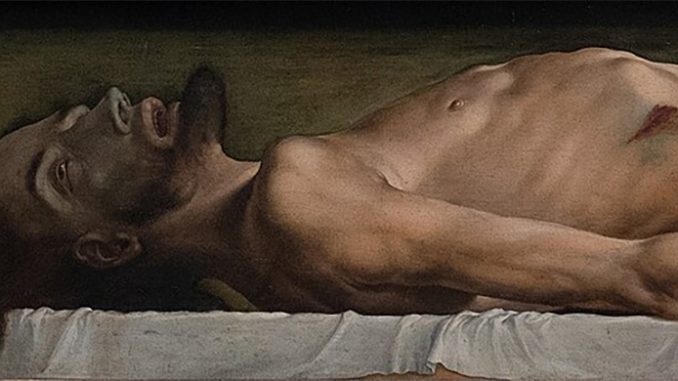
As the nihilists’ party reaches its crescendo (and you haven’t really lived, have you, if you haven’t been at a nihilists’ party at the point wherein it reaches a crescendo?), Ippolit discourses on Hans Holbein the Younger’s painting The Body of the Dead Christ in the Tomb, which Dostoevsky saw firsthand in Basel, and which features largely throughout the novel. Ippolit finds that Holbein renders nature as

some enormous, implacable, dumb beast, or more precisely, much more precisely, strange as it may seem—in the guise of a vast modern machine which has pointlessly seized, dismembered, and devoured . . . a great and priceless being, a being worth all of nature and all her laws, worth the entire earth—which indeed was perhaps created solely to prepare for the advent of that being!
In short, whatever the artist’s original intentions, Holbein’s horrifying painting is “as it were, the medium through which this notion of some dark, insolent, senselessly infinite force to which everything is subordinated is unwittingly conveyed.”
Ippolit questions whether, had Christ seen this image of his entombed body on the eve of his execution, “he would have mounted the cross as he did, and died as he did?”
Granting the agony on display in Holbein’s horrifying painting, does Ippolit’s judgment not rely too heavily on the implied foil of some idealized, angelic incarnation that would be tainted, somehow, by ugliness? Consider Isaiah’s prophecy concerning the Messiah:
…there is no beauty in him, nor comeliness: and we have seen him, and there was no sightliness, that we should be desirous of him: Despised, and the most abject of men, a man of sorrows, and acquainted with infirmity: and his look was as it were hidden and despised, whereupon we esteemed him not. (Isa 53:2-3)
The Prophet’s is a cautionary realism, a saving revelation about the nature of faith: seeing no beauty in the carpenter who made beautiful, useful things for a living, God’s own people will not desire him—will spare the Son of Man no esteem, not simply because His teachings are hard but because he isn’t pleasing to the eyes.
When the source of all goodness contains no comeliness, we begin to see how skewed the attractive slogan really is: Beauty will save the world? It is no accident that the corpus of Aquinas—that great articulator of the transcendentals—is far more concerned with truth and with goodness than with beauty. He argues that if the beautiful is that which pleases when seen, it is the good (not the beautiful) that really piques our desires, that more directly rouses our capacities to love. “[A]nd you will know the truth, and the truth will set you free” (Jn 8:32): the gravity of Christ’s sacrifice, the gratuity of his goodness, is in no way undermined by the Passion’s ugliness.
So throw away your misquoting merchandise, spit out the unsatisfying platitude, and look through the ugliness (of the betrayals and of your own heart, of the tortures and of your own hatreds) to the terrible truths of this Holy Week: Christ’s preternatural goodness did not beautify his human countenance, a revelation—a perfect articulation—of a humility that surpasses understanding.
Look long, look again, with unflinching eyes on the asymmetries that attended our redemption until you find “evidence of things not seen” (Heb 11:1).

If you value the news and views Catholic World Report provides, please consider donating to support our efforts. Your contribution will help us continue to make CWR available to all readers worldwide for free, without a subscription. Thank you for your generosity!
Click here for more information on donating to CWR. Click here to sign up for our newsletter.
Leave a Reply
You must be logged in to post a comment.