
“No one should ever act against the dictates of a well-informed conscience, and we all have a responsibility to form our consciences according to the law of God,” the El Paso, Texas, bishop said.
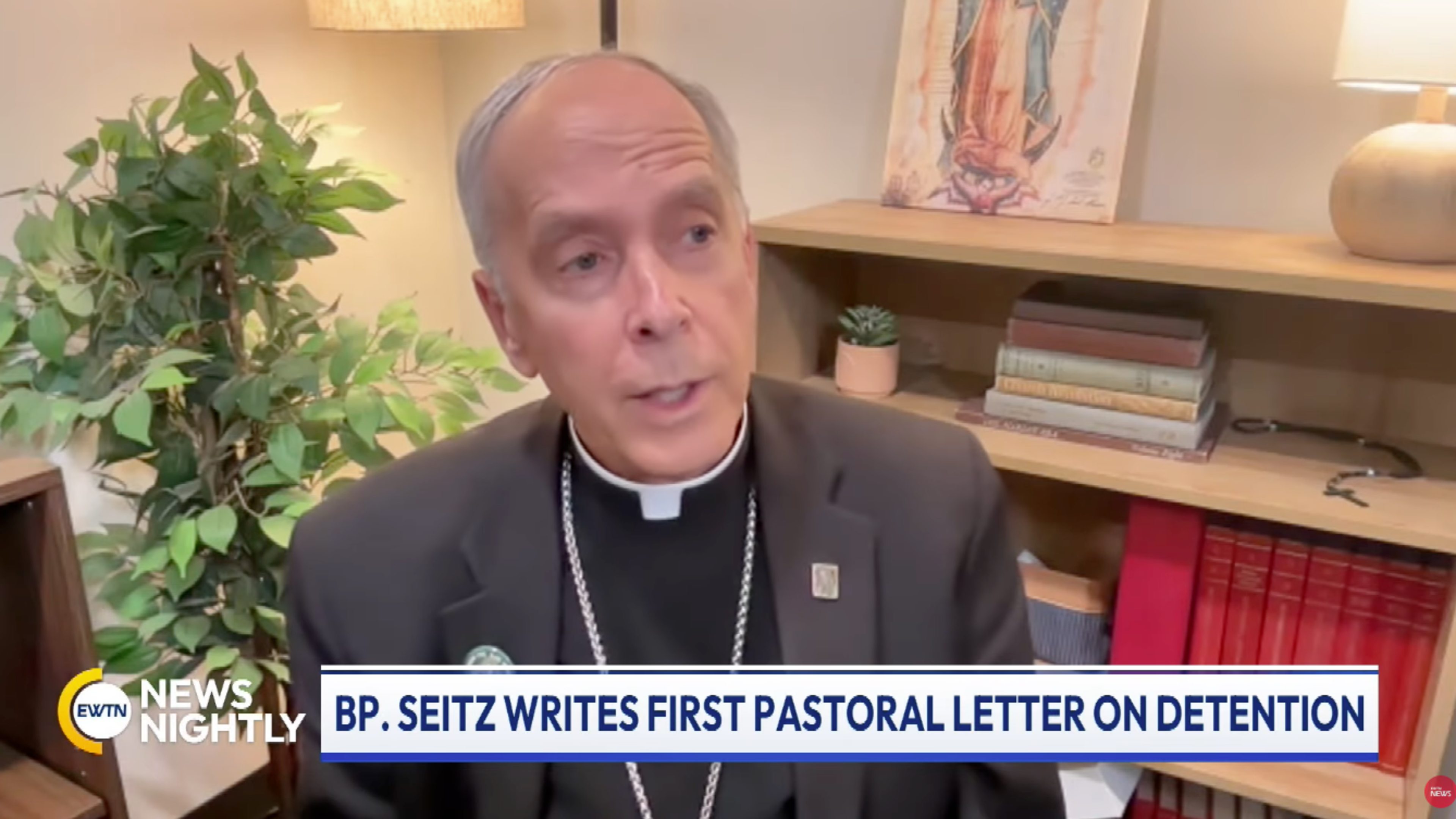
Seitz issued the first pastoral letter on mass detention and deportations on March 14. The letter followed the special message the U.S. bishops released in November 2025 expressing opposition to “indiscriminate mass deportations.”
While the pastoral letter calls for similar actions as the special message, it comes at a time when U.S. Immigration and Customs Enforcement (ICE) has “been out of the headlines … because ICE pulled out great numbers of their agents out of Minnesota,” Seitz told EWTN News.
[embedded content]
“But right here in El Paso, we’re very much aware that this does not necessarily mark an end to the effort at mass detention and mass deportation,” Seitz said. There will be additional detention facilities as the community is “aware three gigantic warehouses have been purchased on the far east of El Paso,” Seitz said.
“So while things are quiet right now in terms of the headlines, we know that this is continuing, and we continue to be very concerned about the fear and anxiety present in the community, as well as the suffering of so many people who have been detained,” he said.
Discernment for law enforcement officers
In his pastoral letter Seitz wrote: The “current national campaign of mass detention and detention is a grave moral evil, one which must be opposed, with prayer, peaceful action, and acts of solidarity with those affected.”
In the Catholic Church, “a grave moral evil” could indicate mortal sin. When asked if agents may need to disobey orders, or even leave their jobs, to avoid mortal sin, Seitz said: “I think the first thing that is most important is that you can’t put your conscience on hold if you’re a disciple of Jesus Christ.”
“You have to evaluate everything in the light of Christ, and in the light of his teaching, and the teaching of the Church,” he said. “You can’t just say, ‘Well, it’s a job’ or ‘These are my orders.’ I’m not saying anything morally that has not been said before. It’s part of the military code, that a soldier should not follow an immoral order.”
You can’t just say, ‘Well, it’s a job’ or ‘These are my orders.’
Bishop Mark SeitzDiocese of El Paso, Texas
In a March 25 interview with “EWTN News Nightly,” Seitz further spoke about the matter, saying: “No one should ever act against the dictates of a well-informed conscience, and we all have a responsibility to form our consciences according to the law of God.”
“That’s actually part of the code, that no soldier should follow an order if it is something calling them to do something that they consider immoral,” Seitz said.
It is reiterating “what has always been the teaching of both the Church and of our government,” Seitz said. “With many of the changes in policy that are coming our way, I do fear that people who work for border enforcement agencies are being put in a very difficult situation.”
Agents need to be praying, studying, and “learning what their faith has to teach them and what the Gospel has to teach them about the way that a person ought to be treated, the human dignity that needs to be respected,” he said.
Finding an alternative approach
When dealing with immigration enforcement, “justice has to be administered in a way that deals with each person as an individual, and their actions have to be evaluated,” Seitz told EWTN News.
Immigration cases need “to be carefully considered,” Seitz said. Rather than arresting people because “they look like they belong to this immigrant group” and then deporting them, law enforcement should “find out the location of a criminal, a person for whom there’s an order of arrest, and arrest them,” he said.
To do so, there’s no need to add “25,000 detention beds in the country” to increase bed capacity to 92,000, Seitz said.
“What we would like to see is, in fact, an orderly system,” Seitz told “EWTN News Nightly.” People would “come to the border and have a process of being able to be vetted there, their background to be checked, and to be able to receive a visa if, for instance, they’re fleeing from a life-threatening situation in their home country. They would have the opportunity to pursue an asylum claim in our country.”
“There are laws governing that process, which … need to be updated,” he said.
If you value the news and views Catholic World Report provides, please consider donating to support our efforts. Your contribution will help us continue to make CWR available to all readers worldwide for free, without a subscription. Thank you for your generosity!
Click here for more information on donating to CWR. Click here to sign up for our newsletter.
Leave a Reply
You must be logged in to post a comment.