
Three Spanish policemen who were visiting Rome as tourists prevented a robbery at one of the city’s most iconic churches — the Basilica of the Holy Cross of Jerusalem — on March 21.
The policemen — one of whom is stationed at the Spanish Embassy to the Holy See — were off duty when they intervened in response to a priest’s call for help.
After hearing the priest’s shouts, they managed to intercept the suspect, who — according to the clergyman — had just stolen several items.
After questioning the suspect, the policemen recovered from the alleged thief two lockpicks (used to open locks), 480 euros (about $555), two watches, and five lottery tickets.
The officers then proceeded to notify the Italian State Police of the incident, who took over the case.
Home of Passion relics
The Basilica of the Holy Cross of Jerusalem is one of the most renowned churches in the Eternal City, owing to the spiritual treasures it holds within its walls.
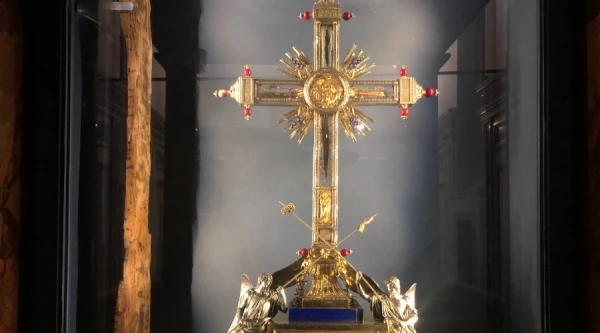
Access to the basilica’s “Chapel of Relics” is gained through one of the church’s side aisles; there, several relics associated with Christ’s passion are preserved, protected behind a glass display case.
These objects were transported from Jerusalem to Rome thanks to St. Helena, mother of the Roman Emperor Constantine.
According to tradition, the chapel houses three fragments of the cross of Christ — displayed in a reliquary dating from 1800 — as well as one of the nails with which soldiers affixed Christ to the cross and two thorns from Christ’s crown.
Also venerated here is the sign known as the “Titulus Crucis,” which Pontius Pilate ordered to be placed at the top of Christ’s cross. It bears the inscription in Hebrew, Greek, and Latin: “Jesus of Nazareth, King of the Jews.”
There is also a fragment of the cross of the good thief, along with a relic of the finger of the apostle Thomas — the very finger with which he touched Christ’s wound to believe that he had risen.
Additionally, in another side chapel — located next to the Chapel of the Relics of the Passion — a modern reproduction of the Shroud of Turin is on display.
This story was first published by ACI Prensa, the Spanish-language sister service of EWTN News. It has been translated and adapted by EWTN News English.