
The day before he became the bishop of Chiclayo, Peru, Pope Leo XIV spent the night in prayer — but not in the diocese’s main cathedral.
Instead, the American missionary traveled 30 miles outside the city to the dusty, half-forgotten town of Zaña.
The purpose of his visit wasn’t just to get some solitude before his busy ministry began. It was also to keep vigil with a beloved Peruvian saint.
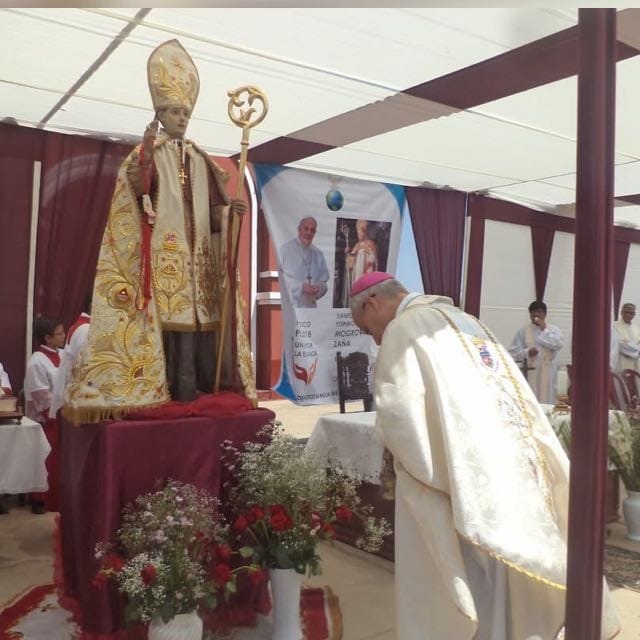
On that day in December 2014, the future pope prayed before a relic of St. Turibius of Mogrovejo, the 16th-century archbishop of Lima who is known today as “the Apostle of Peru.” The local parish in Zaña is named for St. Turibius and keeps a large leg fragment of the saint in a small chapel.
As Father David Farfán, a friend of Pope Leo’s and now the pastor of the local parish, told EWTN News, the soon-to-be bishop even asked to borrow pajamas so he could spend the entire night in prayer before the saint.
“He was so happy for that,” Farfán said. “And the following day, he officially took office as bishop in Chiclayo.”
A special connection
Why did Pope Leo have such a strong devotion to the Peruvian saint?
Because, in many ways, he was following in his footsteps.
Like Pope Leo, St. Turibius was sent to Peru as a missionary. Born in 1538 in Spain, Turibius wasn’t even a priest before becoming a Peruvian bishop — he was a lay canon lawyer.
But in 1579, King Philip II nominated the Spaniard to serve as the second archbishop of Lima. It was a vital assignment, given the centrality of Peru to the Spanish empire’s presence in the New World, and Turibius was selected for both his integrity and administrative abilities.
Pope Gregory XIII approved, and in 1580, Turibius was ordained to the priesthood, consecrated to the episcopate, and sent to Peru. He arrived in 1581 and spent the next 26 years leading what was then the largest archdiocese in all of South America.
St. Turibius’ time in Peru was marked by his profound love for the Indigenous people, who had suffered harsh treatment under Spanish rule. He translated the catechism into native languages like Quechua, founded the first seminary in the New World and opened it to local men, and protected the rights of Indigenous Peruvians from Spanish government officials. The saint even made three separate pastoral journeys across his massive archdiocese — a territory that spanned roughly 180,000 square miles — traveling mostly on foot.
Farfán said he sees several similarities between the Peruvian saint and how Pope Leo led as bishop of Chiclayo.
“Both of them were foreigners,” he said. “And the kind of approach you have when you are a foreigner … is not imposing things, but understanding, listening, and having a wide-open way of allowing people to tell what they feel.”
Marian spirituality, a focus on community, and attentiveness to social problems are other traits that Farfán said he believes the two figures have in common. For instance, he highlighted Pope Leo’s concern over the way mining companies impacted the local community in Chiclayo, an issue that is now being taken up in the Vatican.
And even though he is no longer in Peru, Pope Leo’s devotion to St. Turibius is alive and well.
When the Peruvian bishops came to Rome in January for their ad limina visit, Pope Leo told them it was “providential” they were visiting during the 300th anniversary of St. Turibius’ canonization. He held up the Peruvian saint as a model of evangelistic zeal and fidelity to God’s will.
And, quoting from documents from St. Turibius’ canonization in 1726, Pope Leo told the Peruvian bishops that they should be close to their people, so that what was said about the saint could be said of them: that he felt “so much love for everyone, that he held them in his heart as if he were the father of each one.”
The bishops left Pope Leo with a gift: a tondo depicting the saints of Peru, including St. Rose of Lima and the archbishop who confirmed her, St. Turibius.
The story of Zaña
During his nearly 10 years as bishop in Chiclayo, Pope Leo returned often to Zaña, including for a special Turibius-related celebration. Although St. Turibius’ feast day is March 23, he is also celebrated in Peru on April 27, the date that marks the transfer of the saint’s body to Lima.
And Zaña doesn’t just house a relic of the Apostle of Peru — it was also a pivotal place in St. Turibius’ ministry. In fact, although his final resting place is in the capital city’s cathedral, he actually died in Zaña in 1606 — an important reminder of how pivotal the now-provincial town was in the Church’s early missionary activity in Peru.
According to Alfredo Pérez Samamé, a local historian, St. Turibius made Zaña his initial base of operations, drawing 14 different religious orders to the valley, including Dominicans, Jesuits, and Pope Leo’s own Augustinians.
“According to history, the town once had 18,000 inhabitants — a city that was 100% religious,” Pérez said.
At one point, Zaña was even known as the “Seville of Peru.” However, a series of disasters, including pirate attacks, floods, and earthquakes, destroyed much of it, turning the older parts of Zaña into little more than a ghost town.
A papal homecoming?
However, with Pope Leo expected to make a Peruvian homecoming later in 2026, there is hope that he will make another pilgrimage to Zaña.
The regional government has even started designs for a visitor center and event venue at the original tomb of St. Turibius to not only accommodate a papal visit but also provide a hub for pilgrimage activity going forward.
Locals like Pérez are excited about the potential impact of a papal visit.
“God willing, if the pope visits Peru again and comes to our region of Lambayeque, it would bring significant development,” he told EWTN News. “Tourism would greatly increase due to the town’s religious importance, something that is already happening in Zaña.”
And if Pope Leo does return, he’s likely to stop by the small chapel in the local parish to see his old friend, St. Turibius — a local saint whom Peruvians believe continues to inspire their former bishop, now pope in Rome.
“He already is following his steps,” Farfán said. “And I believe and I pray to Toribio [to show] what he needs to do more for our Church. Because still we have a long, long way to continue offering Jesus Christ to the people.”
This story was first published by the National Catholic Register, the sister partner of EWTN News, and has been adapted by EWTN News.