
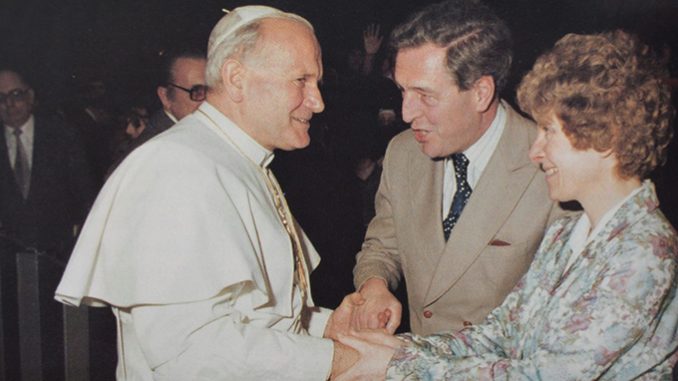
John Joseph Scarisbrick, MBE, died peacefully on Saturday, February 28th, at 5:40 am with his two beloved daughters, Emma and Sarah, by his side.
A towering figure in English Catholic life for over sixty years, Prof. Scarisbrick wrote the definitive biography of Henry VIII and served for many years as chief executive of LIFE, the pro-life organization he founded in 1970 with his heroic wife, Nuala. He also worked together to found three hospices for infants with disabilities, Zoe’s Place, in Liverpool, Coventry, and Middlesbrough, for which he was awarded the MBE [A Member of the Most Excellent Order of the British Empire] in 2015. In telling Lord David Alton of her father’s death, Emma said simply, with all her father’s easy eloquence, “A mighty oak has fallen.”

Although English Catholic life in the twentieth and twenty-first centuries included many brilliant men and women—one thinks of G. K. Chesterton, Hilaire Belloc, Ronald Knox, David Knowles, Maisie Ward, Christopher Dawson, Josephine Ward, Evelyn Waugh, Graham Greene, Dorothy Sayers, J.R. Tolkien, Elizabeth Anscombe, Ian Ker, and Lord Alton, to name but a few—none matched J.J. Scarisbrick’s practical contributions to the Church both as a scholar and defender of what Pope John Paul II called the “civilization of life and love.” That he was also instrumental in calling for the canonization of both Archbishop William Warham and G. K. Chesterton—both of whom, all faithful Catholics naturally hope, will one day be sainted — gives his legacy added lustre.
Prof. Scarisbrick’s scholarly work in Tudor history torched the old Whig interpretation of the English Reformation, in accordance with which the English had abandoned their ancient Catholic faith out of contempt for her priests and doctrines, not to mention the putative usurpations of the papacy and a concomitant openness to Protestantism. As Scarisbrick’s mining of various archives showed, the English had not abandoned their Catholic faith: those inclined to Protestantism were in a minority, and most of the English were faithful to the ancient faith. “They still believed in Heaven, Hell and Purgatory, the communion of saints, the need for expiation and the possibility of it,” Scarisbrick insisted in his Ford Lectures (1982), later published as The Reformation and the English People (1984).
In fact, many were requesting Masses for the dead right up until prayers for the dead and, indeed, the Mass itself were outlawed. The repudiations of the English Reformation, as Scarisbrick noted in his lectures, “were officially implemented from ‘above’ by statute, proclamation and royal commission,” not by any Protestant zeal from ‘below.’” Moreover, “Many folk, well-to-do ones in the know as well as the humbler sort were endowing many of the old [Catholic] structures right up to the moment when they were abolished,” he wrote. “Since people tend not to invest in things which are thought to be threatened with imminent liquidation, we must presume that there was little apprehension that these institutions were about to collapse and little sense that the old ways would not continue as they had for generations and until the end of time.”
Once the monasteries were dissolved, and the new Protestant order established, thanks to the cunning legal ministrations of the Lord Great Chamberlain, Thomas Cromwell, Henry VIII was not behindhand in paying off the apostate gentry for their vital support of the new order—a gentry about whom William Cobbett was memorably acid, saying of them, “For cool, placid, unruffled impudence, there has been no people in the world to equal the ‘Reformation’ gentry….”
If Scarisbrick defended the old Catholic order in his scholarly work, he also defended that order’s belief in the inviolable sanctity of life in his pro-life work.
II.
Born in 1928 in London, Scarisbrick was educated at The John Fisher School and later Christ’s College, Cambridge, where he read history, after spending two years in the Royal Air Force, where he encountered a fount of profanity as inexhaustible as it was unsuspected. There was nothing in his genteel upbringing or early education that could have prepared him for such a cascade of expletives. He also encountered consternation and bafflement from his fellow airmen when they discovered him kneeling to say his evening prayers. However, if Edward Gibbon, the historian of the Decline & Fall of the Roman Empire, looked down his nose at the men with whom he served as Captain of the South Hants Militia, Scarisbrick had nothing but respect for the men he met in the RAF.
When Freddy Gray interviewed Scarisbrick in 2007 in the Catholic Herald, the Catholic journalist (now with the Speccie) recognized something about the man that all who came to love him recognized as well. “The professor’s simple charm makes it easy to forget the huge brainpower behind the eyes. He is winningly unpretentious when asked about his Catholicism. ‘Well, I have never had any crisis of faith,’ he replies. ‘I am rather an unsubtle sort of chap.’”
At Cambridge as an undergraduate, Scarisbrick delighted in the very best lights of the place, who, in their different ways, shared something of his own learned zest—Sir Nikolaus Pevsner, CBE, the brilliant architectural historian, Dom David Knowles, the incomparable historian of the monastic orders in England, and Msgr. Albert Gilbey, the witty Catholic chaplain of Cambridge, whose imperturbable orthodoxy so rankled young Marxists at the University. Scarisbrick was also taught by the sybaritic biographer of Sir Robert Walpole, J.H. Plumb, who would always ask him for news of the cricket world, in which Scarisbrick reveled from boyhood.
After graduating from Cambridge, Scarisbrick joined the faculty of the History School of Queen Mary College, University of London, where he taught with the author of the popular Penguin history of Tudor England, S.T. Bindoff, or “Bindy” as he always called him. In his acknowledgments for his biography of Henry VIII, Scarisbrick included a warm thanks to his old colleague: “It has been my great privilege to be a member of his department for thirteen years,” he wrote, “and what I owe to him is incalculable.” He also thanked two other eminences in Tudor history, Geoffrey Elton and A.G. Dickens, though he parted ways from them in his own interpretation of their shared field. A younger history professor at Cambridge, who would later leave the University to join the Oratory in Edgbaston, Dermot Fenlon, would become a lifelong friend. Fenlon’s promised biography of Baronius might never have seen the light of day, but he did manage to write a good book on Reginald Pole, about whom Scarisbrick was memorably incisive:
Pole’s embassy was something of a fiasco and ended, on the last day of June, with his recall to Rome. Frustrated at every turn by English agents, Pole had waited at Liege for weeks in the vain hope that a new rebellion would break out and allow him to accomplish his extremely improbable mission. Convinced that if the schism were not nipped in the bud and if the present generation of his fellow‐countrymen ‘shall transmit their ideas to their children, England will be lost for ever’, and like Aske, heedless of his personal safety, Pole (again like Aske) never had a realistic grasp of the nature of his mission. As in 1570, papal action came too long after rebellion to be effective. Nonetheless, the crisis of the Pilgrimage of Grace, Paul’s bull and Pole’s expedition was far graver than that of the Northern Rising of 1569 and Pius V’s famous excommunication of Elizabeth. Henry was extremely lucky that Pole took so long to arrive, that Charles and Francis were keener to preserve than to destroy him and that Aske was one of the most trusting and upright subjects in the kingdom. Had things been only slightly different, his Reformation might have been wholly or largely undone, Cromwell, Cranmer and the rest expelled, he himself destroyed and Mary brought to the throne, either with a Portuguese husband or even married to Pole himself (who was not yet ordained priest), sixteen years ahead of her time.
Unlike the Marxist historians who would have such disproportionate sway in Oxbridge, Scarisbrick never saw any inevitability in history: contingency was all. Still, in reading this lively passage, one can see why Fenlon should have been inspired while still a Fellow of Gonville and Caius to follow Scarisbrick’s lead and pursue a study of Pole. The number of other historians inspired by Scarisbrick is doubtless incalculable.
From London, Scarisbrick went to the University of Warwick, where he became Chair of the History Department. It was at Warwick that he met Humfrey Butters, the Falstaffian Renaissance scholar, whom he befriended until Butters’ death in 2019. Being in their company was like being in the company of two old vaudevillians: their persiflage always had a kind of sublime comedy. Once, when the Anglican Butters admitted to a colleague that he might very well opt to be received into the Church of Rome after he had had enough time to consider the matter, Scarisbrick, who overheard the avowal, replied, “I would not be so sure of that, Butters. We have our standards.”
III.
In undermining so many of the false assumptions of the Whig interpretation of the English Reformation, Scarisbrick helped to nurture the work of such younger Tudor historians as Christopher Haigh, G.W. Bernard, and Eamon Duffy, though Duffy never adequately acknowledged how vital Scarisbrick’s trailblazing revisionism had been to The Stripping of the Altars (1989). Scarisbrick’s magisterial biography of Henry VIII remains today, nearly sixty years after its publication, the greatest of all biographies of the Tudor king. Praising its “superb orchestration of historical sources,” especially in light of “the massive and seemingly unending volumes which make up The Letters and Papers… of Henry VIII,” Roy Strong judged that the book succeeds as well as it does precisely because it reveals the king’s life “in all its savagery of intent.”

Scarisbrick’s Catholic sympathies notwithstanding, he could be generous to historians with whose points of view he disagreed. However, when he did take fellow historians to task, he tended to do so with good humour, as here when reviewing Diarmaid MacCulloch’s All Things Made New: Writings on the Reformation (2017), though good humor never prevented him from putting in the knife, whenever doing so seemed warranted.
Some of these essays are a bit heavy going, but MacCulloch has a gift for explaining complicated things simply. He can also produce the arresting new insight: for example, that Thomas Cromwell may have indeed have been a “sacramentary”, as his enemies claimed, ie one who denied any Real Presence, and was thus more radical than was Cranmer at the time. There is also admirable courtesy towards other scholars even when he disagrees with them. So I hope that some criticism will not be out of place. Alas, there is an anti-Catholic tone throughout this book. Catholics are always “Roman” or “Romish”. There are anachronistic references to “the Vatican” (a rather nasty place). The Jesuits are a “sect”. The revolution of 1688 is “Glorious” without inverted commas. It is really excessive to describe as a “catastrophe” the Council of Chalcedon (491) which, thanks not least to Pope Leo the Great, courageously reaffirmed the crucial truth that Christ is both truly God and truly man. And yes, MacCulloch is horrified by the Inquisition, as we all are, especially by the Roman one set up by the future terrible pope, Paul IV. But his review of a recent scholarly study of that tribunal, which showed it to have been considerably less horrific than often lurid anti-Catholic propaganda had claimed, is seriously partisan.
The other thing that needs saying about the scholar in Scarisbrick is that he wrote beautiful English. He had learned from Knowles that one could be both a stylist and a meticulous scholar—something none of the unscholarly Whig stylists managed—and when he set himself to writing of Henry’s “savagery of intent,” he proved that he could do both with moving aplomb. In reading the following passage, for example, one has to remember that there was something of an aesthete in Scarisbrick. He was not only a faithful son of the Church: he was a deft cabinetmaker; he was an artist. That the apostate Tudor had wrecked so much lovely church art genuinely pained him. Speaking of the king whom Dickens called “an intolerable ruffian,” Scarisbrick wrote:
He had struck down incomparable men and women like Catherine of Aragon, More, Aske, Cromwell. He had sent the first cardinal to martyrdom, namely, Fisher, and would like to have done the same to another, namely, Pole. In a few years, hundreds of glorious buildings, ‘one of the great beauties of this realm’, as Aske said, the fruit of generations of piety and architectural accomplishment, and the many fellows of those few survivors, like Fountains, Rievaulx, Wimborne or Tewkesbury, which still stand glorious and defiant, disappeared off the face of the land which they had so long dominated and adorned. Nor was this the full toll of destruction which Henry unleashed; for, with the soaring stone, the vaults, towers and spires, went glass and statue, choirstalls and rood-screens, plate and vestments – the flower of a dozen minor arts. How much of the fair and precious almost every town of England and every corner of the countryside lost in three or four years from 1536 onwards, what it must have felt like to see and hear workmen set about their emptied, echoing spoil and reduce a great abbey to piles of lead and dusty stone, we shall never know. Nor can we know what marvels once awaited the pilgrim to St Thomas’s shrine at Canterbury, or St Swithin’s at Winchester, St Richard’s at Chichester, or St Cuthbert’s at Durham; for Henry bade them go. He who built more than any other Tudor (though little of his work survives) was responsible for more destruction of beautiful buildings and other works of art than the Puritans. Not since the coming of the Danes, and then on a much smaller scale, had so many sacred fanes been despoiled and so much treasure smashed.
In his Lives of the Poets, Samuel Johnson told his young readers, “Whoever wishes to attain an English style, familiar but not coarse, and elegant but not ostentatious, must give his days and nights to the volumes of Addison.” Well, whoever wishes to attain a good style for good scholarly narrative history must give his days and nights to the volumes of Scarisbrick.
IV.
The pro-life work Scarisbrick undertook with his beloved wife Nuala, in the LIFE charity they founded together, continues to this day. Begun in 1970 in response to England’s legalization of abortion in 1967, it grew to be not only a national but an international apostolate and saved more lives than anyone can calculate. After Mrs. Scarisbrick’s death, a profoundly grateful acknowledgment of her work with her husband was posted online: “LIFE did not alter the political status of abortion, or halt its practice. But over the course of Nuala Scarisbrick’s endeavours, some 12,000 mothers and babies were housed, and about 450 people counselled monthly; 1.2 million were reached through public education about pregnancy. The organisation now operates through social media, online, texts and emails, and about 200 people a day contact Life, often needing practical help.” To go to a LIFE Conference with Jack and Nuala Scarisbrick was to see the love they inspired up and down their native land and beyond in all its life-affirming glory.
Freddy Gray’s 2007 interview with the historian notes, accurately enough, that “Scarisbrick still holds a strong admiration for the martyr Fisher. ‘I am convinced that he is really the prototype of the Counter-Reformation bishop,’ he says. ‘Fisher was really the first person to formulate the Catholic response to Protestantism. He had the enormous self-confidence to tell Luther that he was wrong, that he had misinterpreted St Augustine. And what he said carried weight, because actually Fisher was a much better Augustinian scholar than Luther.’” Yet Gray also wrote something profoundly true of the pro-lifer in Scarisbrick, which was of the very essence of the man:
After four decades of campaigning unsuccessfully to end abortion, Scarisbrick remains optimistic. “I believe that truth will out eventually,” he says. “I think there is a deep sense of justice still lurking in the human being. We are creatures who have a response to the transcendent moral law; and a society which professes human rights is living a lie if it denies the fundamental right to life.”
Some readers will see a glimmer of this optimism confirmed in the recent failure of the assisted dying bill in the House of Lords. When news of that failure came over the wires, Prof. Scarisbrick was doubtless thinking of other matters, but the failure of this flagitious bill still shows that our “deep sense of justice” has not become entirely inoperable.
How to conclude? An ebullient, unbiddable, gallant man, John Joseph Scarisbrick had all the affability and joy of the happy warrior.
This is doubtless why he was so beloved by numerous people in so many different walks of life around the world. This is also why he was such an admirable Catholic. He was attuned so in all he did to faith, hope, and charity. His faith was adamantine; his hope was abounding; his charity spoke for itself in all the immense good he did not only for mothers and children but for fathers and whole families as well.
In addition to his scholarly and pro-life work, he loved the music of Edward Elgar and the comic writings of Chesterton and Waugh. He loved to watch the swifts in his back garden swoop, dive, and soar. He loved his fig tree. He loved the society of his wife and children, his grandchildren, and his great-grandchildren, all his abundant, beautiful brood. After he stepped away from running his LIFE organization, he proved a paterfamilias from heaven.
And now that he is on his way back to heaven, we can all thank God for the good work he did while still among us, for it is some of the best work we will ever know. What more can one say? We shall never see the like again of such a supremely talented, faithful, lovable man.
If you value the news and views Catholic World Report provides, please consider donating to support our efforts. Your contribution will help us continue to make CWR available to all readers worldwide for free, without a subscription. Thank you for your generosity!
Click here for more information on donating to CWR. Click here to sign up for our newsletter.
Leave a Reply
You must be logged in to post a comment.