
The 40th anniversary of the bloodless 1986 revolution that ousted dictator Ferdinand Marcos drew thousands to Manila’s EDSA Shrine, where the Church recalled the pivotal role of Cardinal Jaime Sin.
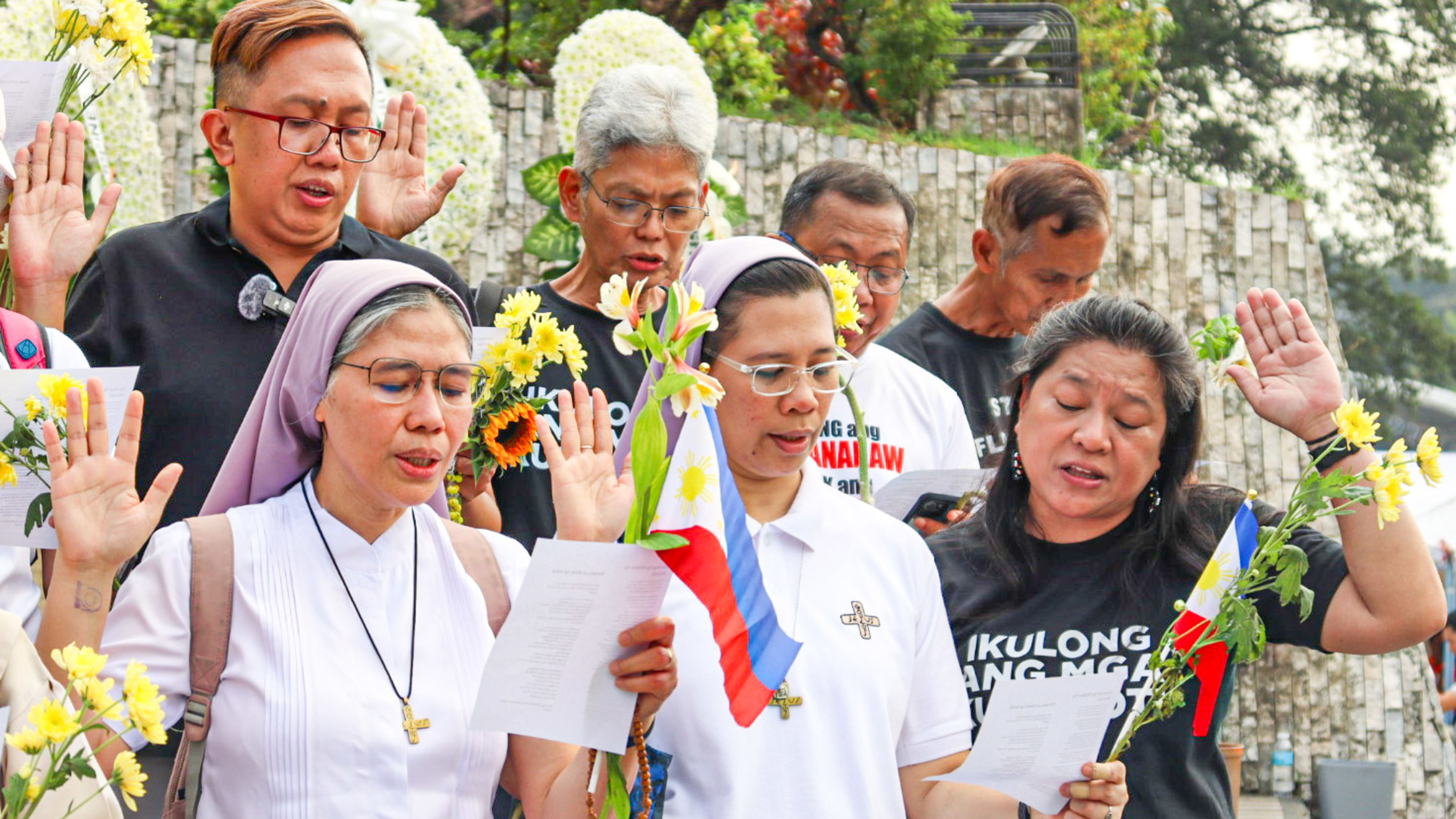
MANILA, Philippines — The Philippines paid tribute to the late Cardinal Jaime Sin on the 40th anniversary of the EDSA People Power Revolution, honoring the former archbishop of Manila for his prophetic role in the bloodless 1986 uprising that ended the two-decade dictatorship of President Ferdinand Marcos Sr.
Lingayen-Dagupan Archbishop Socrates Villegas led the Mass at the National Shrine of Mary, Queen of Peace — commonly known as the EDSA Shrine — on Feb. 25 to mark the milestone.
“Cardinal Sin and others remind us of the important role faith played in the peaceful revolution that restored democracy,” Villegas said.

Sin (1928–2005), who served as archbishop of Manila from 1974 to 2003, is widely regarded as one of the principal architects of the nonviolent revolt. His historic broadcast on the Catholic radio station Radio Veritas on Feb. 22, 1986, inspired millions of Filipinos to create a peaceful human barrier against military tanks, ultimately forcing Marcos to flee the country with his family.
“My dear people, I wish you to pray because it’s only through prayer that we may solve this problem. This is Cardinal Sin speaking to the people, especially in Metro Manila,” the cardinal declared in his Radio Veritas appeal. He urged the faithful to support Defense Minister Juan Ponce Enrile and military Vice Chief of Staff Fidel Ramos, who had withdrawn their support from Marcos.
The cardinal wanted the revolt to happen without violence, telling the people to “pray to Our Blessed Lady to help us so that we can solve this problem peacefully.”
By Feb. 25, 1986, an estimated 2 million Filipinos had filled EDSA — Epifanio de los Santos Avenue — demanding that Marcos step down. Marcos fled to Hawaii, and Corazon Aquino, widow of slain opposition leader Sen. Benigno Aquino Jr., assumed the presidency.

Father Jerome Secillano, rector of the EDSA Shrine, said: “Maybe there wouldn’t be a People Power if Sin hadn’t been such a strong and moral leader during those chaotic years of dictatorship.”
Secillano said that while other figures were active in the uprising, the cardinal’s voice was decisive when he called Filipinos to EDSA in February 1986.
“We want the young people to know the cardinal and understand how important he was in the history of the country,” he added.
As part of the anniversary commemorations, the Manila Cathedral opened to the public the crypt where Sin is buried.
Church’s role in the 1986 revolution
Priests, nuns, seminarians, and laypeople all fought for and protected human dignity during the revolt and in the decades that followed. The Catholic Church played a central role in the country’s struggle for democracy.
Sister Asuncion Borromeo from the Franciscan Missionaries of Mary told EWTN News: “Like many others, I unquestionably answered the cardinal’s call to join the EDSA for the good of the country in 1986.”
“At least I was part of the generation that planted the seeds of democracy and freedom,” Borromeo said. “I might not see justice and freedom fully bloom in my lifetime, but at least I was part of the generation that fought for our freedom.”

Sister Asuncion Borromeo from the Franciscan Missionaries of Mary speaks on Feb. 23, 2026, to EWTN News about her experiences of participating in the EDSA People Power revolution of 1986. | Credit: Santosh Digal
Jesuit Father Albert Alejo, a professor at Ateneo de Manila University, said the Catholic Church remains a moral compass but also has much work ahead.
The third Trillion Peso March
The third edition of the Trillion Peso March took place alongside the 40th anniversary commemorations. The march — organized by Caritas Philippines, the social action arm of the Catholic Bishops’ Conference of the Philippines, along with civil society groups — called for accountability and transparency over infrastructure corruption scandals that have engulfed the current government of President Ferdinand Marcos Jr. The first two marches took place on Sept. 21 and Nov. 30, 2025.
According to the Philippine National Police, 119 rallies were organized by the Catholic Church, civil society movements, and others,
Alejo said: “The anti-corruption movement that started in the Philippines last year calls us to fight the true enemy: negligence and indifference.”
Father Bienvenido Nebres, a Jesuit priest and national scientist of the Philippines, described the EDSA People Power Revolution as a “transfiguration experience.”
He urged Filipinos to uphold democracy by working with institutions, serving the people, and striving for a better future for everyone.
If you value the news and views Catholic World Report provides, please consider donating to support our efforts. Your contribution will help us continue to make CWR available to all readers worldwide for free, without a subscription. Thank you for your generosity!
Click here for more information on donating to CWR. Click here to sign up for our newsletter.
Leave a Reply
You must be logged in to post a comment.