
“We wanted to say that the Church is an open home,” Father Suleiman Haifawi said, “and that authentic faith bears fraternity, and that practical love matters more than words.”

The Catholic Church in Kuwait has launched an initiative of love and fraternity to mark the coinciding start this year of Christians’ Lenten season and Muslims’ observance of Ramadan (which is about 30 days of fasting).
The initiative aims to express solidarity and strengthen the values of coexistence among citizens and residents of one nation.
At the entrance of Holy Family Cathedral, several priests joined in distributing water and dates to Muslim passersby who were fasting, shortly before the sunset call to prayer that marks the time to break the fast.
The gesture, Father Suleiman Haifawi, spokesman for the Catholic Church in Kuwait, explained to ACI MENA, the Arabic-language sister service of EWTN News, was meant to share in “the first moment of breaking the fast” by offering “dates and water, the two essential elements in the tradition of ending the day’s fast.”
Haifawi said the overlap between Lent and Ramadan is more than a calendar coincidence. It is, he said, a sign of hope with a deeper spiritual meaning: that shared spiritual values can bring people closer and unite fellow citizens.
“Fasting, at its core, is a school of repentance, prayer, and mercy,” he said. “When we Christians fast and our Muslim brothers and sisters fast at the same time, we feel there is a shared call to return to God, to purify the heart, and to serve the human person.”
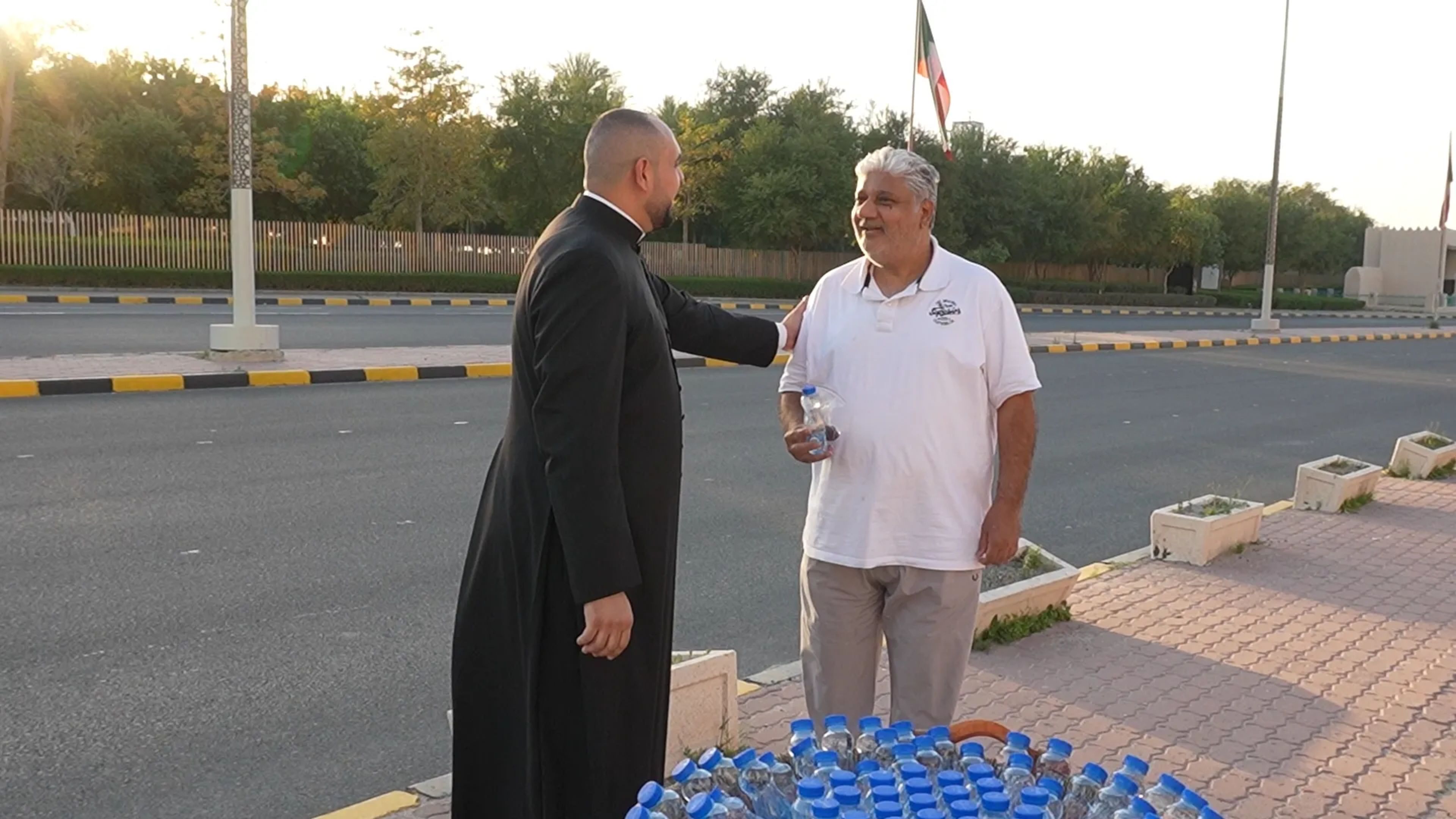
The Catholic Church in Kuwait launched an initiative to distribute dates and water to fasting Muslim passersby before their iftar meal at sunset. | Credit: Photo courtesy of the Apostolic Vicariate of Northern Arabia
A gesture of solidarity
Haifawi described the initiative as an act of solidarity, respect, and consideration for those who are fasting.
“We wanted to say that the Church is an open home,” he said, “and that authentic faith bears fraternity, and that practical love matters more than words. We also want to remind Christians that fasting should lead us to openness toward others and to serving them, not to withdrawal.”
As for the message to Muslims, he said it is a way of affirming respect for their fast and sharing in the joy of the holy month. “We pray that it will be a month of goodness and blessing for you and for Kuwait,” he said.
Haifawi also highlighted the moving response from passersby, many of whom expressed thanks and happiness at the gesture.
“Some stopped to thank us and shake hands; others took photos and said they were proud to see this in Kuwait,” he said. He noted that those who engaged with the initiative came from various nationalities, underscoring its broadly human dimension, but one comment in particular stood out: “This is the Kuwait we love.”
A model of coexistence
Kuwait, Haifawi said, has long been distinguished by openness and a culture of mutual respect. Coexistence there is not merely a slogan, he added, but a daily reality: people practice their faith in peace, reflecting a deep social awareness of the importance of religious freedom.
“The spirit of the Kuwaiti constitution, the official support for moderation, and the awareness of society itself, all of these factors have made Kuwait a model in the region,” he said. “Through our initiative, we wanted to affirm that model, and to show that its people — Muslims and Christians — share the values of mercy, respect, and service to those in need.”
The Apostolic Vicariate of Northern Arabia and the Catholic Church in Kuwait have long sought to foster a culture of encounter, dialogue, and service to society through humanitarian initiatives, joint gatherings, and charitable work.
Haifawi said that although the initiative is symbolic, it flows from a firm conviction that strengthening human fraternity is not a one-time event but an ongoing path.
“We believe that building bridges requires simple steps,” he said, “but steps that are sincere.”
This story was first published by ACI MENA, the Arabic-language sister service of EWTN News. It has been translated and adapted by EWTN News English.
If you value the news and views Catholic World Report provides, please consider donating to support our efforts. Your contribution will help us continue to make CWR available to all readers worldwide for free, without a subscription. Thank you for your generosity!
Click here for more information on donating to CWR. Click here to sign up for our newsletter.
Leave a Reply
You must be logged in to post a comment.