
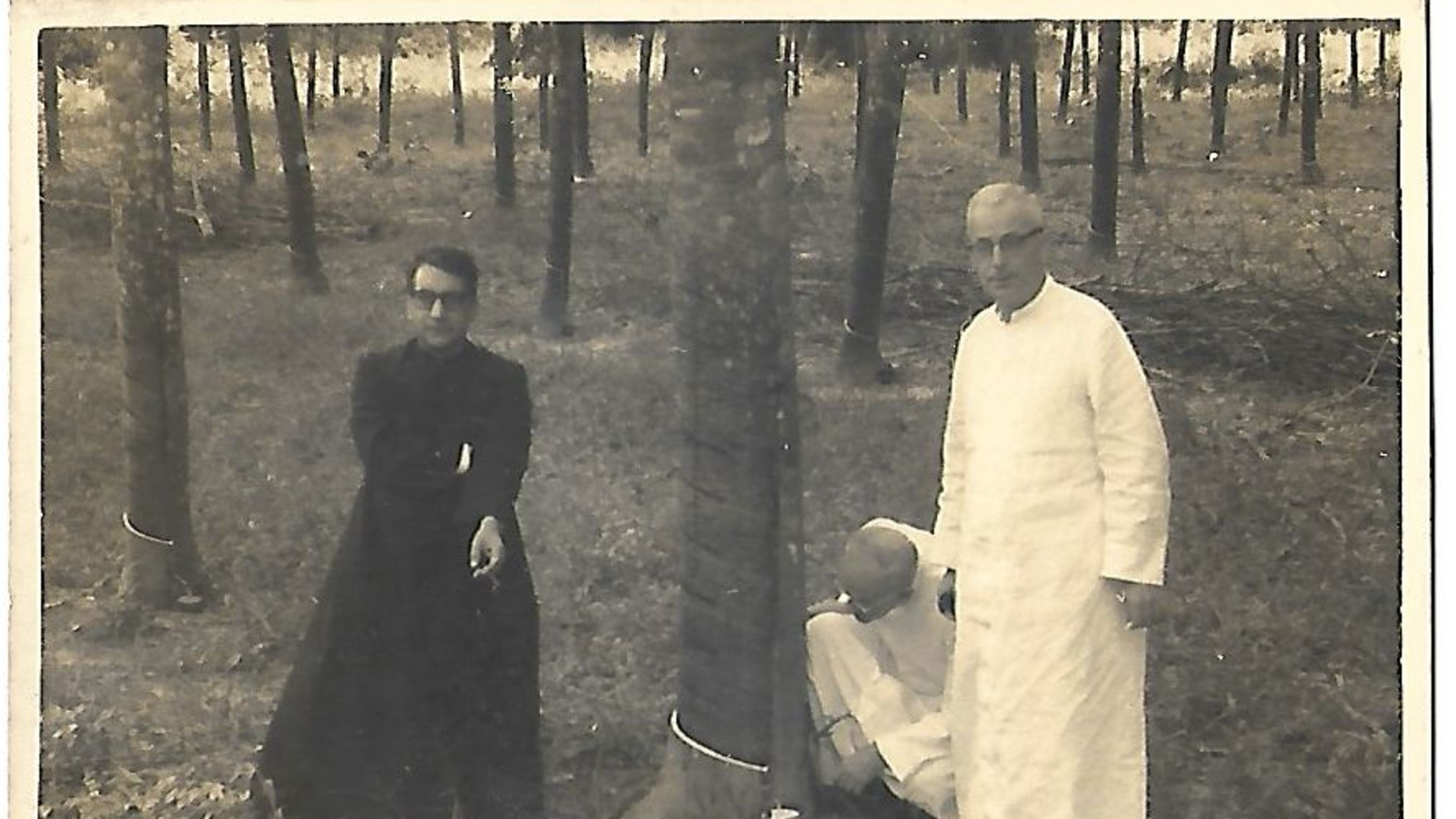
When a 50-year-old Italian priest arrived on the shores of a small island in the Malay Archipelago in 1955, few could have imagined that his mission would plant the seeds of a Franciscan legacy across Singapore and Southeast Asia.
Blessed Gabriele Allegra, OFM, was a Franciscan missionary from the province of Catania, Sicily. Before coming to Singapore, he had spent almost two decades in China and Hong Kong. Since his ordination in Rome in 1930, Allegra had been driven by a singular mission — to translate the Bible into Chinese.
His “specific vocation,” as he described it, took shape even before his ordination. During a 1928 ceremony marking 600 years since the death of Friar John of Montecorvino — the first Franciscan archbishop of Peking — a violent thunderstorm struck. Lightning flashed across the sky, startling those present. Allegra later recalled feeling a surge of electricity course through his body at that very moment. Friar John had translated only a few books of Scripture before his death, but that experience convinced Allegra to continue the unfinished work.

His Chinese collaborators later gave him the name Léi Yǒngmíng — 雷永明 — meaning “forever thunder,” a tribute to that fateful moment. In 1931, a year after his ordination, Allegra was sent to China to begin what would become a 40-year labor of faith — producing the first complete Catholic translation of the Bible into Chinese, which remains the Church’s official Mandarin edition today.
But Allegra’s mission eventually took him beyond China.
Faith and resistance in a time of upheaval
The Second World War and the communist victory in China in 1949 reshaped Asia’s political landscape. Across the newly independent nations of Southeast Asia — Indonesia, Malaysia, Singapore, the Philippines, and the countries of Indochina — communism began to take root. With large ethnic Chinese communities in these regions, Allegra grew deeply concerned about the spread of Marxist ideology and its threat to faith and religious freedom.
In 1954, he drafted a memorandum to the Vatican’s Sacred Congregation for the Propagation of the Faith and the General Curia of the Order of Friars Minor. The document proposed ways to counter communist influence and to spread the Church’s social teachings among Chinese communities outside mainland China.

The Vatican approved the proposal later that year, identifying Singapore as the ideal site for a new Sociological Institute — an institution that would promote the Church’s social doctrine across Southeast Asia. This initiative would also extend the work of Allegra and his team, who had spent two decades translating Scripture in Hong Kong.
A Franciscan presence takes root
In 1955, Allegra traveled to Singapore to meet then-Archbishop Michel Olçomendy and Bishop Carlo van Melckebeke, a Belgian missionary expelled from China after the communist takeover. Both bishops supported Allegra’s vision. That same year, the groundwork for a permanent Franciscan presence in Southeast Asia was laid.
To lead the new institute, the Franciscans appointed Friar Vergil Mannion, OFM, an Irish missionary who had previously served in China. He arrived in Singapore in 1957 and secured a plot of land along Old Jurong Road — today part of Bukit Batok. The site was strategically chosen for its proximity to Nanyang University (now Nanyang Technological University), which had become a focal point for communist student activism.

Construction of the Sociological Institute began in 1958. Building on Allegra’s momentum, Mannion and his fellow friars translated the Church’s social teachings into Mandarin and distributed them through pamphlets and leaflets — the very same medium communists were using to spread propaganda. Their efforts sought to counter ideology with truth and revolution with faith.
From resistance to renewal
By the early 1960s, as the threat of communism waned in the region, the friars’ mission evolved from one of ideological resistance to one of spiritual renewal. The Jurong Road complex was transformed into a retreat center, and the friars began offering daily Mass at their oratory, dedicated to St. Mary of the Angels.
Word spread quickly, and what began as a quiet chapel on a hill soon drew larger crowds from nearby neighborhoods. In 1970, Australian friars formally took over the mission and entered into an agreement with the Archdiocese of Singapore to establish the Parish of St. Mary of the Angels — now home to more than 12,000 parishioners.
A legacy of faith and vision
“The vision of Blessed Allegra led to the foundation of the Franciscan presence in Singapore,” said Friar John-Paul Tan, OFM, the first Singaporean Franciscan priest formed through the local friary in 1983. “Not only did he have this biblical vision of translating the Bible into Chinese, but he also saw evangelization as a way to introduce the Church’s social teachings — centered on human dignity and the value of work — so that people of that time did not have to buy into communist ideologies.”
Allegra’s dual legacy — as translator and missionary — continues to shape Franciscan life in the region. His conviction that faith must speak in both the language and the realities of the people remains as relevant today as it was in the turbulent 1950s.

Candles burn before an image of Blessed Gabriele Allegra in the Roman Catholic Cathedral of Hong Kong on Feb. 10, 2015. | Credit: Jaqueline and Bryan, CC BY-SA 4.0, via Wikimedia Commons
Today, the Franciscans in Singapore are part of the Custody of St. Anthony (Malaysia-Singapore-Brunei), which was granted autonomy on April 25, 2023, by decree of Friar Massimo Fusarelli, OFM, the minister general of the Order of Friars Minor. The custody oversees missions and parishes across Singapore and Malaysia and continues to run retreats throughout the region.
More than half a century after his first voyage to Southeast Asia, Blessed Gabriele Allegra’s vision still echoes — not only in the pages of the Chinese Bible he helped bring to life but also in the enduring Franciscan witness of faith, justice, and peace in the region he once served.
If you value the news and views Catholic World Report provides, please consider donating to support our efforts. Your contribution will help us continue to make CWR available to all readers worldwide for free, without a subscription. Thank you for your generosity!
Click here for more information on donating to CWR. Click here to sign up for our newsletter.
Leave a Reply
You must be logged in to post a comment.